UNITED STATES
SECURITIES AND EXCHANGE COMMISSION
Washington, D.C. 20549
SCHEDULE 14A
Proxy Statement Pursuant to Section 14(a) of the Securities Exchange Act of 1934
(Amendment No. )
| Filed by the Registrant [X] | ||
| Filed by a Party other than the Registrant [ ] | ||
| Check the appropriate box: | ||
| [ ] Preliminary Proxy Statement | ||
| [ ] Confidential, for Use of the Commission Only (as permitted by Rule 14a-6(e)(2)) | ||
| [X] Definitive Proxy Statement | ||
| [ ] Definitive Additional Materials | ||
| [ ] Soliciting Material under §240.14a-12 | ||
| (Name of Registrant as Specified In Its Charter) | |||||||||||
| (Name of Person(s) Filing Proxy Statement, if other than the Registrant) | |||||||||||
| Payment of Filing Fee (Check the appropriate box): | |||||||||||
| [X] | No fee required | ||||||||||
| [ ] | Fee paid previously with preliminary materials | ||||||||||
| [ ] | Fee computed on table in exhibit required by Item 25(b) per Exchange Act Rules 14a6(i)(1) and 0-11 | ||||||||||
 | MGIC Investment Corporation | ||||
Notice of 2026 Annual Meeting of Shareholders | |||||
 | Meeting Date & Time April 23, 2026 9:00 a.m. Central Time |  | Via Webcast www.virtualshareholdermeeting.com/MTG2026 Admittance to the webcast begins at 8:45 a.m. Central Time | |||||||||||
To MGIC Investment Corporation Shareholders:
At our 2026 Annual Shareholders’ Meeting, you will be asked to vote upon the following proposals:
| Items of Business |  | ||||
| Proposal 1 | Election of ten directors | ||||
| Proposal 2 | Advisory vote to approve named executive officer compensation | ||||
Proposal 3 | Ratification of appointment of PricewaterhouseCoopers LLP as our independent registered public accounting firm for 2026 | ||||
Proposal 4 | Any other matters that properly come before the meeting | ||||
Your vote is very important. Whether or not you plan to attend our Annual Meeting, we encourage you to read our proxy materials and to vote as soon as possible using one of the methods described beginning on page 75.
| By Order of the Board of Directors, | ||
 | ||
| Paula C. Maggio | ||
| Executive Vice President, General Counsel and Secretary | ||
March 20, 2026 | ||
 | PROXY STATEMENT AND 2025 ANNUAL REPORT TO SHAREHOLDERS AVAILABLE AT HTTPS://MATERIALS.PROXYVOTE.COM/552848 | |||||||
Table of Contents
| Compensation Discussion and Analysis (Continued) | |||||
Pension Benefits at 2025 Fiscal Year-End | |||||
App | |||||
App B - 1 | |||||
| MGIC Investment Corporation P.O. Box 488 MGIC Plaza, 270 East Kilbourn Avenue Milwaukee, WI 53201 | ||||
Proxy Statement
Our Board of Directors is soliciting proxies for the Annual Meeting of Shareholders to be held Thursday, April 23, 2026 at 9:00 a.m. Central Time, via webcast at www.virtualshareholdermeeting.com/MTG2026, and at any postponement or adjournment of the meeting. In this Proxy Statement we sometimes refer to MGIC Investment Corporation as “the Company,” “we” or “us.” This Proxy Statement and the enclosed form of proxy are being mailed to shareholders beginning on March 20, 2026. If you have any questions about attending our Annual Meeting, you can call Investor Relations at (414) 347-2635.
Proxy Summary
This summary highlights information contained elsewhere in our Proxy Statement and does not contain all of the information you should consider. Please review the Company’s complete Proxy Statement before voting. Please refer to our Glossary of Terms and Acronyms in Appendix A to this Proxy Statement for definitions of certain capitalized terms.
Voting Matters and Board Recommendation
| Proposal | Voting Matter | More Information | Board Vote Recommendation | ||||||||
| 1 | Election of Ten Directors | Page 25 | FOR each Director Nominee | ||||||||
| 2 | Advisory Vote on Executive Compensation | Page 29 | FOR | ||||||||
3 | Ratification of Independent Registered Public Accounting Firm | Page 70 | FOR | ||||||||
MGIC Investment Corporation – 2026 Proxy Statement │ 1
PROXY SUMMARY
Our Business Strategies and 2025 Highlights
Through our subsidiary, Mortgage Guaranty Insurance Corporation ("MGIC"), we are a leading provider of mortgage insurance to lenders throughout the United States and to Fannie Mae and Freddie Mac ("the GSEs"). Our business strategies are to:
1.Maximize the value we create through our mortgage credit enhancement activities;
2.Differentiate ourselves through our customer experience;
3.Advance our competitive advantage through our digital and analytical capabilities;
4.Excel at acquiring, managing and distributing mortgage credit risk and the related capital;
5.Maintain financial strength through economic cycles; and
6.Foster an environment that attracts and retains the best talent and positions our people to succeed
As we began 2025, we faced a challenging market defined by high mortgage interest rates and rising home prices that squeezed affordability. Despite these pressures, we maintained operational momentum and delivered strong results, successfully performing against the metrics that govern the annual bonuses and long-term equity incentives for our Named Executive Officers ("NEOs"):
$61.9B | $303.1B | 13.5% | +42% | |||||||||||||||||||||||||||||||||||||||||||||||||||||
New Insurance Written1 | Insurance In Force1 | Return on Equity1 | Adjusted Book Value Per Share2 | |||||||||||||||||||||||||||||||||||||||||||||||||||||
1 For the year ended December 31, 2025. See the "Annual Bonus" section of the Compensation Discussion & Analysis for details regarding the calculation of these metrics. 2 Cumulative growth in adjusted book value per share from 12/31/2022 to 12/31/2025. Adjusted book value per share is a non-GAAP financial measure. For a description of how we calculate this measure for each equity award and a reconciliation of this measure to its nearest comparable GAAP measure, see Appendix B. | ||||||||||||||||||||||||||||||||||||||||||||||||||||||||
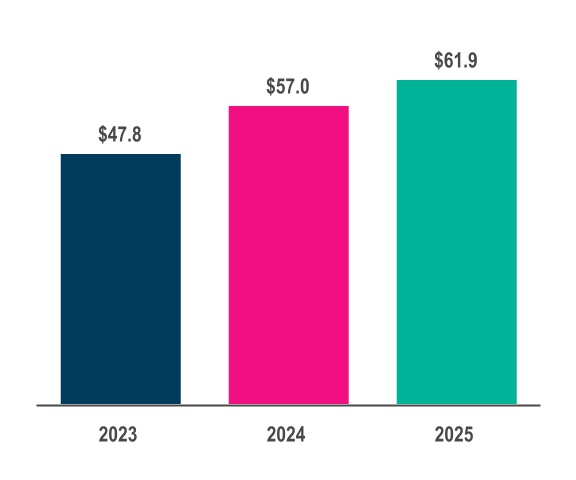
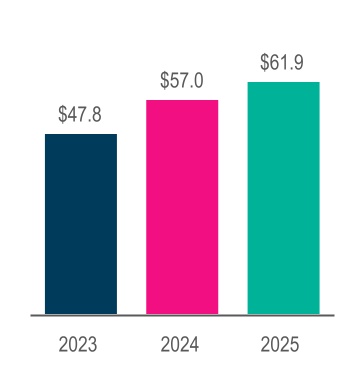
•In 2025, our new insurance written ("NIW") was $61.9 billion, up from $57.0 billion in 2024, and $47.8 billion in 2023. The 2025 increase reflects a higher market share as compared to 2024.
•Our insurance in force ("IIF") at the end of 2025 was $303.1 billion, an all-time high for not only the Company, but also for the entire private mortgage insurance industry.
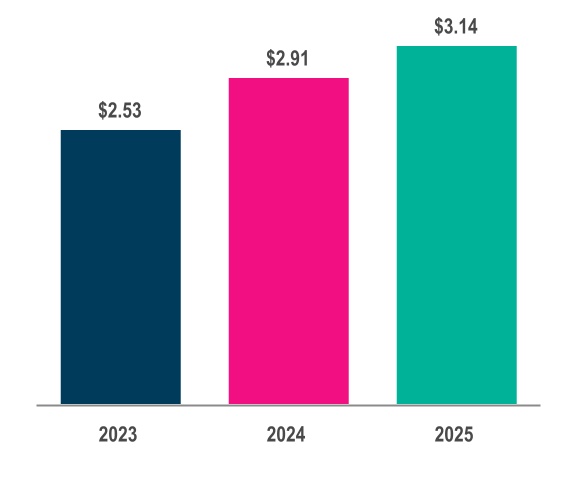
•Our adjusted net operating income per diluted share was $3.14, up nearly 8% from $2.91 in 2024. This is a component of return on equity ("ROE"), one of the financial performance measures that determined payouts under our 2025 bonus plan.
•Adjusted book value per share increased by 42% from the end of 2022 to the end of 2025, the performance period of the cliff-vesting long-term equity awards that were granted to our NEOs in 2023.
2 │ MGIC Investment Corporation – 2026 Proxy Statement
PROXY SUMMARY
Insurance in Force
(billions)1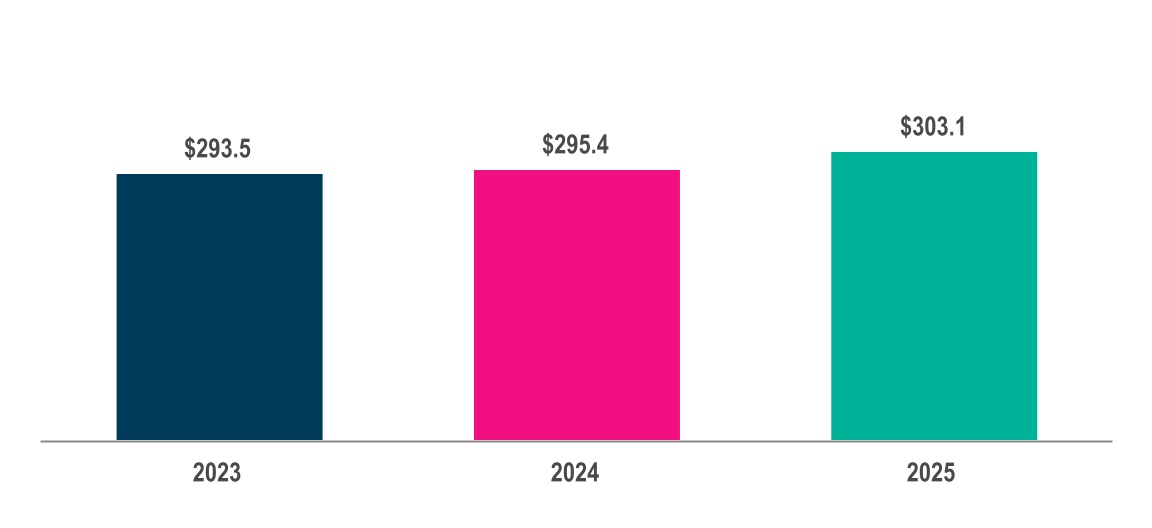
New Insurance Written
(billions)2
Adjusted Net Operating Income per Diluted Share3
1 | For purposes of the bonus plan, IIF is the unpaid principal balance, as reported to us, of the loans insured by us, as of the end of the year, adjusted for financial impacts of GSE-mandated mortgage insurance cancellations inconsistent with prior business practices. | ||||
2 | For purposes of the bonus plan, NIW includes (i) traditional loan level insurance, (ii) loan level insurance executed through a managing agent or directly with a GSE or other entity, and (iii) credit risk transfer (calculated as 1/3 of the unpaid principal balance of the loans committed to be insured by us during the year). NIW received credit for bonus purposes only if its expected risk-adjusted return on capital exceeded the Company's hurdle rate. Because the NIW for the bonus plan includes a more comprehensive definition of NIW when compared to the primary NIW disclosed for financial reporting purposes, NIW figures shown in our financial reporting differ slightly from what is shown in this Proxy Statement. | ||||
3 | This is a non-GAAP measure of performance. For a description of how we calculate this measure and for a reconciliation of this measure to its nearest comparable GAAP measure, see Appendix B to this Proxy Statement. | ||||
MGIC Investment Corporation – 2026 Proxy Statement │ 3
PROXY SUMMARY
Following are several additional 2025 accomplishments that furthered each of our business strategies:
| Business Strategy | Results | |||||||
| Maximize value created through mortgage credit enhancement activities | è | Increased book value per common share by approximately 13%. Paid shareholder dividends of $0.56 per share, a 14% increase from $0.49 per share in 2024. Repurchased 12% of the shares outstanding at the beginning of the year. | ||||||
| Differentiate through customer experience | è | Continued to build and leverage durable relationships through consultative sales. Simplified sales and operations by phasing out programs that no longer contributed to core business objectives. Launched new customer-facing community lending resources. | ||||||
Advance our competitive advantage through our digital and analytical capabilities | è | Invested in data and analytics to drive efficiencies and align activity to value. Retired legacy technology and successfully modernized key business processes. Established a new data center facility to advance our capabilities. | ||||||
| Excel at acquiring, managing and distributing mortgage credit risk and related capital | è | Reinsurance transactions provide a source of capital relief and allow us to better manage our risk profile. In 2025 we expanded our reinsurance program as follows: •Secured quota share reinsurance covering the majority of our 2027 NIW •Secured excess of loss reinsurance covering our 2025 and 2026 NIW •Placed two seasoned excess of loss reinsurance transactions covering our 2020 and 2021 book year vintages •Renegotiated seasoned quota share transactions reducing future ongoing costs | ||||||
4 │ MGIC Investment Corporation – 2026 Proxy Statement
PROXY SUMMARY
| Business Strategy | Results | |||||||
| Maintain financial strength through economic cycles | è | MGIC Investment Corporation ended 2025 with $1.1 billion of cash and investments. MGIC paid $800 million in dividends to MGIC Investment Corporation, increased from the $750 million paid in 2024. Sustainably reduced underwriting and other expenses, net, by 8% as compared to 2024. Our capital is well in excess of the requirements of the GSEs and state regulators. S&P upgraded MGIC's financial strength and credit rating to A- and at the same time upgraded the credit rating on MGIC Investment to BBB-. With this ratings change, MGIC Investment became fully investment grade. The outlook for the ratings is positive. Moody's Ratings upgraded MGIC Investment's senior unsecured debt rating to Baa2 from Baa3. Moody's also upgraded the insurance financial strength rating of MGIC, to A2 from A3. The outlook for the ratings is stable. | ||||||
Foster an environment that attracts and retains the best talent and positions people to succeed | è | Continued to provide a competitive package of benefits that considers the physical, emotional, financial, and social aspects of co-worker wellbeing, with expanded support for parental, caregiver and bereavement leave. Held quarterly leadership and all-company meetings focusing on collaboration, enterprise planning, prioritization and transparency through open dialogue. Modernized our co-worker engagement survey strategy and platform to provide managers with more frequent and holistic insights into workforce sentiment. | ||||||
MGIC Investment Corporation – 2026 Proxy Statement │ 5
PROXY SUMMARY
Board Nominees
| Name | Age1 | Director Since | Primary Occupation | Independent | Committee Memberships2 3 | ||||||||||||||||||
C. Edward Chaplin ▲ | 69 | 2014 | Former President and CFO of MBIA Inc. | Yes | • Audit (C) • Securities Inv. | ||||||||||||||||||
| Curt S. Culver | 73 | 1999 | Chairman of the Board and former CEO of MGIC Investment Corp. | No | • Executive | ||||||||||||||||||
Jay C. Hartzell | 56 | 2019 | President of Southern Methodist University | Yes | • Risk Management • Securities Inv. (C) | ||||||||||||||||||
Martin P. Klein | 66 | 2025 | Former Executive Vice President and Chief Financial Officer of Athene Holdings LTD | Yes | • Risk Management • Securities Inv. | ||||||||||||||||||
Teresita M. Lowman ▲ | 61 | 2022 | Strategic Advisor to Launch Factory; Former VP of DXC Technology Company | Yes | • Audit • BT&T (C) | ||||||||||||||||||
| Timothy J. Mattke | 50 | 2019 | CEO of MGIC Investment Corp. | No | • Executive (C) | ||||||||||||||||||
Daniela A. O'Leary-Gill ▲ | 61 | 2025 | Former Chief Operating Officer of BMO U.S, BMO Financial Group | Yes | • Audit • BT&T | ||||||||||||||||||
| Sheryl L. Sculley ▲ | 73 | 2019 | Consultant with Strategic Partnerships, Inc.; Adjunct Professor at the University of Texas at Austin; Former City Manager of the City of San Antonio, Texas | Yes | • Audit • BT&T | ||||||||||||||||||
| Michael L. Thompson | 70 | 2023 | CEO of Fair Oaks Foods | Yes | • MDNG • Risk Management | ||||||||||||||||||
| Mark M. Zandi | 66 | 2010 | Chief Economist of Moody's Analytics, Inc. | Yes | • MDNG • Risk Management (C) | ||||||||||||||||||
| 1 | As of March 20, 2026 | ||||||||||||||||||||||
| 2 | BT&T = Business Transformation and Technology; MDNG = Management Development, Nominating and Governance | ||||||||||||||||||||||
3 | As of March 20, 2026. Please see "Board Meetings and Committees" for information about Committee membership and leadership changes as of March 31, 2026. | ||||||||||||||||||||||
| ▲ | Audit Committee Financial Expert | ||||||||||||||||||||||
| C | Committee Chair | ||||||||||||||||||||||
6 │ MGIC Investment Corporation – 2026 Proxy Statement
PROXY SUMMARY
Corporate Sustainability
For nearly 70 years, our product – private mortgage insurance – has helped families achieve the dream of homeownership sooner than they otherwise could, allowing them to invest in their futures and build generational wealth. This mission is as important today as ever – especially as the path to homeownership remains challenging for many.
Our role in the housing ecosystem carries a responsibility not just to homebuyers, but also to the stakeholders who make our work possible – our co-workers, customers, investors, community partners, and industry organizations. We succeed together, and that success is built on transparency, collaboration, and a commitment to long-term impact.
None of this happens in isolation. Our engaged Board of Directors and corporate leadership help drive our vision to be the most trusted, transparent and authentic partner in our industry. We are proud of the critical role private mortgage insurance plays in the housing finance system, and we know it takes continued work with industry stakeholders to make a real difference for families and build more resilient communities.
Compensation Highlights
Pay Opportunity Mix. At-risk performance-based compensation represented a majority of the 2025 target total direct compensation ("TDC") opportunity of our NEOs.
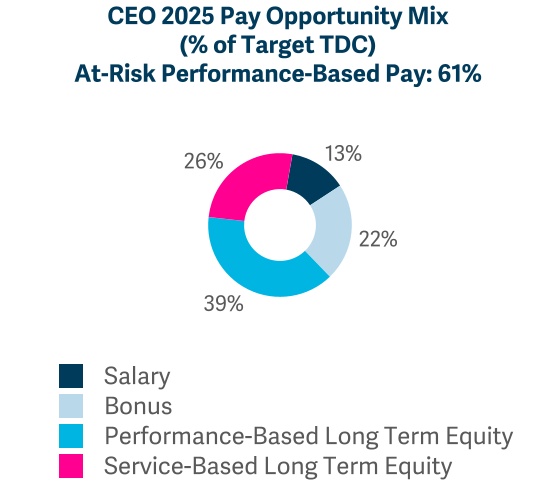
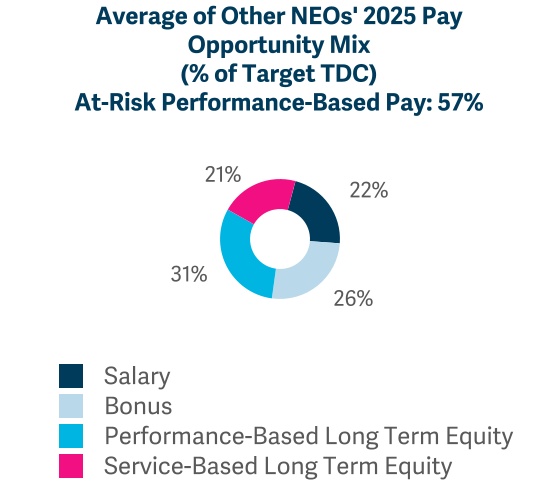
Long-Term Equity Incentives. To align our long-term equity awards with the interests of shareholders, a majority of the long-term equity awards granted in February 2025 to our NEOs are performance-based. Sixty percent (60%) of the long-term equity awarded to NEOs in 2025 will cliff vest after three years based on achievement of a three-year cumulative adjusted book value ("ABV") per share growth goal. The remaining forty percent (40%) of the long-term equity awards granted to NEOs in 2025 vests ratably over three years based on continued service.
Performance-Based Bonus. Our bonus program is designed to strongly align pay with our performance. Bonus payouts for 2025 were based on our achievement against three financial performance goals (ROE, NIW and IIF) and performance against three specific business objectives.
Best Practices. Our compensation program is grounded in best practices, which include strong stock ownership guidelines for NEOs, no hedging or pledging of our stock, a rigorous "clawback" policy intended to comply with Securities and Exchange Commission ("SEC") and stock exchange listing standards, limited severance and change in control benefits (with no tax gross-ups), and modest perquisites.
MGIC Investment Corporation – 2026 Proxy Statement │ 7
CORPORATE GOVERNANCE AND BOARD MATTERS
Corporate Governance and Board Matters
The Board of Directors oversees the management of the Company and our business. The Board selects our Chief Executive Officer ("CEO"), who in conjunction with our senior management team, is responsible for operating our business.
Corporate Governance Guidelines and
Code of Conduct and Ethics
The Board has adopted Corporate Governance Guidelines, which set forth a framework for our governance. The Corporate Governance Guidelines cover the Board’s composition, leadership, meeting process, director independence, Board membership criteria, committee structure, succession planning and director compensation. The Corporate Governance Guidelines also provide that a director shall not be nominated by the Board for re‑election if at the date of the Annual Meeting of Shareholders, the director is age 74 or more. As a result, our 2026 Annual Meeting will be the last at which two of our directors, Curt Culver and Sheryl Sculley, will be eligible for re-election.
The Board meets in executive session outside the presence of any member of our management during at least two Board meetings annually and at any additional times determined by the Board or the Lead Director. The Lead Director presides at these sessions. See “Board Leadership” for information about the Lead Director’s responsibilities and authority.
The Corporate Governance Guidelines also provide that a director who retires from his or her principal employment or joins a new employer shall offer to resign from the Board. Unless the Board determines that a Chief Executive Officer who is Chairman of the Board should continue as Chairman of the Board after his or her tenure as Chief Executive Officer, a director who is an officer of the Company or a subsidiary and leaves the Company shall resign from the Board. In 2014, the Board determined that Mr. Culver should become non-executive Chairman of the Board upon retirement from his position as Chief Executive Officer in 2015.
The Guidelines impose specific limitations on other directorships. The Guidelines limit our independent directors from serving as a director of more than three public companies other than the Company. Directors who are officers of the Company or a subsidiary may not serve as a director of more than one public company other than the Company. It is expected that each director will be mindful of other existing and planned future commitments, such that other directorships and commitments do not materially interfere with their service on the Board. Additionally, to avoid overboarding, conflicts of interest and independence issues, a director may not accept a position on the board of directors of another public company without first conferring with the Board Chairperson and Lead Director.
We have a Code of Conduct and Ethics emphasizing our commitment to conducting our business in accordance with legal requirements and high ethical standards. The Code of Conduct and Ethics applies to all employees, including our executive officers, and is also applicable to our directors. Certain portions of the Code of Conduct and Ethics that apply to transactions with our executive officers, directors, and their immediate family members are described under “Related Person Transactions” below. These descriptions are subject to the actual terms of the Code of Conduct and Ethics.
Our Corporate Governance Guidelines and our Code of Conduct and Ethics are available on our website (http://mtg.mgic.com) under the “Leadership & Governance; Documents” links. Written copies of these documents are available to any shareholder who submits a written request to our Secretary. We intend to disclose on our website any waivers from, or amendments to, our Code of Conduct and Ethics that are subject to disclosure under applicable rules and regulations.
8 │ MGIC Investment Corporation – 2026 Proxy Statement
CORPORATE GOVERNANCE AND BOARD MATTERS
Director Independence
Our Corporate Governance Guidelines regarding director independence provide that a director is not independent if the director has any specified disqualifying relationship with us. The disqualifying relationships are equivalent to those of the independence listing standards of the New York Stock Exchange ("NYSE"), except that our disqualification for board interlocks is more stringent than the NYSE listing standards. Also, for a director to be independent under the Guidelines, the director may not have any material relationship with us. For purposes of determining whether a disqualifying or material relationship exists, we consider relationships with MGIC Investment Corporation and its consolidated subsidiaries.
The Board has determined that all of our directors except for Mr. Culver, our former CEO, and Mr. Mattke, our current CEO, are independent under the Corporate Governance Guidelines and the NYSE listing standards. The Board made its independence determinations by considering whether any disqualifying relationships existed during the periods specified under the Corporate Governance Guidelines and the NYSE listing standards. To determine that there were no material relationships, the Board applied categorical standards that it had adopted and incorporated into our Corporate Governance Guidelines. All independent directors met these standards. Under these standards, a director is not independent if payments under transactions between us and a company of which the director is an executive officer or 10% or greater owner exceeded the greater of $1 million or 1% of the other company’s gross revenues. Payments made to and payments made by us are considered separately, and this quantitative threshold is applied to transactions that occurred in each of the three most recent fiscal years of the other company. Also under these standards, a director is not independent if during our last three fiscal years the director:
•was an executive officer or member of a law firm or investment banking firm providing services to us;
•was an executive officer of a charity to which we made contributions; or
•received any direct compensation from us other than as a director, or if during such period a member of the director’s immediate family received compensation from us.
In making its independence determinations, the Board considered payments we made to Moody’s Analytics (of which Dr. Zandi is an executive officer) for research and subscription services for Moody’s Economy.com and related publications, and payments to Moody’s Investors Service for credit rating services. These transactions were below the quantitative threshold contained in our Corporate Governance Guidelines and were entered into in the ordinary course of business by us, Moody’s Analytics and Moody’s Investors Service.
MGIC Investment Corporation – 2026 Proxy Statement │ 9
CORPORATE GOVERNANCE AND BOARD MATTERS
Related Person Transactions
Among other things, our Code of Conduct and Ethics prohibits us from entering into transactions in which our executive officers, chief accounting officer, or any their respective immediate family members have a material personal financial interest (either directly or through a company with which the officer has a material relationship) unless all of the following conditions are satisfied:
•the terms of the contract or transaction are fair and equitable, at arm’s length and are not detrimental to our interests;
•the existence and nature of the interests of the officer are fully disclosed to and approved by the Audit Committee; and
•the interested officer has not participated on our behalf in the consideration, negotiation or approval of the contract or transaction.
The Code of Conduct and Ethics defines a material interest as one in which our officer or officer's immediate family member is a director or officer of the counterparty to the transaction, or our officer or a member of our officer’s immediate family has a financial interest in such counterparty or any of its affiliates that is in the aggregate at least 10% of the value of such counterparty or the consolidated value of the organization's affiliates. Our Audit Committee does not consider payments and benefits arising in the ordinary course of employment with us, or through services as a director, to be “transactions” subject to its approval.
In addition, the Code of Conduct and Ethics requires Audit Committee approval of all transactions with any director or a member of the director’s immediate family, other than transactions involving the provision of goods or services in the ordinary course of business of both parties. The Code of Conduct and Ethics contemplates that our non-management directors will disclose all transactions between us and parties related to the director, even if they are in the ordinary course of business.
Under its Charter, the Audit Committee is responsible to conduct a review and oversee all related party transactions for potential conflicts of interest and prohibit such transactions if the Audit Committee determines them to be inconsistent with the interests of the Company. For purposes of the Charter, “related party transaction” means a transaction in which the Company (or its affiliates) is a participant, the amount exceeds $120,000, and in which one of the following had or will have a direct or indirect material interest: an executive officer, director, or director nominee, or their immediate family members or persons sharing their households, or 5% shareholders.
Insider Trading Policy
We have adopted an Insider Trading Policy that we believe is reasonably designed to promote compliance with insider trading laws, rules and regulations, and applicable NYSE listing standards. Our Insider Trading Policy limits the timing and types of transactions in our securities, as well as transactions in the securities of companies with which the Company does business and competitors of the Company. The Insider Trading Policy applies to all directors and employees of the Company and its subsidiaries, and may be extended to apply to third-party contractors or consultants who have access to non-public information about the Company. Among other restrictions, the Insider Trading Policy prohibits directors, NEOs, other officers and certain employees from engaging in short sales of Company securities, entering into hedging transactions referencing the Company’s equity securities, holding Company securities in a margin account, or pledging Company securities as collateral for a loan. All directors and officers (including NEOs), as well as certain other employees with access to material non-public information must also comply with pre-clearance procedures prior to any transaction in Company securities. A copy of our Insider Trading Policy is filed as Exhibit 19 to our Annual Report on Form 10-K for the year ended December 31, 2025.
10 │ MGIC Investment Corporation – 2026 Proxy Statement
CORPORATE GOVERNANCE AND BOARD MATTERS
Board Leadership
Mr. Culver serves as non-executive Chairman of the Board, and effective as of March 31, 2026, Mr. Chaplin will serve as Lead Director. Under this structure, the Chairman chairs Board meetings, where the Board discussion includes strategic and business issues. The Board believes that this approach has been appropriate because Mr. Culver, as the Company's former CEO, is very familiar with our business and strategic plans as reviewed by the Board. Mr. Culver joined the Company in 1982, and served as Chief Executive Officer from 2000 until his retirement in 2015, when he became our non-executive Chairman of the Board.
Because the Board also believes that strong, independent Board leadership is a critical aspect of effective corporate governance, the Board maintains the position of Lead Director. The Lead Director is an independent director selected by the independent directors. The Lead Director’s responsibilities and authority include:
•presiding at all meetings of the Board at which the Chairman is not present;
•having the authority to call and lead executive sessions of directors without the presence of any director who is an officer (or if determined by the Board, a former officer) (the Board meets in executive session during at least two Board meetings each year);
•serving as a conduit between the CEO and the independent directors to the extent requested by the independent directors;
•serving as a conduit for the Board’s informational needs, including proposing topics for Board meeting agendas; and
•being available, if requested by major shareholders, for consultation and communication.
The Board believes that a leader intimately familiar with our business and strategic plans serving as Chairman, together with an experienced and engaged Lead Director, is the most appropriate leadership structure for the Board at this time. The Board periodically reviews the structure of the Board and the Board’s leadership.
Board Leadership Transition
In February 2026, Ms. Kozlak notified the Company that she would not be standing for re-election at the 2026 Annual Meeting of Shareholders. Her decision was not based on any disagreement regarding any matter related to the operations, policies, or practices of the Company. Following receipt of Ms. Kozlak's notice, the Board initiated a leadership transition. Considering Mr. Chaplin's significant experience with our Board, having served as a member since 2014 and as Chairperson of our Audit Committee from 2023 until 2026, and his strong management, leadership, and financial skills, the Management Development, Nominating and Governance Committee ("MDNG Committee") recommended that he succeed Ms. Kozlak in the role of Lead Director. The independent directors unanimously accepted that recommendation. The change is effective March 31, 2026 in order to provide for a transition period with Mr. Chaplin serving in the role of Lead Director while Ms. Kozlak continues to serve as a director.
Communicating with the Board
Shareholders and other interested persons can communicate with members of the Board, non-management members of the Board as a group or the Lead Director, by sending a written communication to our Secretary, addressed to: MGIC Investment Corporation, Secretary, P.O. Box 488, Milwaukee, WI 53201. The Secretary will provide any such communication, other than a solicitation for a product or service, to the Lead Director or Chairman.
MGIC Investment Corporation – 2026 Proxy Statement │ 11
CORPORATE GOVERNANCE AND BOARD MATTERS
Director Selection
The Board believes that the Board, as a whole, should possess a combination of skills, professional experience, and diversity of backgrounds necessary to oversee our business. In addition, the Board believes there are certain attributes every director should possess, as reflected in the Board’s membership criteria. Accordingly, the Board and the MDNG Committee consider the qualifications of directors and director candidates individually and in the broader context of the Board’s overall composition and our current and future needs.
The MDNG Committee is responsible for developing Board membership criteria and recommending director nominees to the Board. The criteria for membership, which are set forth in our Corporate Governance Guidelines, include:
Board Membership Criteria | ☑ | An inquiring and independent mind | ||||||
| ☑ | Sound and considered judgment | |||||||
| ☑ | High standards of ethical conduct and integrity | |||||||
| ☑ | Well-respected experience at senior levels of business, academia, government or other fields | |||||||
| ☑ | Ability to commit sufficient time and attention to Board activities | |||||||
| ☑ | Anticipated tenure on the Board | |||||||
| ☑ | Continued substantial majority of independent directors | |||||||
| ☑ | Inclusion of a variety of occupational and personal backgrounds | |||||||
| ☑ | A range of viewpoints and perspectives | |||||||
The MDNG Committee seeks to enhance the Board by balancing skills, tenure, and individual demographics in order to maintain a balance and variety of experiences and viewpoints. The MDNG Committee, in conjunction with the Board, periodically evaluates the composition of the Board to assess the skills and experience that are currently represented on the Board, as well as the skills and experience that the Board will find valuable in the future. In identifying director candidates from time to time, the MDNG Committee may establish specific skills and experience that it believes we should seek in order to maintain a balanced and effective board.
Strategic Skills and Experience
The following graphic summarizes certain skills and experiences considered important by the Board, how those skills and experiences are relevant to the Company and its business strategies, and how they are represented in the Board members standing for election at the Annual Meeting of Shareholders. The MDNG Committee evaluates new director candidates considering these skills and experiences, and the criteria listed above, as well as other factors the MDNG Committee deems relevant, through background reviews, input from other members of the Board and our executive officers, and personal interviews with the candidates attended by at least the MDNG Committee Chair. The MDNG Committee will evaluate director candidates recommended by shareholders using the same process and criteria that apply to candidates from other sources.
12 │ MGIC Investment Corporation – 2026 Proxy Statement
CORPORATE GOVERNANCE AND BOARD MATTERS
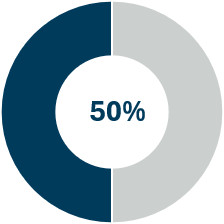
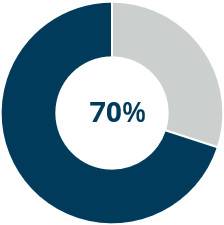
Percent of Director Slate Possessing Key Skills and Experience | |||||||||||
Accounting | Chief Executive Officer | Data & Analytics | Financial | ||||||||
 |  | | 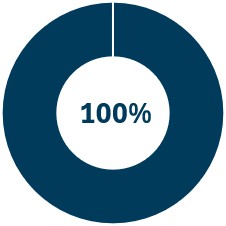 | ||||||||
Housing Markets / Risk Management | Human Resources | Insurance | Investments | ||||||||
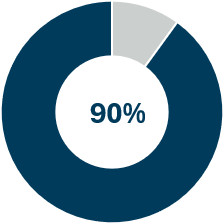 | | 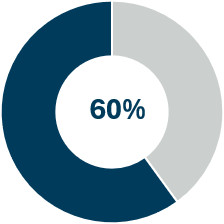 | | ||||||||
Public Company Executive | Regulatory / Public Affairs | Technology / Cyber | ||||||||||||
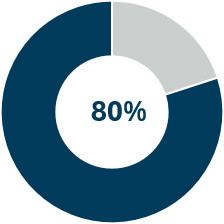 | |  | ||||||||||||
| Accounting | Chief Executive Officer | |||||||
| We operate in a complex financial and regulatory environment. | Experience at the highest level of an organization provides expertise that will foster participation in the development and implementation of the Company's business strategies. | |||||||
| Data & Analytics | Financial | |||||||
| Understanding the use of structured and unstructured data, as well as the tools and processes necessary to enable the development of actionable insights via advanced quantitative and statistical methods is important as we continue to pursue our strategic initiatives. | Knowledge of finance or financial reporting and experience with debt and capital markets transactions is important to executing our business strategies. | |||||||
| Housing Markets / Risk Management | Human Resources | |||||||
| Our business involves taking and managing risk associated with the housing markets. | As a financial services firm, human capital represents an important asset. Knowledge of human resources matters is important to executing our business strategies. | |||||||
| Insurance | Investments | |||||||
| Insurance industry experience provides understanding of our business and strategies. | We manage a large and long-term investment portfolio to support our obligations to pay future claims of our policyholders. | |||||||
| Public Company Executive | Regulatory / Public Affairs | |||||||
| As a complex, publicly-held company, practical insight into shareholder concerns and governance matters is important. | Our business requires compliance with a variety of federal, state and GSE requirements, and involves relationships with various government and non-government organizations. | |||||||
| Technology / Cyber | ||||||||
| We manage critical technology and cybersecurity risks. | ||||||||
MGIC Investment Corporation – 2026 Proxy Statement │ 13
CORPORATE GOVERNANCE AND BOARD MATTERS
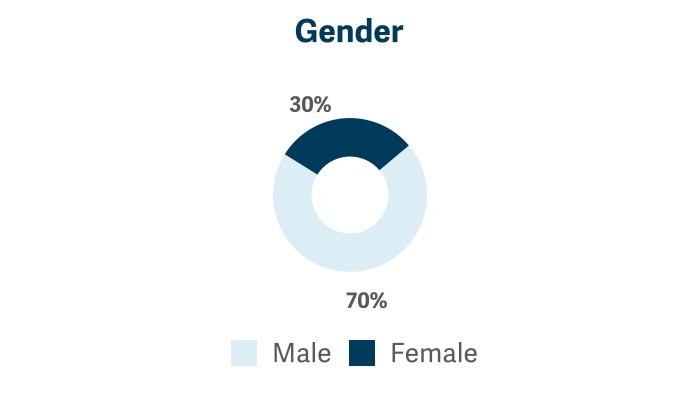
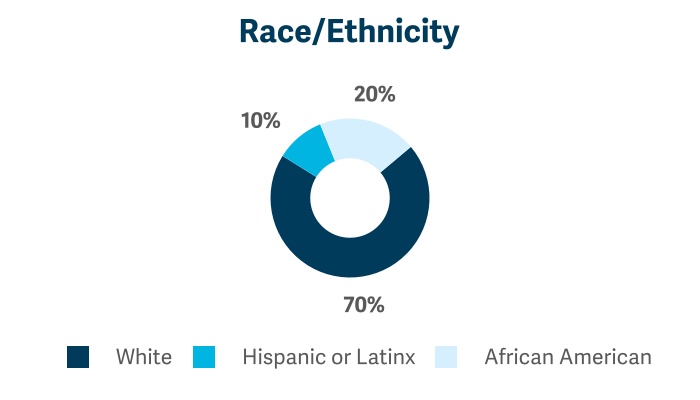
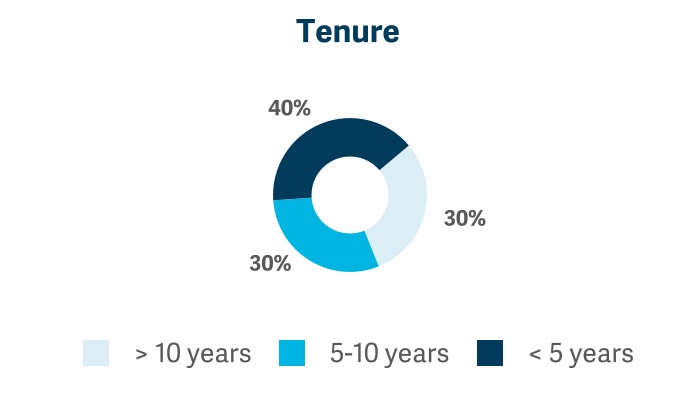
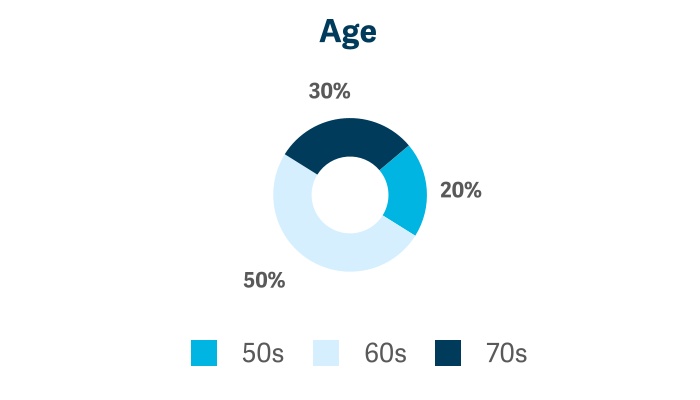
Board Demographics
The following charts reflect the tenure, ages and diversity of the Board members standing for election at our 2026 Annual Meeting of Shareholders.
Our Director Nominees1
| 8 | of | 10 | 65 | Years | 6.4 | Years | ||||||||||||||||||||
Independent | Average Age | Median Tenure | ||||||||||||||||||||||||
1 As of March 20, 2026.
14 │ MGIC Investment Corporation – 2026 Proxy Statement
CORPORATE GOVERNANCE AND BOARD MATTERS
Oversight of Risk and Corporate Sustainability Matters
Management
The Company maintains a Senior Management Oversight Committee (“SMOC”) that, at the management level, serves as its primary business, operations, strategy, and risk management oversight committee. SMOC is the senior-most committee of management leadership and oversees the identification and governance of key risks and the Company's risk framework. SMOC also oversees reporting by management to the Board, with the exception of those topics that are attorney-client privileged or that Board or Committee Chairpersons deem to be confidential.
SMOC manages the risks associated with the strategic and business issues critical to the Company, such as those related to credit policy, the characteristics of the Company's NIW and IIF, existing and proposed new regulation, product pricing, and capital structure. SMOC is chaired by the Company's Chief Executive Officer. Other members are the Company's President and Chief Operating Officer, General Counsel, and Chief Financial and Risk Officer, who is the principal management liaison to the Board's Risk Management Committee. SMOC has sub-committees to assist in the effective discharge of its responsibilities for oversight and management of specific risks. These sub-committees create additional transparency across the major types of risk the Company manages, increase communication and collaboration, and develop talent.
The Company maintains a Corporate Sustainability Executive Council that, at the management level, supports the Company's on-going commitment to environmental, health and safety, corporate social responsibility, corporate governance, and sustainability. In performing this general responsibility, the Council has discretion to: adopt the Company’s general strategy with respect to sustainability matters; identify current and emerging sustainability issues that may affect the Company’s business, strategy, operations, performance, or public image; make recommendations regarding policies, practices, procedures, or disclosures to address sustainability matters; oversee related disclosures surrounding sustainability matters; and advise on material concerns of shareholders or stakeholders regarding sustainability matters.
Board of Directors and Committees
The Board is responsible for oversight of how our senior management addresses material risks. In this regard, the Board seeks to understand the material risks we face and to allocate, among the full Board and its committees, responsibilities for overseeing how management addresses the risks. Overseeing risk is an ongoing process. Each of the Board's committees (other than the Executive Committee) meet regularly, play significant roles in carrying out the risk oversight function, and report back to the full Board. Each of their roles in the oversight of the Company's risk is described below under "Board Meetings and Committees."
We believe that our leadership structure, discussed in “Board Leadership” above, supports the risk oversight function of the Board. Our former CEO serves as Chairman of the Board and has a wealth of experience with the risks of our Company and industry. Our current CEO is a director who keeps the Board informed about the current risks we face. In addition, independent directors chair the various committees involved with risk oversight and there is open communication between senior management and directors.
MGIC Investment Corporation – 2026 Proxy Statement │ 15
CORPORATE GOVERNANCE AND BOARD MATTERS
Board Meetings and Committees
The Board of Directors held five meetings during 2025. Each director elected at our 2025 Annual Meeting of Shareholders attended at least 75% of the meetings of the Board and committees of the Board on which he or she served. The Annual Meeting of Shareholders is scheduled in conjunction with a Board meeting and, as a result, directors are expected to attend the Annual Meeting. The 2025 Annual Meeting of Shareholders was attended by each of the directors who stood for election at the meeting.
The Board has six standing committees: Audit; Business Transformation & Technology ("BT&T"); MDNG; Risk Management; Securities Investment; and Executive. Information regarding these committees is provided below. With the exception of the Executive Committee, each committee consists entirely of independent directors and the charters for those committees are available on our website (http://mtg.mgic.com) under the “Leadership & Governance; Documents” links. Written copies of these charters are available to any shareholder who submits a written request to our Secretary. The functions of the Executive Committee are established under our Amended and Restated Bylaws ("Bylaws") and are described below. An overview of committee membership as of the date of the filing of this Proxy Statement, and the number of 2025 committee meetings, are set forth directly below. A table showing Committee memberships as approved by the Board and as effective on March 31, 2026 immediately follows. A more detailed description of the Board's Committees and their respective roles can also be found below.
Committee Composition as of March 20, 2026
| Audit | BT&T | Executive | MDNG | Risk Management | Securities Investment | |||||||||||||||
C. Edward Chaplin* | C | l | ||||||||||||||||||
| Curt S. Culver | l | |||||||||||||||||||
Jay C. Hartzell* | l | C | ||||||||||||||||||
Martin P. Klein* | l | l | ||||||||||||||||||
| Jodeen A. Kozlak* | l | C | l | |||||||||||||||||
Teresita M. Lowman* | l | C | ||||||||||||||||||
| Timothy J. Mattke | C | |||||||||||||||||||
Daniela A. O'Leary-Gill* | l | l | ||||||||||||||||||
Sheryl L. Sculley* | l | l | ||||||||||||||||||
Michael L. Thompson* | l | l | ||||||||||||||||||
| Mark M. Zandi* | l | C | ||||||||||||||||||
2025 Meetings | 10 | 5 | 0 | 4 | 4 | 4 | ||||||||||||||
| * = Independent Director | ||||||||||||||||||||
| C = Chairperson | ||||||||||||||||||||
16 │ MGIC Investment Corporation – 2026 Proxy Statement
CORPORATE GOVERNANCE AND BOARD MATTERS
Committee Composition as of March 31, 2026
| Audit | BT&T | Executive | MDNG | Risk Management | Securities Investment | |||||||||||||||
C. Edward Chaplin* | l | C | l | |||||||||||||||||
| Curt S. Culver | l | |||||||||||||||||||
Jay C. Hartzell* | l | C | ||||||||||||||||||
Martin P. Klein* | l | l | ||||||||||||||||||
Teresita M. Lowman* | l | C | ||||||||||||||||||
| Timothy J. Mattke | C | |||||||||||||||||||
Daniela A. O'Leary-Gill* | C | l | ||||||||||||||||||
Sheryl L. Sculley* | l | l | ||||||||||||||||||
Michael L. Thompson* | l | l | ||||||||||||||||||
| Mark M. Zandi* | l | C | ||||||||||||||||||
| * = Independent Director | ||||||||||||||||||||
| C = Chairperson | ||||||||||||||||||||
MGIC Investment Corporation – 2026 Proxy Statement │ 17
CORPORATE GOVERNANCE AND BOARD MATTERS
Audit Committee | Key Responsibilities: •Oversee the integrity of our financial statements •Oversee the effectiveness of our system of internal controls over accounting and financial reporting, and disclosure controls and procedures •Appoint, retain and oversee the independent registered public accountant, and evaluate its qualifications, independence and performance •Oversee the performance of our internal audit function •Oversee our compliance with legal and regulatory requirements •Review related party transactions, as further described above under "Related Person Transactions" Risk Oversight Role: •Risks associated with inadequate or failed internal processes, systems, third-party vendors/partners, or resources disrupt business operations and result in losses •Risks involving non-conformance with laws, rules, regulations, private mortgage insurer eligibility requirements, industry practices or ethical standards •Risks related to estimation of losses or contractual obligations | ||||||||||
C. Edward Chaplin, Chair* | |||||||||||
MEMBERS: | |||||||||||
Teresita M. Lowman | |||||||||||
| Daniela A. O'Leary-Gill | |||||||||||
Sheryl L. Sculley | |||||||||||
Meetings held in 2025: 10 | |||||||||||
*Effective March 31, 2026, Mr. Chaplin will step down from the Committee and Ms. O'Leary-Gill will assume the role of Committee Chairperson. | |||||||||||
| All members of the Audit Committee meet the heightened independence criteria that apply to Audit Committee Members under SEC rules and NYSE listing standards. | |||||||||||
The Board has determined that Mr. Chaplin and Mses. Lowman, O'Leary-Gill and Sculley are “audit committee financial experts” as defined in SEC rules | |||||||||||
| Business Transformation and Technology Committee | Key Responsibilities: •Oversee the Company's information technology strategy and initiatives •Oversee information technology trends that pose risks or opportunities for the Company •Oversee how information technology supports the Company's business strategies •Oversee major business transformation projects Risk Oversight Role: •Risks associated with the Company's technology capabilities •Cybersecurity risks | ||||||||||
Teresita M. Lowman, Chair | |||||||||||
MEMBERS: | |||||||||||
Daniela O'Leary-Gill | |||||||||||
Sheryl L. Sculley | |||||||||||
Meetings held in 2025: 5 | |||||||||||
18 │ MGIC Investment Corporation – 2026 Proxy Statement
CORPORATE GOVERNANCE AND BOARD MATTERS
| Management Development, Nominating & Governance Committee | Key Responsibilities: •Oversee our executive compensation program, including approving corporate goals relating to compensation for our CEO, determining our CEO’s annual compensation, approving compensation for our other senior executives and making recommendations to the Board regarding incentive compensation plans and equity-based plans for the CEO and senior management •Evaluate the annual performance of the CEO and oversee the CEO succession planning process •Make recommendations to the Board regarding the compensation of directors •Review our Corporate Governance Guidelines and oversee the Board’s self-evaluation and director orientation processes •Identify new director candidates through recommendations from Committee members, other Board members and our executive officers; consider candidates recommended by shareholders (see “What are the deadlines for submission of shareholder proposals, or for nominating or recommending a director candidate for nomination, for the next Annual Meeting?” below); and make recommendations to the Board to fill open director and committee member positions Risk Oversight Role: •Oversee corporate governance matters •Oversee operational risks related to human capital, which include risks associated with human capital management policies such as executive compensation; succession planning; management recruitment, retention, training and development; workforce planning, recruitment, morale and talent; diversity and inclusion strategies and initiatives; and work environment, including health and safety | ||||||||||
Jodeen A. Kozlak, Chair* | |||||||||||
MEMBERS: | |||||||||||
Michael Thompson | |||||||||||
Mark M. Zandi | |||||||||||
Meetings held in 2025: 4 | |||||||||||
| *Effective March 31, 2026, Ms. Kozlak will step down from the Committee and Mr. Chaplin will assume the role of Committee Chairperson. | |||||||||||
All members of the MDNG Committee and Mr. Chaplin meet the heightened independence criteria that apply to compensation committee members under the rules of the SEC and NYSE listing standards. | |||||||||||
Risk Committee | Key Responsibilities: •Assist in the Board's oversight of the administrating of the Company Enterprise Risk Management program ("ERM"), including oversight of: ◦The capabilities of, and the resources allocated to, ERM ◦The methodologies, policies, systems and processes established by management to identify, assess, measure, monitor, mitigate, limit, report on, and establish risk profiles for key risks categories ◦The enterprise-wide assessment of key current and potential future risks regularly conducted by management ◦Coordinate with the Board and other Board Committees to assign oversight responsibilities for categories of key risk to the Board and other Committees ◦Review significant regulatory reports or disclosures required by law relating to the risk management program of the Company Risk Oversight Role: •Risks related to underwriting, product pricing, models, artificial intelligence, and counterparty risk | ||||||||||
Mark M. Zandi, Chair | |||||||||||
MEMBERS: | |||||||||||
Jay C. Hartzell | |||||||||||
Martin P. Klein | |||||||||||
Michael Thompson | |||||||||||
Meetings held in 2025: 4 | |||||||||||
MGIC Investment Corporation – 2026 Proxy Statement │ 19
CORPORATE GOVERNANCE AND BOARD MATTERS
| Securities Investment Committee | Key Responsibilities: •Oversee the structure of capital, access to capital, and credit rating matters. This may include: ◦Reviewing Management's capital and liquidity plans ◦Making recommendations to the Board with respect to the Company's capital management ◦Oversight of the Company's plans and objectives regarding credit ratings Risk Oversight Role: •The risk that movement in market rates or prices, such as interest rates or equity prices, will adversely affect the value of the Company's investment portfolio •The risk that losses incurred from liquidating assets may lead to a failure to meet contractual obligations | ||||||||||
Jay C. Hartzell, Chair | |||||||||||
MEMBERS: | |||||||||||
C. Edward Chaplin | |||||||||||
Martin P. Klein | |||||||||||
Jodeen A. Kozlak* | |||||||||||
Meetings held in 2025: 4 | |||||||||||
| *Effective March 31, 2026, Ms. Kozlak will step down from the Committee. | |||||||||||
| Executive Committee | The Executive Committee provides an alternative to convening a meeting of the entire Board should a matter arise between Board meetings that requires Board authorization. The Executive Committee is established under our Bylaws and has all authority that the Board may exercise with the exception of certain matters that under the Wisconsin Business Corporation Law are reserved to the Board itself. | |||||||||||||
Timothy J. Mattke, Chair | ||||||||||||||
MEMBERS: | ||||||||||||||
Curt S. Culver | ||||||||||||||
Jodeen A. Kozlak* | ||||||||||||||
| *Effective March 31, 2026, Ms. Kozlak will step down from the Committee and Mr. Chaplin will join the Committee. | ||||||||||||||
20 │ MGIC Investment Corporation – 2026 Proxy Statement
CORPORATE GOVERNANCE AND BOARD MATTERS
Nominees for Director
For Term Ending at the Annual Meeting in 2027
Each of the nominees listed below is a current director of the Company. In evaluating directors for nomination to the Board, the MDNG Committee considered a variety of factors. These included the Board membership criteria described under “Director Selection” above, and past performance on the Board based on any feedback from other Board members.
Information about our director nominees appears below. The biographical information is as of March 20, 2026 and for each director includes a discussion about the skills and qualifications that the Board views as supporting the director’s continued service on the Board.
 | C. Edward Chaplin Director Since: 2014 Age: 69 | Committees*: •Audit (Chair) •Securities Investment | Public Directorships: •Brighthouse Financial, Inc. | ||||||||
| C. Edward Chaplin was President and Chief Financial Officer at MBIA Inc., a provider of financial guarantee insurance and the largest municipal bond-only insurer, from 2008 until 2016, and remained with MBIA as Executive Vice President until his January 1, 2017 retirement. He joined MBIA in 2006 as its Chief Financial Officer, after having served as a member of its Board of Directors from 2003 until 2006. Prior to joining MBIA, Mr. Chaplin was Senior Vice President and Treasurer of Prudential Financial Inc., a firm he joined in 1983 and for which he held various senior management positions, including Regional Vice President of Prudential Mortgage Capital Company. Mr. Chaplin brings to the Board a deep understanding of the insurance and real estate industries, management and leadership skills, and financial expertise. | |||||||||||
| *Effective March 31, 2026, Mr. Chaplin will become the Lead Independent Director, step down from the Audit Committee, and become Chairperson of the MDNG Committee. Ms. O'Leary-Gill will assume the role of Audit Committee Chairperson. | |||||||||||
 | Curt S. Culver Chairman of the Board Director Since: 1999 Age: 73 | Committees: •Executive | |||||||||
| Curt S. Culver is the Board's Chairman. Mr. Culver’s career spans more than 40 years in the private mortgage insurance industry, including 33 years at MGIC. Mr. Culver joined MGIC in 1982, was named President and Chief Operating Officer in 1996, and on January 1, 2000 became Chief Executive Officer of MGIC Investment Corporation. He added the title of Chairman of the Board in 2005. Upon his retirement in 2015, he became Non-Executive Chairman. Mr. Culver brings to the Board extensive knowledge of our business and operations and a long-term perspective on our strategy. | |||||||||||
MGIC Investment Corporation – 2026 Proxy Statement │ 21
CORPORATE GOVERNANCE AND BOARD MATTERS
 | Jay C. Hartzell Director Since: 2019 Age: 56 | Committees: •Risk Management •Securities Investment (Chair) | |||||||||
Jay C. Hartzell is the President of Southern Methodist University. He previously served as the President of the University of Texas at Austin from 2020 until 2025. Prior to that, he was the Dean of the McCombs School of Business, one of the nation’s largest and most prestigious business schools, where he served as a faculty member for more than 20 years. He started his academic career as an assistant professor of finance at New York University’s Stern School of Business. As a senior university administrator and an experienced academic, Dr. Hartzell provides our Board with expertise on business organization, governance, real estate finance and corporate finance matters. | |||||||||||
 | Martin P. Klein Director Since: 2025 Age: 66 | Committees: •Risk Management •Securities Investment | |||||||||
| Martin P. Klein, a director since 2025, formerly served as a Senior Advisor to Athene Holdings LTD. Prior to his role as Senior Advisor, he was Executive Vice President and Chief Financial Officer from 2015-2025. He also served as a Partner at Apollo Global Management, Inc. which merged with Athene in 2022. Prior to joining Athene, he held the position of Executive Vice President and Chief Financial Officer at Genworth Financial from 2011-2015, serving as acting Chief Executive Officer and President in 2012. Mr. Klein brings to the Board substantial financial expertise. As Chief Financial Officer at Athene, he was responsible for overseeing that Company's financial management, including enterprise finance, reporting, tax, and actuarial, as well as the risk management and internal audit functions. Additionally, his former role at Genworth provides him with extensive knowledge of the mortgage insurance industry. | |||||||||||
 | Teresita M. Lowman Director Since: 2022 Age: 61 | Committees: •Audit •Business Transformation & Technology (Chair) | |||||||||
Teresita (Sita) M. Lowman is a Strategic Advisor to Launch Factory, an incubator of technology start-up companies, a role she assumed in April 2021. She previously served at DXC Technology Company, a multi-billion-dollar Fortune 500 information technology services company, from 2017 until October 2021, most recently as the Vice President and General Manager of its America’s Microsoft Dynamics Portfolio, and prior to that as the global SAP platform services leader. She earlier served in leadership roles at Hewlett Packard Enterprise, Nortel Networks and Texas Instruments Defense Group (acquired by Raytheon). Ms. Lowman brings to the Board significant leadership experience in information technology, business transformation, and enterprise risk across a range of industries. Her technical expertise includes digital transformation, cyber security, SaaS, cloud computing, data analytics, risk management and business continuity. | |||||||||||
22 │ MGIC Investment Corporation – 2026 Proxy Statement
CORPORATE GOVERNANCE AND BOARD MATTERS
 | Timothy J. Mattke Director Since: 2019 Age: 50 | Committees: •Executive (Chair) | |||||||||
| Timothy J. Mattke has been our Chief Executive Officer since 2019. He served as our Executive Vice President and Chief Financial Officer from 2014 to 2019, and our Controller from 2009 to 2014. Before then, he held other positions within the Accounting and Finance Departments. Before joining the Company in 2006, Mr. Mattke had been with PricewaterhouseCoopers LLP. Mr. Mattke brings to the Board extensive knowledge of our industry, business and operations; financial acumen; a long-term perspective on our strategy; and the ability to lead our Company as the mortgage finance system and the mortgage insurance industry evolve. | |||||||||||
 | Daniela O'Leary-Gill Director Since: 2025 Age: 61 | Committees*: •Audit •Business Technology & Transformation | Public Directorships: •Morgan Stanley Pathway Funds | ||||||||
Daniela O’Leary-Gill, a director since 2025, is the former Chief Operating Officer for BMO U.S., BMO Financial Group (2018-2020). For more than 25 years, Ms. O’Leary-Gill held progressively senior finance, strategy and governance leadership roles globally and in the U.S. for BMO Financial Group. She also served on the Board of Directors of Discover Financial Services and Discover Bank from 2022-2025. Ms. O'Leary-Gill's extensive experience in the financial services sector supports and strengthens MGIC's governance, risk management, and regulatory compliance programs. She also offers a strong background in cybersecurity and data analytics, having previously spearheaded enterprise-wide technology initiatives to redesign significant business practices. | |||||||||||
*Effective March 31, 2026, Mr. Chaplin will step down from the Audit Committee and Ms. O'Leary-Gill will assume the role of Audit Committee Chairperson. | |||||||||||
 | Sheryl L. Sculley Director Since: 2019 Age: 73 | Committees: •Audit •Business Technology & Transformation | |||||||||
Sheryl L. Sculley is the former City Manager of the City of San Antonio Texas, the Chief Executive Officer of the municipal corporation, a position she held from 2005 until her retirement in April 2019. Prior to serving in that role, Ms. Sculley had been the Assistant City Manager (Chief Operating Officer) of Phoenix, Arizona from 1989 until 2005, the City Manager (Chief Executive Officer) of Kalamazoo, Michigan from 1984 until 1989 and in other city management roles before then. Today she is a consultant with Strategic Partnerships, Inc., and an adjunct professor at the University of Texas LBJ School of Public Affairs. Ms. Sculley’s experience as a Chief Executive Officer leading large municipalities provides our Board with expertise on management, investment, financial and human resources matters. | |||||||||||
MGIC Investment Corporation – 2026 Proxy Statement │ 23
CORPORATE GOVERNANCE AND BOARD MATTERS
 | Michael L. Thompson Director Since: 2023 Age: 70 | Committees: •Risk Management •Management Development, Nominating & Governance | |||||||||
| Michael L. Thompson is the Chief Executive Officer of Fair Oaks Foods, a food manufacturing company of high-quality meats and non-meat proteins, a role he has held since 2003. Prior to Fair Oaks Foods, Mr. Thompson spent nearly 20 years at McDonald’s Corporation where he served in leadership roles including Vice President of North American Supply Chain Management (1985-2003). Mr. Thompson brings to the Board executive management and operational expertise gained through his experience as a Chief Executive Officer and as an executive at a large multinational public company. In addition, Mr. Thompson possesses broad-based skills in a number of areas relevant to our business including financial reporting and transactions, the insurance industry, and regulatory compliance. | |||||||||||
 | Mark M. Zandi Director Since: 2010 Age: 66 | Committees: •Risk Management (Chair) •Management Development, Nominating & Governance | |||||||||
Mark M. Zandi has been Chief Economist of Moody’s Analytics, Inc. since 2007, where he directs economic research and consulting. Moody’s Analytics is a leading provider of economic research, data, and analytical tools. It is a subsidiary of Moody’s Corporation that is separately managed from Moody’s Investors Service, the rating agency subsidiary of Moody’s Corporation. Dr. Zandi is a trusted adviser to policymakers and an influential source of economic analysis for businesses, journalists and the public, and he frequently testifies before Congress on economic matters. Dr. Zandi, with his economics and residential real estate industry expertise, brings to the Board a deep understanding of the economic factors that shape our industry. In addition, Dr. Zandi has expertise in the legislative and regulatory processes relevant to our business. | |||||||||||
24 │ MGIC Investment Corporation – 2026 Proxy Statement
CORPORATE GOVERNANCE AND BOARD MATTERS
Item 1 – Election of Directors
Item 1 consists of the election of directors. The Board, upon the recommendation of the MDNG Committee, has nominated C. Edward Chaplin, Curt S. Culver, Jay C. Hartzell, Martin P. Klein, Teresita M. Lowman, Timothy J. Mattke, Daniela A. O'Leary-Gill, Sheryl L. Sculley, Michael L. Thompson, and Mark M. Zandi for re-election to the Board to serve until our 2027 Annual Meeting of Shareholders. If any nominee is not available for election, proxies will be voted for another person nominated by the Board or the size of the Board will be reduced.
Shareholder Vote Required
Our Articles of Incorporation contain a majority vote standard for the election of directors in uncontested elections. Under this standard, each of the ten nominees must receive a “majority vote” at the meeting to be elected a director. A “majority vote” means that when there is a quorum present, more than 50% of the votes cast in the election of the director are cast “for” the director, with votes cast being equal to the total of the votes “for” the election of the director plus the votes “withheld” from the election of the director. Therefore, under our Articles of Incorporation, a “withheld” vote is effectively a vote “against” a nominee. Broker non-votes will be disregarded in the calculation of a “majority vote.” Any incumbent director who does not receive a majority vote (but whose term as a director nevertheless would continue under Wisconsin law until his or her successor is elected) is required to send our Board a resignation. The effectiveness of any such resignation is contingent upon Board acceptance. The Board will accept or reject a resignation in its discretion after receiving a recommendation made by our MDNG Committee and will promptly publicly disclose its decision regarding the director’s resignation (including the reason(s) for rejecting the resignation, if applicable).
THE BOARD OF DIRECTORS RECOMMENDS A VOTE FOR EACH OF THE TEN NOMINEES. SIGNED PROXY CARDS AND VOTING INSTRUCTION FORMS WILL BE VOTED FOR THE NOMINEES UNLESS A SHAREHOLDER GIVES OTHER INSTRUCTIONS ON THE PROXY CARD OR VOTING INSTRUCTION FORM. | ||
MGIC Investment Corporation – 2026 Proxy Statement │ 25
COMPENSATION OF DIRECTORS
Compensation of Directors
Non-Employee Director Compensation Program
Under our Corporate Governance Guidelines, compensation of non-employee directors is reviewed periodically by the MDNG Committee. The MDNG Committee has retained Frederic W. Cook & Co., ("the Compensation Consultant") a nationally recognized executive compensation consulting firm to, among other things, help it evaluate and advise on our executive compensation program and the compensation of our directors. The MDNG has historically directed the Compensation Consultant to review MGIC’s non-employee director compensation program annually in the fourth quarter of each fiscal year. No changes were made following the October 2024 review. In October 2025, the Compensation Consultant presented board compensation benchmarking data to the MDNG Committee. Following the review of the data, and upon the advice of the Compensation Consultant, the MDNG Committee recommended, and the Board approved, an increase to the annual equity retainer and increased retainers for the chairpersons of the Board's BT&T, Risk Management, and Securities Investment Committees. Additional information about the those changes is below.
The table below describes the components of the 2025 non-employee director compensation program in effect January 1 through October 22, 2025. The program changes adopted on October 23, 2025 are outlined immediately below the table. Mr. Mattke is our CEO and receives no additional compensation for service as a director, and he is not eligible to participate in any of the following programs or plans.
| Compensation Component | Compensation | |||||||
| Annual Retainer – Chairman of the Board | $250,000, which may be elected to be deferred and either converted into cash-settled share units or credited to a bookkeeping account to which interest is credited. | |||||||
| Annual Retainer – Non-Chairman Directors | $125,000, which may be elected to be deferred and either converted into cash-settled share units or credited to a bookkeeping account to which interest is credited. | |||||||
| Annual Retainer – Equity | $125,000 in stock-settled restricted stock units ("RSUs") that vest immediately but are not settled for approximately one year. Such settlement may be deferred at the option of the director. | |||||||
| Annual Retainer – Lead Director | $25,000 | |||||||
| Annual Retainer – Committee Chair | $40,000 for the Audit Committee $35,000 for the MDNG Committee $20,000 for other committees1 | |||||||
| Annual Retainer – Committee Member | $15,000 for Audit Committee $5,000 for other committees1 | |||||||
Stock Ownership Guidelines2 | Ownership of a number of shares of Common Stock with a value of $625,000, including deferred share units that have vested or are scheduled to vest within one year. Directors are expected to meet the guideline within five years of joining the Board. | |||||||
| Expense Reimbursement | Subject to certain limits, we reimburse directors, and for meetings not held on our premises, their spouses, for travel, lodging and related expenses incurred in connection with attending Board and Committee meetings. | |||||||
| Directors & Officers Insurance | We pay premiums for D&O liability insurance under which the directors are insureds. | |||||||
26 │ MGIC Investment Corporation – 2026 Proxy Statement
COMPENSATION OF DIRECTORS
1 Excludes the Executive Committee. Other than the Executive Committee, directors who are members of management do not serve on any committees but may attend committee meetings.
2 Each of our non-employee directors satisfies this guideline.
October 2025 Changes to the Non-Employee Director Compensation Program
Following the October 2025 review, and upon the advice of the Compensation Consultant, the MDNG Committee recommended, and the Board approved the following changes to MGIC’s non-employee director compensation program to ensure the program remained competitive with market practices.
Annual Equity Retainer
The annual equity award value was increased to $135,000 beginning with the 2026 annual equity grants.
Committee Chairperson Retainers
The annual retainers for the chairpersons of the BT&T and Securities Investment Committees were each increased by $5,000, and the annual retainer for the chairperson of the Risk Management Committee was increased by $10,000. These changes were effective on October 23, 2025.
Deferred Compensation Plan and Annual Grant of Share Units
Under the Deferred Compensation Plan for Non-Employee Directors (the "Deferred Compensation Plan"), our non-employee directors can elect to defer payment of all or part of their retainers until the director’s death, disability, termination of service as a director or to another date specified by the director. A director who elects to defer payments may have his or her deferred compensation bookkeeping account credited quarterly with interest accrued at an annual rate equal to the six-month U.S. Treasury Bill rate determined at the closest preceding January 1 and July 1 of each year, or may elect to have the payments deferred during a quarter translated into share units. Each share unit is equal in value to one share of common stock of the Company ("Common Stock"). If a director defers payments into share units, dividend equivalents in the form of additional share units are credited to the director’s account as of the date of payment of cash dividends on our Common Stock.
Under the Deferred Compensation Plan, in 2025, we also provided to each director the annual equity retainer described above, which is a grant of restricted stock units to be ultimately settled in shares of our Common Stock. In February 2025, non-management directors were granted restricted share units valued at $125,000. Each director's shares vested at the time of grant and were settled on February 13, 2026, unless the director elected a later settlement date. The directors could elect to have their restricted share units settled in up to ten annual installments beginning shortly after departure from the Board, or on another date specified by the director that was after February 13, 2026. Dividends in the form of additional restricted stock units are credited to the director as of the date of payment of cash dividends on our Common Stock.
MGIC Investment Corporation – 2026 Proxy Statement │ 27
COMPENSATION OF DIRECTORS
2025 Director Compensation
The following table shows the compensation paid to each of our non-management directors in 2025. Mr. Mattke, our CEO, was also a director in 2025 but received no compensation for service as a director.
| Name | Fees Earned or Paid in Cash ($) | Total Stock Awards ($)1 | Total ($) | |||||||||||||||||
Analisa M. Allen2 | $ | 135,000 | $ | 115,841 | $ | 250,841 | ||||||||||||||
Daniel A. Arrigoni4 | 65,000 | 125,000 | 190,000 | |||||||||||||||||
| C. Edward Chaplin | 170,000 | 115,841 | 285,841 | |||||||||||||||||
| Curt S. Culver | 250,000 | 115,841 | 365,841 | |||||||||||||||||
| Jay C. Hartzell | 151,250 | 115,841 | 267,091 | |||||||||||||||||
Timothy A. Holt4 | 68,750 | 125,000 | 193,750 | |||||||||||||||||
| Martin P. Klein | 26,047 | 36,302 | 62,349 | |||||||||||||||||
Jodeen A. Kozlak3 | 190,000 | 115,841 | 305,841 | |||||||||||||||||
Michael E. Lehman4 | 78,750 | 125,000 | 203,750 | |||||||||||||||||
Teresita M. Lowman | 161,250 | 115,841 | 277,091 | |||||||||||||||||
Daniela A. O'Leary-Gill | 27,976 | 36,302 | 64,278 | |||||||||||||||||
| Sheryl L. Sculley | 145,000 | 115,841 | 260,841 | |||||||||||||||||
Michael L. Thompson | 135,000 | 115,841 | 250,841 | |||||||||||||||||
| Mark M. Zandi | 152,500 | 115,841 | 268,341 | |||||||||||||||||
| 1 | The amount shown in this column for each director represents the grant date fair value of the restricted stock units granted to non-employee directors in 2025 under our Deferred Compensation Plan, computed in accordance with the Financial Accounting Standards Board ("FASB") Accounting Standard Codification ("ASC") Topic 718. The value of each share unit is equal to the value of our Common Stock on the grant date. Stock awards granted to directors are subject to a holding period of one year after the applicable vesting date. For such awards, the grant date fair values were discounted approximately 7% for the restriction of liquidity. Because they did not serve for the full calendar year, the awards granted to Messrs. Arrigoni, Holt, Lehman, and Klein, and to Ms. O'Leary-Gill were not discounted. See “Non-Employee Director Compensation Program — Deferred Compensation Plan and Annual Grant of Share Units” above for more information about these grants. The aggregate number of vested and unvested stock awards outstanding as of March 6, 2026 for each director, is described under “Stock Ownership." | |||||||
| 2 | Resigned from the Board effective January 31, 2026. | |||||||
| 3 | Not standing for re-election at the April 23, 2026 Annual Meeting of Shareholders. | |||||||
| 4 | Messrs. Arrigoni, Holt and Lehman did not stand for re-election at our April 2025 Annual Shareholder Meeting. In recognition of their service on our Board, a $25,000 donation was made to a charity of each board member's choice. These donations were not solicited by Messrs. Arrigoni, Holt or Lehman and were not made pursuant to any agreements. The charitable donation amounts are not included in the table. | |||||||
28 │ MGIC Investment Corporation – 2026 Proxy Statement
COMPENSATION OF DIRECTORS
Executive Compensation
Item 2 – Advisory Vote to Approve our Named Executive Officer Compensation
As a matter of good governance and as required by Section 14A of the Securities Exchange Act, we are asking shareholders to approve, on an advisory basis, the compensation of our NEOs as disclosed in this Proxy Statement.
While this vote is advisory and is not binding, the Board and the MDNG Committee will review and consider the voting results when making future decisions regarding compensation of our NEOs. See “Shareholder Outreach and Consideration of Last Year’s ‘Say on Pay’ Vote” in the Executive Summary to our Compensation Discussion and Analysis ("CD&A"). We anticipate holding our next advisory vote on the compensation of our NEOs in 2027.
Shareholder Vote Required
Approval of the compensation of our NEOs requires the affirmative vote of a majority of the votes cast on this matter. Abstentions and broker non-votes will not be counted as votes cast.
THE BOARD OF DIRECTORS RECOMMENDS A VOTE FOR THE APPROVAL OF THE COMPENSATION OF OUR NEOs. SIGNED PROXY CARDS AND VOTING INSTRUCTION FORMS WILL BE VOTED FOR THE APPROVAL OF THE NEO COMPENSATION UNLESS A SHAREHOLDER GIVES OTHER INSTRUCTIONS ON THE PROXY CARD OR VOTING INSTRUCTION FORM. | ||
Compensation Discussion and Analysis
In this CD&A, we describe the objectives and components of our executive compensation program for our NEOs, and how we make compensation decisions. Please refer to our Glossary of Terms and Acronyms in Appendix A for definitions of certain capitalized terms and acronyms.
Our 2025 NEOs are shown in the table below:
| Name | Title | ||||
| Timothy J. Mattke | Chief Executive Officer ("CEO") | ||||
| Nathaniel H. Colson | Executive Vice President, Chief Financial Officer ("CFO") | ||||
| Salvatore A. Miosi | President and Chief Operating Officer ("COO") | ||||
| Paula C. Maggio | Executive Vice President, General Counsel and Secretary | ||||
Our four 2025 NEOs were the only individuals who served as executive officers, as defined by the SEC, during 2025.
MGIC Investment Corporation – 2026 Proxy Statement │ 29
COMPENSATION DISCUSSION & ANALYSIS
Executive Summary
Key Takeaways
We delivered strong financial results in 2025, successfully navigating ongoing headwinds
As we began 2025, we faced a challenging market defined by high mortgage interest rates and rising home prices that squeezed affordability. Despite these pressures, we maintained operational momentum and delivered strong results, including with respect to performance measures that determine the annual bonus and long-term equity compensation of our NEOs.
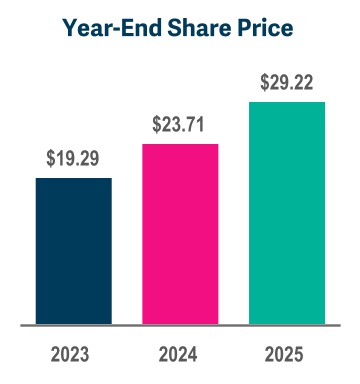
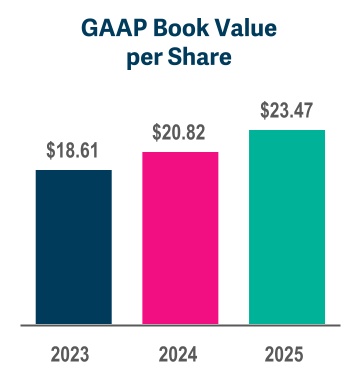
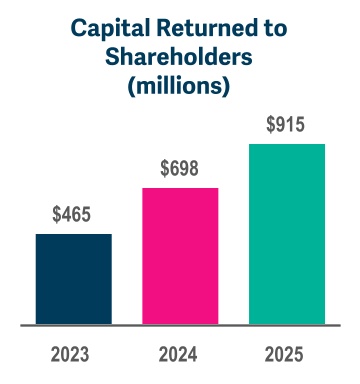
For the second consecutive year our stock price increased by 23%. We grew GAAP book value per share by 13%, while returning approximately $915 million to shareholders through share repurchases and dividends, a 31% increase compared to 2024, and a 97% increase from 2023. Growth in adjusted book value per share is used to determine vesting of our performance-based long-term equity awards.
30 │ MGIC Investment Corporation – 2026 Proxy Statement
COMPENSATION DISCUSSION & ANALYSIS
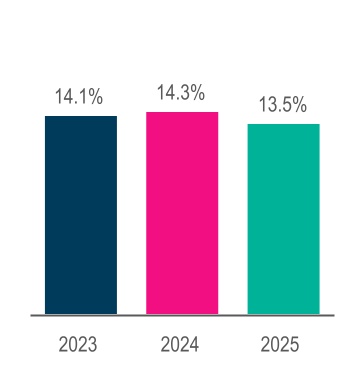
NIW, ROE and IIF are the financial measures by which payouts under our 2025 bonus plan are determined. In 2025, our NIW was $61.9 billion, up from $57.0 billion in 2024, and $47.8 in 2023. The 2025 increase reflects a higher market share as compared to 2024. Our ROE for 2025 was 13.5%; our IIF at the end of 2025 reached a company and industry all-time high of $303.1 billion.
NIW (billions)1
ROE2
IIF (billions)3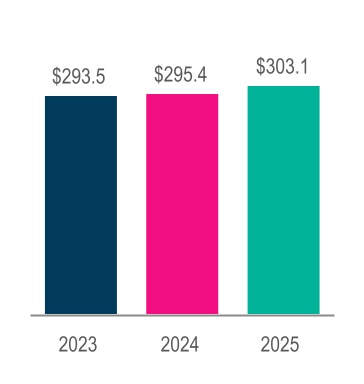
1 | For purposes of the bonus plan, NIW includes (i) traditional loan level insurance, (ii) loan level insurance executed through a managing agent or directly with a GSE or other entity, and (iii) credit risk transfer (calculated as 1/3 of the unpaid principal balance of the loans committed to be insured by us during the year). NIW received credit for bonus purposes only if its expected risk-adjusted return on capital exceeded the Company's hurdle rate. Because the NIW for the bonus plan includes a more comprehensive definition of NIW when compared to the primary NIW disclosed for financial reporting purposes, NIW figures shown in our financial reporting differ slightly from what is shown in this Proxy Statement. | ||||
2 | We calculate ROE as adjusted net operating income, divided by beginning of the year GAAP shareholders' equity, excluding accumulated other comprehensive income (loss) and adjusted for financial impacts of GSE-mandated mortgage insurance cancellations inconsistent with prior business practices. Adjusted net operating income is a non-GAAP measure of performance. For a description of how we calculate this measure and for a reconciliation of this measure to its nearest comparable GAAP measures, see Appendix B. | ||||
3 | The unpaid principal balance, as reported to us, of the loans insured by us, as of the end of the year, adjusted for financial impacts of GSE-mandated mortgage insurance cancellations inconsistent with prior business practices. | ||||
MGIC Investment Corporation – 2026 Proxy Statement │ 31
COMPENSATION DISCUSSION & ANALYSIS
Our compensation programs are working effectively and are aligned with shareholder interests.
● | Performance-based compensation represents the majority of our NEOs' Target TDC opportunity. It was 61% of our CEO's 2025 target TDC opportunity and, on average, 57% of the target TDC of our other NEOs. | |||||||||||||
● | There is a strong link between the bonus performance measures and our business strategies. | |||||||||||||
| ○ | Three financial performance measures had a total weight of 75% in determining the bonuses, and all target levels for 2025 were set above 2024 levels: | |||||||||||||
| ■ | Return on Equity (weighted 45%). Funding at the target level required an 12.5% ROE and funding at the maximum level required a 17.0% ROE. | |||||||||||||
| ■ | New Insurance Written (weighted 15%). NIW received credit for bonus purposes only if its expected risk-adjusted return on capital exceeded the Company's hurdle rate. | |||||||||||||
| ■ | Insurance In Force (weighted 15%). IIF balances the volatility of the NIW performance measure that can be influenced by a strong or weak mortgage refinancing environment. | |||||||||||||
| ○ | Strategic performance had a total weight of 25% and includes qualitative measures relating to transformation of our business operations, managing our amount and form of capital, and demonstrating our commitment to corporate sustainability. | |||||||||||||
● | Long-term equity awards are designed to align management and shareholder interest in increasing shareholder value: | |||||||||||||
| ○ | Performance-based long-term equity awards promote a long-term focus for our NEOs and reward multi-year financial results. All performance-based long-term equity awards granted to NEOs are dependent on achievement of rigorous book value per share growth goals. | |||||||||||||
| ○ | Service-based equity awards are intended to attract and retain key talent. | |||||||||||||
Shareholder Outreach and Consideration of Last Year’s “Say on Pay” Vote
We value the views of our shareholders. In addition to ongoing meetings throughout the year, we also seek to engage with our investors on a regular, annual basis in order to solicit their feedback and to provide information about our strategies, corporate governance and sustainability matters, and executive compensation. As part of this effort, we generally invite shareholders who collectively own approximately 70% of our stock to meet with us. We met with shareholders owning 14%, 17%, and 18% of our stock in 2023, 2024 and 2025, respectively.
At each of the 2023, 2024 and 2025 Annual Meetings, more than 98% of the "Say on Pay" votes cast were in support of the compensation of our NEOs. The MDNG Committee views these voting results as confirmation of shareholder support of our executive compensation program.
32 │ MGIC Investment Corporation – 2026 Proxy Statement
COMPENSATION DISCUSSION & ANALYSIS
Compensation-Related Governance Policies and Best Practices
We have many compensation-related governance policies and best practices that we believe align our executive compensation with shareholder interests, including those highlighted below. For more information about certain of these practices, see "Other Aspects of our Executive Compensation Programs," below.
| Stock Ownership Guidelines | è | Our stock ownership guidelines require our CEO to own Company stock equal in value to at least six times his base salary, and require our President and Executive Vice Presidents ("EVPs") to own Company stock equal in value to at least three times their base salaries. All other officers are required to own Company stock with a value equal to or greater than their respective base salary levels. | ||||||
| Post-Vesting Stock Holding Requirements | è | For long-term equity granted in 2024 and before, our NEOs and other executive officers are required to hold, for one year after vesting, the lower of 25% of shares that vest under equity awards and 50% of the shares that were received by the officer after taking account of shares withheld to cover taxes. For long-term equity granted in or after 2025, NEOs are required to hold 100% of vested shares net of taxes for one year. | ||||||
No Hedging or Pledging | è | Our policies prohibit directors, NEOs, other officers and certain employees from engaging in short sales of Company securities, entering into hedging transactions referencing the Company’s equity securities, holding Company securities in a margin account, or pledging Company securities as collateral for a loan. | ||||||
| High Percentage of Performance-Based Compensation | è | 61% of our CEO's 2025 target TDC opportunity was tied to achievement of preset performance goals. On average, 57% of the 2025 target TDC opportunities for the other NEOs were tied to achievement of such goals. | ||||||
Timing of Equity Grants Managed by Established Policy | è | We have an Equity Grant Policy that requires that equity grants are made at a standard time, shortly after the release of earnings. | ||||||
| Limited Perquisites | è | Our perquisites are very modest, ranging between approximately $0 and $10,200 in 2025 for our NEOs. | ||||||
| Effective Use of Equity Compensation with Low Burn Rate and Dilution | è | The total equity awards granted to all participants under our Incentive Plans in 2025 represented approximately 0.29% of our outstanding shares as of December 31, 2024. The Company's dilution from outstanding awards was below the 25th percentile among all companies in our 2025 Benchmarking Peer Group (calculated as outstanding equity awards on December 31, 2024, as a percentage of fully diluted total shares outstanding). | ||||||
MGIC Investment Corporation – 2026 Proxy Statement │ 33
COMPENSATION DISCUSSION & ANALYSIS
| Limited Change in Control Benefits | è | “Double trigger” is generally required for any benefits to be paid. Equity awards may vest upon a change in control only if the MDNG Committee determines that the awards will not be assumed or replaced. Cash severance does not exceed 2 times base salary plus bonus plus retirement plan accrual. There is no excise tax gross-up provision. | ||||||
| “Clawback” Policy | è | Our “clawback” policy applies to cash bonuses as well as performance and time-vested long-term equity award compensation received by our NEOs and other executive officers. The policy is intended to be compliant with the final SEC rules and stock exchange listing standards regarding the recoupment policy required by the Dodd-Frank Wall Street Reform and Consumer Protection Act. | ||||||
| Compensation Consultant | è | The Compensation Consultant is retained by the MDNG Committee and performs no services for the Company other than the consulting services to the MDNG Committee regarding executive compensation and non-employee director compensation. | ||||||
| Compensation Risk Evaluation | è | Annually, the MDNG Committee reviews an incentive compensation risk evaluation designed to ensure that our compensation programs do not motivate excessive risk-taking and are not reasonably likely to have a material adverse effect on the Company. | ||||||
Omnibus Incentive Plan | è | Our 2025 Omnibus Incentive Plan ("Plan") was approved by shareholders in April 2025 and contains the following provisions: •No granting of stock options with an exercise price less than the fair market value of the Company’s common stock on the date of grant; •No re-pricing (reduction in exercise price) of stock options and no exchange of underwater stock options for another award or for cash, without shareholder approval; •No inclusion of reload provisions in any stock option grant; •No payment of dividends on RSUs before they are vested; •No excise tax gross-ups; and •Awards subject to applicable Company clawback policy. | ||||||
34 │ MGIC Investment Corporation – 2026 Proxy Statement
COMPENSATION DISCUSSION & ANALYSIS
Objectives of Our Executive Compensation Program
In setting compensation, the MDNG Committee focuses on target TDC, which consists of base salary, target bonus (or non-equity incentive compensation) and target equity awards (valued at their grant date fair value as reported in the Summary Compensation Table). The objectives of our executive compensation program are to:
•Attract and retain high-quality executives. We want to offer a competitive pay opportunity that provides for:
¢ Target TDC within a range near the median level of our executives' Benchmarking Peer Group counterparts;
¢ Performance-based bonus and long-term equity award opportunities that may be earned above or below the target opportunity; and
¢ Service-based long-term equity awards that attract and retain talent.
•Align executive compensation with long-term shareholder interests. We align compensation and long-term shareholder interests by paying a majority of TDC in:
¢ Bonuses that are at-risk and are based on specific performance measures that align payouts with Company performance, with quantitative financial performance measures accounting for 75% of the bonus calculation and qualitative business objectives, which directly support our business strategies, accounting for 25% of the bonus calculation;
¢ Performance-based long-term equity awards that vest based on Company performance versus three-year financial objectives, aligning payouts with Company performance and our stock performance; and
¢ Service-based long-term equity awards that attract and retain talent, and align the interests of management with shareholders.
MGIC Investment Corporation – 2026 Proxy Statement │ 35
COMPENSATION DISCUSSION & ANALYSIS
How We Make Compensation Decisions
Role of the Management Development, Nominating and Governance Committee
The MDNG Committee, which consists solely of directors who meet the heightened independence criteria that apply to compensation committee members under SEC rules and NYSE listing standards, is responsible for overseeing the development and administration of our executive compensation program. The MDNG Committee approves the compensation of our CEO and our other senior executives, and performs other tasks, including:
•Reviewing and approving bonus and equity compensation goals and objectives;
•Evaluating performance in light of these goals and objectives; and
•Evaluating the competitiveness of the CEO and NEOs’ total compensation package.
The MDNG Committee also performs other duties and supports the Board’s role in overseeing the risks facing the Company, as described in more detail above under “Board Meetings and Committees.”
The MDNG Committee is supported in its work by our CEO, our Chief Human Resources Officer, our General Counsel and the Compensation Consultant, as described below. Our Chairman of the Board, who retired as our CEO in 2015 but now is not a member of our management, regularly participates in meetings of the MDNG Committee.
The MDNG Committee may delegate its responsibilities to subcommittees of the MDNG Committee.
Role of the Compensation Consultant
The MDNG Committee retained the Compensation Consultant to, among other things, help it evaluate and advise on our executive compensation program and the compensation of our directors. The MDNG Committee has assessed the independence of the Compensation Consultant pursuant to SEC rules and NYSE listing standards and concluded that its work for the MDNG Committee does not raise any conflict of interest.
Our Chief Human Resources Officer coordinates the Compensation Consultant's assignments and, in providing its services to the MDNG Committee, the Compensation Consultant regularly interacts with our senior management. However, the Compensation Consultant reports directly to the MDNG Committee; the MDNG Committee retains authority to approve the compensation of the Compensation Consultant, determine the nature and scope of its services and evaluate its performance. The Compensation Consultant provides no services to the Company other than consulting services to the MDNG Committee regarding executive compensation and non-executive director compensation. The MDNG Committee may replace the Compensation Consultant or hire additional consultants at any time. A representative of the Compensation Consultant attends meetings of the MDNG Committee, as requested.
In connection with our executive compensation program, the Compensation Consultant provides various services to the MDNG Committee, including advising the MDNG Committee on the principal aspects of our executive compensation program and evolving industry practices and providing market information and analysis regarding the competitiveness of our program, including its relationship to performance.
36 │ MGIC Investment Corporation – 2026 Proxy Statement
COMPENSATION DISCUSSION & ANALYSIS
The Compensation Consultant's work for the MDNG Committee during 2025 and early 2026 included:
•An evaluation of NEO compensation compared to Benchmarking Peers and recommendations for changes to our NEO compensation programs, generally;
•Advice about our base salaries and their amounts relative to our other compensation components;
•Advice about the annual bonus plan, including the performance measures and goals incorporated into the formula that is used to determine payouts;
•Advice about the long-term equity incentive program, including the type and level of awards granted under the program and the vesting provisions;
•Analysis of the alignment between pay delivery and performance versus our direct mortgage insurance peers to evaluate the effectiveness of our incentive plan structures and the rigor of previously established goals;
•Review and analysis of our Benchmarking Peer Group used to evaluate our executive compensation and non-employee director compensation;
•Advice on the key terms of our 2025 Omnibus Incentive Plan;
•Review of drafts of the CD&A and related compensation tables for the Proxy Statement;
•An evaluation of non-employee director compensation compared to our Benchmarking Peers;
•Review of our stock ownership guidelines; and
•Review of, and comment on, management's compensation risk assessments.
Role of Officers
While the MDNG Committee is ultimately responsible for making all compensation decisions affecting our NEOs, our CEO participates in the process because the MDNG Committee views his input as necessary given his close day-to-day association with the other NEOs and his knowledge of our operations. Among other things, our CEO makes recommendations on the components of compensation for the NEOs, other than himself. Our CEO generally does not participate in the portions of Committee meetings regarding the review of his own performance or the determination of the amounts of his compensation or when the MDNG Committee members meet in executive session.
Our Chief Human Resources Officer and our General Counsel also participate in the MDNG Committee’s compensation process. Our Chief Human Resources Officer is responsible for coordinating the work of the Compensation Consultant for the MDNG Committee and the annual preparation of an executive compensation risk evaluation. She maintains knowledge of executive compensation trends, practices, rules and regulations and works with our General Counsel on related legal and tax compliance matters as well as on other matters related to executive compensation. The MDNG Committee receives information from management that includes: detailed breakdowns of the compensation of the NEOs; the total amount of stock and RSUs held by each NEO; and the other compensation information disclosed in this Proxy Statement.
MGIC Investment Corporation – 2026 Proxy Statement │ 37
COMPENSATION DISCUSSION & ANALYSIS
Benchmarking
To provide the MDNG Committee with a framework for evaluating compensation levels for our NEOs against market practices, the Compensation Consultant periodically prepares reports analyzing compensation data for our Benchmarking Peers.
The criteria considered by the MDNG Committee when selecting Benchmarking Peers include whether the candidate: 1) is a mortgage insurer; 2) has significant exposure to residential real estate; 3) is in an industry in which we compete for talent; 4) chose us as a benchmarking peer or chose as a compensation peer one of our mortgage insurance peers; and 5) is reasonably similar in size to us. Based on these criteria, in July 2024, the MDNG Committee accepted the Compensation Consultant's proposal to keep the 2024 Benchmarking Peer Group unchanged for 2025. The companies in our Benchmarking Peer Group that were used in competitive analysis used to inform decisions based on target pay opportunities and program design for 2021-2025 are shown below:
2021-2025 Benchmarking Peer Groups | |||||||||||||||||||||||||||||||||||
MGIC Peer Groups | Mortgage Insurer - Direct Competitor1 | Exposure to Residential Real Estate Market | Industry in which we Compete for Talent | Chose us as a Peer | Business | ||||||||||||||||||||||||||||||
Enact Holdings | X | X | X | X | Mortgage Insurer | ||||||||||||||||||||||||||||||
Mr. Cooper Group2 | X | X | Mortgage Orig & Svg | ||||||||||||||||||||||||||||||||
2024-2025 | Arch Capital Group Ltd. | X | X | X | X | Includes Mortgage Insurer | |||||||||||||||||||||||||||||
| Assured Guaranty Ltd. | X | X | X | Financial Guaranty Insurer | |||||||||||||||||||||||||||||||
| Essent Group Ltd. | X | X | X | X | Mortgage Insurer | ||||||||||||||||||||||||||||||
2023 | First American Fin'l Corp. | X | X | Title Ins & Other R.E. Services | |||||||||||||||||||||||||||||||
NMI Holdings Inc. | X | X | X | X | Mortgage Insurer | ||||||||||||||||||||||||||||||
2021-2022 | Onity Group (f/k/a Ocwen Financial Corp.) | X | X | X | Mortgage Svg & Lending | ||||||||||||||||||||||||||||||
PennyMac Fin'l Services Inc. | X | X | X | Mortgage Svg & Lending | |||||||||||||||||||||||||||||||
Radian Group Inc. | X | X | X | X | Mortgage Insurer | ||||||||||||||||||||||||||||||
Stewart Info Services Corp. | X | X | X | Title Ins & Other R.E. Services | |||||||||||||||||||||||||||||||
Walker and Dunlop, Inc. | X | X | X | Real Estate Services & Finance | |||||||||||||||||||||||||||||||
Flagstar Bancorp Inc. | X | X | Mortgage Orig & Svg; Banking | ||||||||||||||||||||||||||||||||
Fidelity National Financial Inc. | X | X | Title Ins & Other R.E. Services | ||||||||||||||||||||||||||||||||
Genworth Financial Inc. | X | X | X | X | Includes Mortgage Insurer | ||||||||||||||||||||||||||||||
1 Parent companies of direct competitors whose overall results are principally or significantly impacted by these competitors.
2 Acquired by Rocket Mortgage in 2025.
As shown in the table below, our market capitalization is in the top quartile of, and our revenue is reasonably comparable to, the companies in our 2025 Benchmarking Peer Group.
| MGIC Percentile Rank Versus Benchmarking Peer Group | |||||
12/31/25 Market Capitalization | 82nd | ||||
2025 Revenue | 34th | ||||
38 │ MGIC Investment Corporation – 2026 Proxy Statement
COMPENSATION DISCUSSION & ANALYSIS
Why we have Historically not Included Property and Casualty Insurers in our Benchmarking Peer Group
We have not historically included property and casualty insurers in our Benchmarking Peer Group because those companies that do not also write mortgage insurance: 1) are not subject to residential mortgage risk or the residential real estate market to the same extent as are we or our Benchmarking Peers, 2) are not the companies with which we compete for executive talent, and 3) generally do not select us as a benchmarking peer.
Our Benchmarking Peer Group for 2026
The MDNG Committee's Compensation Consultant reviews the Benchmarking Peer Group annually and reports its findings and recommendations to the MDNG Committee. In July 2025, at the recommendation of the Compensation Consultant, the MDNG Committee chose to maintain our peer group for purposes of benchmarking 2026 compensation.
In March of 2025 it was announced that one of our compensation peers, Mr. Cooper Group, would be purchased by a third-party. The transaction closed in October of 2025. As compensation information for Mr. Cooper Group was made publicly available in its 2025 Proxy Statement, the Compensation Consultant recommended that the MDNG Committee retain Mr. Cooper Group as a peer for purposes of establishing 2026 compensation. During 2026, the Compensation Consultant and the MDNG Committee will review the Company's peer group and make necessary adjustments in light of this and any other relevant events.
MGIC Investment Corporation – 2026 Proxy Statement │ 39
COMPENSATION DISCUSSION & ANALYSIS
Components of Our Executive Compensation Program
Each of the components of our executive compensation is discussed below. To meet our objective of aligning compensation and shareholder interests, our executive compensation program includes an annual base salary, annual bonus plan that is tied to performance measures that directly support the Company's business strategies, and long-term equity awards with vesting over a three-year period. Sixty percent of our long-term equity awards are earned based on growth in the Company's adjusted book value per share over a three-year performance period. The remaining 40% of our long-term equity awards vest ratably over three years. The ultimate value of all of our long-term equity awards reflects our stock price.
With input from the MDNG Committee's Compensation Consultant, the MDNG Committee approved a 2025 target TDC opportunity for each NEO in January 2025. Performance-based, at-risk compensation continues to represent the majority of the TDC opportunity of our CEO and the average TDC opportunity of our NEOs, as shown in the charts below.
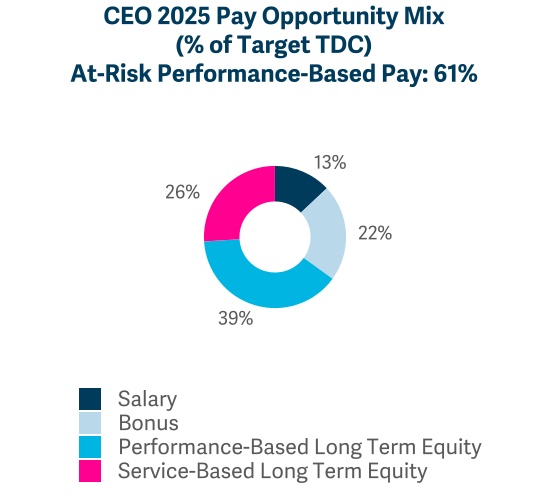
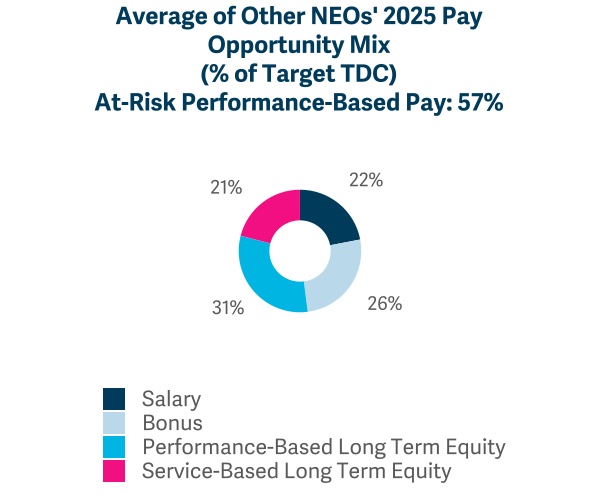
Base Salary
In considering any change to our CEO’s compensation, including base salary, the MDNG Committee considers market competitiveness, tenure in position and its evaluation of his performance. Subjects covered by the evaluation of his performance include financial results, leadership, strategic planning, succession planning, community and industry involvement, and communications and relations with the Board. Base salary changes for our other NEOs are recommended to the MDNG Committee by the CEO based on his evaluation of each NEO’s performance, base salary levels of Benchmarking Peer Group counterparts, responsibilities of each NEO, and considerations of internal equity. The MDNG Committee approves salary changes for the President and Executive Vice Presidents based on the CEO’s recommendations, benchmarking data, and its own assessment of the NEOs through regular interaction, including at Board meetings.
For purposes of determining our NEOs' 2025 salaries, the MDNG Committee reviewed the most recently available salary data from our Benchmarking Peers. This review revealed that base salaries for each of our NEOs was competitive with their respective Benchmarking Peer Group counterparts. As such, the MDNG Committee opted to keep the 2025 base salary amounts consistent with 2024.
40 │ MGIC Investment Corporation – 2026 Proxy Statement
COMPENSATION DISCUSSION & ANALYSIS
| NEO Base Salaries | |||||||||||
| Executive | 2023 | 2024 | 2025 | ||||||||
| Timothy J. Mattke, CEO | $1,000,000 | $1,050,000 | $1,050,000 | ||||||||
| Nathaniel H. Colson, EVP and CFO | $520,000 | $600,000 | $600,000 | ||||||||
Salvatore A. Miosi, President and COO | $735,000 | $758,000 | $758,000 | ||||||||
| Paula C. Maggio, EVP and General Counsel | $617,000 | $636,000 | $636,000 | ||||||||
Annual Bonus
Our bonus plan is designed to strongly align pay delivery with our performance, as defined by achievement of our annual financial performance measures and business objectives.
Bonus Opportunity. Consistent with prior years, in 2025 each of our current executives had a target bonus opportunity expressed as a multiple of base salary. Actual earned bonuses could range from 0% to 200% of the target opportunities, depending on performance. The threshold (and below threshold), target and maximum bonus opportunities for each NEO employed at the end of 2025 and eligible to receive a bonus are shown in the following table.
2025 Bonus Opportunities (Multiple of Base Salary)1 | ||||||||||||||
| Executive | Below Threshold | Threshold | Target | Maximum | ||||||||||
| Timothy J. Mattke | 0 | 0.875 | 1.75 | 3.50 | ||||||||||
| Nathaniel H. Colson | 0 | 0.50 | 1.00 | 2.00 | ||||||||||
| Salvatore A. Miosi | 0 | 0.675 | 1.35 | 2.70 | ||||||||||
| Paula C. Maggio | 0 | 0.50 | 1.00 | 2.00 | ||||||||||
1 Represents a multiple of the base salary amounts that become effective in March or April of the year for which the bonuses are awarded. Such base salary amounts will not be the same as the base salary amounts disclosed in the SCT due to the effects of the timing of the pay increases and the variability in the number of pay periods in each calendar year.
For all NEOs, the multiples for the 2025 annual bonus are unchanged from 2024. Similar to the NEO salaries, in October 2024, the MDNG Committee's review of peer benchmarking data prepared by the Compensation Consultant confirmed that each NEO's bonus opportunity was competitive with the Company's Benchmarking Peers. As a result, in January 2025, the MDNG Committee approved maintaining the threshold, target, and maximum bonus opportunities that were put in place for 2024.
In January 2025, the MDNG Committee approved three financial performance measures (with a total weight of 75%) and the three business objectives (with a total weight of 25%) to be used when determining 2025 NEO bonuses:
•Financial Performance Measures. The MDNG Committee chose to maintain ROE, NIW and IIF as the financial performance measures in the 2025 bonus plan to provide an incentive for bottom line and top line growth and for reasonable consistency with the 2021-2024 bonus plans. The IIF metric balances the volatility of the NIW metric that can be impacted by a strong or weak mortgage refinancing environment. The ROE, IIF, and NIW targets established for 2025 performance each exceeded the target levels set in 2024.
MGIC Investment Corporation – 2026 Proxy Statement │ 41
COMPENSATION DISCUSSION & ANALYSIS
•Business Objectives Performance Measures. Each business objective selected by the MDNG Committee directly supports our business strategies. These objectives include transforming our business operations, managing our amount and form of capital, and demonstrating our commitment to corporate sustainability to our stakeholders, including our co-workers, customers, investors, and community, and creating a co-worker experience that attracts, develops, and retains the right talent.
Calculation of 2025 Bonus. Threshold, target and maximum performance levels were established for each financial performance measure. Actual performance at such levels would result in credit of 0% for below threshold performance, 50% for threshold performance, 100% for target performance, and 200% for maximum performance, with credit for performance achievement between the threshold and target levels, and the target and maximum levels, calculated by linear interpolation. The payout percentage determined by the Company’s actual 2025 performance for each financial performance measure was multiplied by an assigned weight to determine a weighted score for that measure. For the business objectives, the MDNG Committee reviewed the Company’s activities with respect to each objective (some of which is included in the discussion below) in determining the score.
2025 Bonus Percentage | |||||||||||||||||||||||
| Percent Earned | Weighted Score | ||||||||||||||||||||||
2025 Performance Levels | Actual 2025 | ||||||||||||||||||||||
| Threshold 50% | Target 100% | Maximum 200% | |||||||||||||||||||||
| Weight | |||||||||||||||||||||||
| Financial Performance Measures: | |||||||||||||||||||||||
| Return on Equity | 8.0% | 12.5% | 17.0% | 13.5% | 122.2 | % | 45.0 | % | 55.0 | ||||||||||||||
| New Insurance Written (billions) | $38.5 | $60.8 | $100.7 | $61.9 | 102.8 | % | 15.0 | % | 15.4 | ||||||||||||||
| Insurance in Force (billions) | $273.4 | $295.4 | $313.9 | $303.1 | 141.6 | % | 15.0 | % | 21.2 | ||||||||||||||
| Total Score for Financial Performance Measures | 75.0 | % | 91.7 | ||||||||||||||||||||
| Business Objectives: | |||||||||||||||||||||||
| Transformation | For a discussion of performance against these business objectives, see "Performance Against Business Objectives" | ||||||||||||||||||||||
Corporate Sustainability | |||||||||||||||||||||||
| Capital | |||||||||||||||||||||||
| Total Score for Business Objectives | 120.0 | % | 25.0 | % | 30.0 | ||||||||||||||||||
2025 Bonus Percentage | 121.7 | % | |||||||||||||||||||||
The aggregate weighted financial and business performance scores resulted in a preliminary bonus percentage of 121.7%. The MDNG Committee has discretion to adjust the preliminary bonus percentage up or down by as much as 10 percentage points, but chose not to do so, concluding that payouts were already well-aligned with the Company’s performance. More information about the evaluation and scoring of each of these financial and business performance scores is below.
42 │ MGIC Investment Corporation – 2026 Proxy Statement
COMPENSATION DISCUSSION & ANALYSIS
Performance Against Financial Measures
Return on Equity ("ROE")
ROE Performance Levels for Company's 2025 Bonus Plan | |||||
| Company's Threshold ROE (for 50% bonus payout. If performance is below threshold, no credit is given) | 8.0 | % | |||
| Company's Target ROE (for 100% bonus payout) | 12.5 | % | |||
| Company's Maximum ROE (for 200% bonus payout) | 17.0 | % | |||
Company's Actual 2025 ROE | 13.5 | % | |||
Note: For purposes of the bonus plan, we calculate ROE as adjusted net operating income, divided by beginning of the year GAAP shareholders' equity, excluding accumulated other comprehensive income (loss) and adjusted for financial impacts of GSE-mandated mortgage insurance cancellations inconsistent with prior business practices. Adjusted net operating income is a non-GAAP measure of performance. For a description of how we calculate this measure and for a reconciliation of this measure to its nearest comparable GAAP measures, see Appendix B. | |||||
As noted above, the MDNG Committee strives to link compensation to Company performance, designing incentives so that the earned TDC of our NEOs varies based on results. In setting the 2025 target ROE, the MDNG Committee reviewed our 2024 performance and forecasts for 2025, and approved a more challenging, yet achievable target; the 2024 threshold and maximum levels were maintained. Ultimately, our actual 2025 ROE results exceeded the target, primarily due to the re-estimation of loss reserves on previously received delinquency notices.
The Company continued to engage in stock repurchases in 2025. However, the 2025 repurchases did not affect the equity measure used in the ROE calculation as ROE is calculated as adjusted net operating income, divided by beginning shareholders' equity (which is not affected by 2025 share repurchases).
New Insurance Written ("NIW")
2025 NIW Performance Levels (billions) | |||||
| Company's Threshold NIW (for 50% bonus payout. If performance is below threshold, no credit is given) | $ | 38.5 | |||
| Company's Target NIW (for 100% bonus payout) | $ | 60.8 | |||
| Company's Maximum NIW (for 200% bonus payout) | $ | 100.7 | |||
Company's Actual 2025 NIW | $ | 61.9 | |||
Note: For purposes of the bonus plan, NIW includes (i) traditional loan level insurance, (ii) loan level insurance executed through a managing agent or directly with a GSE or other entity, and (iii) credit risk transfer (calculated as 1/3 of the unpaid principal balance of the loans committed to be insured by us during the year). NIW received credit for bonus purposes only if its expected risk-adjusted return on capital exceeded the Company's hurdle rate. Because the NIW for the bonus plan includes a more comprehensive definition of NIW when compared to the primary NIW disclosed for financial reporting purposes, NIW figures shown in our financial reporting differ slightly from what is shown in this Proxy Statement. | |||||
In establishing the 2025 performance goals for NIW, the MDNG Committee reviewed our prior years' results and our 2025 forecast. The volume of mortgage originations was predicted to be slightly higher in 2025 as compared to 2024. Because of the expected uptick in the level of mortgage originations, the MDNG Committee increased the target goal for 2025 NIW by 14.5% as compared to the target goal set for 2024 NIW. Our actual 2025 NIW for bonus purposes was $61.9 billion; our outperformance against the $60.8 million target reflected a higher market share as compared to 2024.
MGIC Investment Corporation – 2026 Proxy Statement │ 43
COMPENSATION DISCUSSION & ANALYSIS
Insurance in Force ("IIF")
2025 IIF Performance Levels (billions) | |||||
| Company's Threshold IIF (for 50% bonus payout. If performance is below threshold, no credit is given) | $ | 273.4 | |||
| Company's Target IIF (for 100% bonus payout) | $ | 295.4 | |||
| Company's Maximum IIF (for 200% bonus payout) | $ | 313.9 | |||
Company's Actual 2025 IIF | $ | 303.1 | |||
| Note: For purposes of the bonus plan, IIF is the unpaid principal balance, as reported to us, of the loans insured by us, as of the end of the year, adjusted for financial impacts of GSE-mandated mortgage insurance cancellations inconsistent with prior business practices. | |||||
Our book of IIF is an important driver of our future revenues, and its growth is driven by NIW and the retention of our IIF, as measured by our annual persistency (the percentage of our insurance remaining in force from one year prior). For years in which total mortgage originations are forecasted to be up, we would expect our NIW to increase. Generally speaking, in an environment with more mortgage originations, we would also expect policy cancellation rates to increase, and in turn result in decreased annual persistency, although the impact to persistency generally lags the impact to NIW.
It is through this lens that the MDNG Committee set an increase for each of the 2025 IIF threshold, target and maximum performance levels. Our actual 2025 results for IIF set a Company and industry record-high of $303.1 billion, approximately 8% higher than the average yearly IIF for the previous 5 years. These results translated to a payout between the target and the maximum for 2025.
| 2020 | 2021 | 2022 | 2023 | 2024 | 2020-2024 Average IIF | ||||||||||||
| $246.6 | $274.4 | $295.3 | $293.5 | $295.4 | $281.0 | ||||||||||||
44 │ MGIC Investment Corporation – 2026 Proxy Statement
COMPENSATION DISCUSSION & ANALYSIS
Performance Against Business Objectives
Each business objective directly supports our business strategies. During 2025, the Company achieved favorable results against the business objectives used to determine the bonuses of our NEOs.
| Business Objective | Results | |||||||
Transformation - Transform our business to sustain our success. | è | •Invested in data and analytics to drive efficiencies and align activity to value. •Retired legacy technology and successfully modernized key business processes. •Established a new data center facility to advance our capabilities. •Simplified sales and operations by phasing out programs that no longer contributed to core business objectives. | ||||||
Capital - Ensure that we have the appropriate amount and form of capital to support our strategies and meet the needs of our stakeholders. | è | •MGIC Investment Corporation ended 2025 with $1.1 billion of cash and investments. •MGIC paid $800 million in dividends to MGIC Investment Corporation, an increase from the $750 million paid in 2024. •Sustainably reduced underwriting and other expenses, net, by 8% as compared to 2024. •S&P upgraded MGIC's financial strength and credit rating to A- and at the same time upgraded the credit rating on MGIC Investment to BBB-. With this ratings change, MGIC Investment became fully investment grade. The outlook for the ratings is positive. •Moody's Ratings upgraded MGIC Investment's senior unsecured debt rating to Baa2 from Baa3. Moody's also upgraded the insurance financial strength rating of MGIC, to A2 from A3. The outlook for the ratings is stable. | ||||||
MGIC Investment Corporation – 2026 Proxy Statement │ 45
COMPENSATION DISCUSSION & ANALYSIS
Corporate Sustainability - Demonstrate our commitment to all our stakeholders through practices and initiatives intended to support the long-term sustainability of our business and create a co-worker experience that attracts, develops and retains the right talent | è | •Continued to provide a competitive package of benefits that considers the physical, emotional, financial, and social aspects of co-worker wellbeing, with expanded support for parental, caregiver and bereavement leave. •Held quarterly leadership and all-company meetings focusing on collaboration, enterprise planning, prioritization and transparency through open dialogue. •Modernized our co-worker engagement survey strategy and platform to provide managers with more frequent and holistic insights into workforce sentiment. | ||||||
The MDNG Committee found the Company's progress with respect to the Transformation and Corporate Sustainability business objectives to be on target for 2025; due to what it believed to be outperformance in the management of capital, the MDNG Committee approved a payout of 120.0% of the target score for performance against the business objectives. As stated above, the Company returned more than $900 million to shareholders in 2025 while maintaining capital levels that were well in excess of what is required by the GSEs and state regulators.
Long-Term Equity Awards
Background Considerations
Consistent with our belief that there should be a strong link between earned compensation and long-term performance, long-term equity awards provide one of our most significant TDC opportunities. We emphasize this component of our executive compensation program because it aligns executives’ interests with those of shareholders by linking compensation to both company performance and total shareholder return, while fostering a long-term planning horizon and supporting the retention of our leadership team. Long-term equity awards at their target grant date fair value represented 65% of the 2025 target TDC opportunity of our CEO, and, on average, 52% of the 2025 target TDC opportunities of the other NEOs.
In January 2025, the MDNG Committee established a target long-term equity award opportunity for NEOs. To set these targets, the MDNG Committee considered a competitive market analysis of each NEO's TDC opportunity, the portion of such opportunity provided as long-term equity awards relative to their Benchmarking Peer Group counterparts, tenure in the position and internal equity.
Below is a discussion of our 2025 long-term equity awards, and a discussion of our 2024 and 2023 long-term equity awards, which is provided for comparison purposes and because a portion of the long-term equity awards granted in those years either vested based on 2025 performance or remain outstanding.
2025 Long-Term Equity Awards
In October 2024, the Compensation Consultant provided the MDNG Committee with a comprehensive review of the Company's executive compensation practices, including a competitive analysis of our Benchmarking Peers' long-term incentive program designs. A key finding from this review was that on average, performance-based equity made up 55-60% of the long-term equity granted by our Benchmarking Peer Group, with the remainder being comprised of time-based equity (i.e. vesting based on continued service only). The MDNG Committee also recognized that none of the Benchmarking Peers awarded 100% performance-based long-term equity, as was the Company's historic practice.
46 │ MGIC Investment Corporation – 2026 Proxy Statement
COMPENSATION DISCUSSION & ANALYSIS
In an effort to better align with peer practice, enhance retention, and reduce the volatility in expenses related to performance-vesting units, the MDNG elected to introduce a mix of performance and time-vesting RSUs in the long-term equity granted in 2025 to the Company's executive officers. Recognizing that it is best practice that a majority of long-term equity continue to be performance based, the MDNG Committee decided that a target long-term incentive mix consisting of 60% performance-based RSUs and 40% time-based RSUs was most appropriate. Similar to the 2023 and 2024 grants, the performance-based RSUs granted in 2025 will cliff vest after three years based on the percentage achievement of a three-year cumulative adjusted book value ("ABV") per share growth goal. The time-based RSUs vest in three annual installments beginning on February 28, 2026.
The intended target value of the long-term equity awards is translated into a number of service-based RSUs and a target number of performance-based RSUs based on the closing price of our stock on the date of grant; the grant-date fair value of the awards is then discounted by 7% from the intended target value for a restriction of liquidity due to a one-year post-vest holding period. The actual number of performance-vesting RSUs to be earned will range from 0% to 200% of the target number of RSUs, depending on performance versus the three-year cumulative goals outlined in the table below, with actual vesting determined by linear interpolation where performance falls between levels.
Book value growth was chosen as the performance goal, in part because of its simplicity and relevance to management and investors. Book value growth measures cumulative build-up of equity in the Company; we believe its use as a performance goal aligns executive compensation with the financial strength of the Company.
2025 Long-Term Equity Award Performance Goal – 3-year Cumulative ABV Growth | ||||||||||||||
Below Threshold (no vesting) | Threshold (for 25% vesting) | Target (for 100% vesting) | Maximum (for 200% vesting) | |||||||||||
| Required Growth | Less than $2.00 | $2.00 | $8.01 | Greater than or equal to $10.58 | ||||||||||
| Compound Annual Growth Rate | < 2.9% | 2.9% | 10.9% | ≥14.00% | ||||||||||
ABV per share is a non-GAAP financial measure. For a description of how we calculate this measure for each equity award and a reconciliation of this measure to its nearest comparable GAAP measure, see Appendix B. | ||||||||||||||
The MDNG Committee viewed the $8.01 required growth in adjusted book value per share for target vesting of the 2025 long-term equity awards as sufficiently rigorous when considering our business plan. The required growth for target vesting set for the 2025 grants is 24% more than the target set for the 2024 grants, and 9% more than the actual results achieved with respect to the 2022-2024 performance period for RSUs that vested in February of 2025.
2023 and 2024 Long-Term Equity Awards
The 2023 and 2024 long-term equity awards granted to our NEOs consisted of 100% performance-vesting RSUs and were granted in February 2023 and 2024, respectively. The intended target value of the awards was translated into a target number of RSUs based on the closing stock price on the grant date. Actual vesting may range from 0% to 200% of the target number of RSUs, based on three-year cumulative ABV per share growth. These 2023 and 2024 performance-vesting grants will cliff vest at the end of the three-year performance period. For information about the number and value of unvested units associated with those awards, please see the Outstanding Equity Awards and 2025 Fiscal Year-End table.
For the 2023 awards, a 9.9% compound annual growth in ABV (or a $5.69 per share growth) is required for 100% (target) vesting; 13.0% compound annual growth (or >$7.73 per share growth) is required for maximum vesting; 2.6% compound annual growth (or $1.42 per share growth) is required for threshold vesting; and anything less than the threshold growth will result in 0% vesting. The actual vesting percentage is determined by linear interpolation based on where the actual growth in ABV per share falls between $1.42 and $7.73.1
1 As reported in our 2025 Proxy Statement, the required compound annual growth in ABV rate for threshold, target and maximum vesting of the 2023 long-term equity awards was incorrectly reported in the Company's 2024 Proxy Statement. The corrected values are reflected herein.
MGIC Investment Corporation – 2026 Proxy Statement │ 47
COMPENSATION DISCUSSION & ANALYSIS
For the 2024 awards, an 9.9% compound annual growth in ABV (or $6.47 per share growth) is required for 100% (target) vesting; 14% compound annual growth (or >$9.52 per share growth) is required for maximum vesting; 2.7% compound annual growth (or $1.65 per share growth) is required for threshold vesting; and anything less than the threshold growth will result in 0% vesting. The actual vesting percentage is determined by linear interpolation based on where the actual growth in ABV per share falls between $1.65 and $9.52.
The table below shows:
•the three-year cumulative goal for targeted vesting of the 2025, 2024 and 2023 ABV awards to NEOs,
•the growth in ABV per share as of the end of 2025, as calculated for the awards; and
•the final vesting percentage for the 2023 awards.
Growth in Adjusted Book Value per Share for Targeted Vesting of 2023-2025 Cliff ABV Awards | |||||||||||||||||
| 3-year Cumulative Goal for Target | 2023-2025 Actual Growth | 2024-2025 Actual Growth | 2025 Actual Growth | Vesting % | |||||||||||||
2025 Equity Awards | $8.01 | $2.97 | |||||||||||||||
2024 Equity Awards | $6.47 | $5.51 | |||||||||||||||
2023 Equity Awards | $5.69 | $7.42 | 184.8% of Target | ||||||||||||||
With respect to all of the long-term equity awards, dividends are not paid currently; instead accumulated dividends are paid out only upon vesting..
Pension Plan
Prior to 2023, our executive compensation program included a qualified pension plan (which had previously been transitioned to a cash balance plan) and a supplemental executive retirement plan ("SERP"). These plans compute retirement benefits based only on current cash compensation (salary and annual bonus) and therefore do not include long-term incentives that can result in substantial increases in pension value. As of January 1, 2023 the pension plan was frozen (no future benefits accrue for participants due to employment and no new participants will be added). Participants continue to earn interest credits on applicable benefits. More information about our pension plan can be found following the table titled “Pension Benefits at 2025 Fiscal Year-End” in “Compensation and Related Tables” below.
Perquisites
To maintain focus on performance-oriented compensation and to align with shareholder interests, the Company provides only de minimis perquisites to our NEOs, ranging from $0 to $10,136 in 2025. Benefits consisted primarily of club membership dues and executive physical expenses.
48 │ MGIC Investment Corporation – 2026 Proxy Statement
COMPENSATION DISCUSSION & ANALYSIS
OTHER ASPECTS OF OUR EXECUTIVE COMPENSATION PROGRAM
Stock Ownership by Named Executive Officers
Stock Ownership Guidelines. We have stock ownership guidelines for our executive officers to align the interests of our executives with those of our shareholders and to mitigate potential risks from incentive arrangements. Stock considered owned consists of shares owned outright by the executive and time-vested RSUs. Performance-vested RSUs are not considered owned for purposes of the stock ownership guidelines.
The stock ownership guidelines require ownership of stock valued at six times base salary for our CEO, three times base salary for the President and EVPs, and one times base salary for Senior Vice Presidents. Until the guideline is met, an NEO must retain the portion of shares received upon distribution of equity awards equal to the lower of 25% of the shares that vested and 50% of the shares that were received by the NEO after taking account of shares withheld to cover taxes.
All of our 2025 NEOs have met the applicable guidelines. As of December 31, 2025, our CEO owned stock valued at approximately 27 times his base salary. The stock ownership of our other NEOs ranged from 10 to 20 times their base salaries.
Equity Holding Post-Vesting Requirement. A portion of long-term equity awards granted to our NEOs in 2023, 2024 and before must not be sold for one year after vesting. The number of shares that must not be sold is the lower of 25% of the shares that vested and 50% of the shares that were received by the officer after taking account of shares withheld to cover taxes. Beginning with the long-term equity grants awarded to executive officers in 2025, the one year holding period will apply to 100% of the vested shares, net of shares withheld to cover taxes. The holding period does not apply to involuntary transactions, such as would occur in a merger, and for certain other dispositions.
Hedging and Pledging
Our hedging policy applies to our directors, NEOs, all other officers and certain other employees (generally, those who have regular access to material nonpublic information about the Company that gets incorporated into the Company’s periodic releases and reports), as well as their family members and entities that they control or influence. Under our hedging policy, the covered individuals/entities may not enter into hedging transactions designed to hedge or offset a decrease in the value of "Company Securities" or of vested or unvested restricted stock units (whether cash- or stock-settled). The definition of "Company Securities" includes the Company's Common Stock, options to purchase Common Stock, and convertible debentures, as well as derivative securities that are not issued by the Company, such as exchange-traded put or call options or swaps relating to the Company's securities. The hedging policy includes the following non-exhaustive list of examples of prohibited hedging transactions: forward sale contracts, equity swaps and credit defaults swaps relating to Company Securities. Financial instruments that hedge general industry risk or whose underlying security is that of an unrelated company are specifically not prohibited.
Under our pledging policy, the same individuals/entities who are subject to our hedging policy may not hold Company Securities in a margin account or pledge Company Securities as collateral for a loan.
“Clawback” Policy
The Board has adopted a compensation clawback policy (the "Clawback Policy") intended to comply with SEC rules and stock exchange listing standards regarding the recoupment policy required by the Dodd-Frank Wall Street Reform and Consumer Protection Act. The purpose of the Clawback Policy is to establish the terms under which the Company is required to recover certain amounts of incentive-based compensation from current and former executive officers in the event of an accounting restatement resulting from material non-compliance with any financial reporting requirement under federal securities laws. "Incentive-based compensation" is defined in the Clawback Policy as any compensation that is granted, earned, or vested based wholly or in part upon the attainment of a measure that is determined
MGIC Investment Corporation – 2026 Proxy Statement │ 49
COMPENSATION DISCUSSION & ANALYSIS
and presented in accordance with the accounting principles used in preparing the Company’s financial statements, and any measures that are derived wholly or in part from such measures.
In the event that the requirement to recover incentive-based compensation is triggered under the Clawback Policy, the MDNG Committee has discretion to seek to recover service-based compensation if such compensation was received during the fiscal period to which the accounting restatement applies. For purposes of the Policy, service-based compensation is defined as equity awards that are granted, earned, or vested based wholly upon the satisfaction of time-based or service-based requirements. In exercising its discretion to seek to recover service-based compensation, the MDNG Committee may take into account such considerations as it deems appropriate, including, without limitation, whether an accounting restatement was caused or contributed to by fraud, willful misconduct or gross negligence.
The Clawback Policy applies to incentive-based and service-based compensation received on or after October 2, 2023. Prior to the SEC's 2023 adoption of its final rule regarding recovery of erroneously awarded compensation the Company had in place a pre-existing clawback policy. That pre-existing policy continues to apply to compensation received prior to October 2, 2023. Under the pre-existing policy, the Company will seek to recover from any NEO or other executive officer, to the extent the MDNG Committee deems appropriate, amounts associated with cash incentive compensation that was earned and equity awards that vested based on achievement of a performance goal if a subsequent financial restatement shows that such compensation should not have been paid.
Change in Control Provisions
Each of our NEOs is a party to a Key Executive Employment and Severance Agreement with us (a "KEESA"), as described in the section titled “Potential Payments Upon Termination or Change-in-Control – Termination and Change in Control Agreements” below. The period for which our KEESAs provide employment protection ends on the third anniversary of the date of a change in control. Our KEESAs provide for a cash payment in two lump sums (or one lump sum if neither the Company nor any affiliate’s stock is publicly traded) only after both a change in control and a specified employment termination (a “double trigger”). Our KEESAs also provide for "double trigger" vesting of equity awards: there must be a change in control and a qualifying employment termination.
The agreements for our outstanding equity awards provide that the equity will not vest upon a change in control if the MDNG Committee reasonably determines in good faith prior to the occurrence of the change in control that the awards will be assumed or replaced by the employee’s employer immediately following the change in control with an alternative award meeting specified requirements.
Our KEESAs do not contain a gross-up by the Company for any excise tax payments resulting from payments upon a change in control. Payments under the KEESAs are capped by reducing such payments to an amount that will not trigger payment of federal excise taxes on such payment (the "Cut-Back Provision"), but only if the resulting after-tax value to the participant of the total payments upon a change in control would be greater than the after-tax value to the participant if the cash payments were not so reduced with the participant responsible for the excise taxes.
In 2024, the Board formally adopted an Executive Severance Plan (the "Severance Plan"). The change in control benefits provided under the Severance Plan are materially similar to those provided for in the existing KEESAs. In the event of a qualifying termination related to a change in control, NEOs with existing KEESAs will receive only the benefits provided under their KEESAs, except to the extent that the Severance Plan provides more favorable benefits. Following adoption of the Severance Plan, the Company does not intend to enter into KEESAs with new or internally-promoted officer-level employees; instead, all new officers will participate only in the Severance Plan.
For additional information about our KEESAs and the Severance Plan, see “Compensation and Related Tables – Potential Payments Upon Termination or Change-in-Control – Termination and Change in Control Agreements” below.
50 │ MGIC Investment Corporation – 2026 Proxy Statement
COMPENSATION DISCUSSION & ANALYSIS
Tax Deductibility Limit
Section 162(m) of the Internal Revenue Code disallows a tax deduction to public corporations for compensation in excess of $1 million paid during a year to certain "covered employees," generally including our NEOs. The MDNG Committee intends to set compensation for our NEOs at levels it believes are necessary to attract, motivate, retain and reward them, even if a portion of such compensation is not deductible as a result of Section 162(m).
In making decisions about executive compensation, consideration is given to the impact of other regulatory provisions, including the provisions of Section 409A of the Internal Revenue Code regarding non-qualified deferred compensation and the change in control provisions of Section 280G of the Internal Revenue Code.
Process for Approving Compensation Components; Timing of Equity Awards
There were no option awards granted to our NEOs during 2025.
The MDNG Committee has not adjusted executive officers' future compensation based upon amounts realized or forfeited pursuant to previous equity awards.
The MDNG Committee does not take into account material nonpublic information in determining the timing and terms of equity-based awards, and we have not timed the disclosure of material nonpublic information for the purpose of affecting the value of executive compensation.
The Board has delegated limited authority to the CEO to grant equity awards to non-executive officers.
MGIC Investment Corporation – 2026 Proxy Statement │ 51
COMPENSATION DISCUSSION & ANALYSIS
COMPENSATION COMMITTEE REPORT
Among its other duties, the MDNG Committee assists in the oversight by the Board of Directors of MGIC Investment Corporation’s executive compensation program, including approving corporate goals relating to compensation for the CEO and senior officers, evaluating the performance of the CEO and determining the CEO’s annual compensation and approving compensation for MGIC Investment Corporation’s other senior executives.
The MDNG Committee reviewed and discussed with management the foregoing Compensation Discussion and Analysis. Based upon this review and discussion, the MDNG Committee recommended to the Board of Directors that the Compensation Discussion and Analysis be included in MGIC Investment Corporation’s Proxy Statement for its 2026 Annual Meeting of Shareholders.
Members of the Management Development, Nominating and Governance Committee:
Jodeen A. Kozlak, Chair
Michael L. Thompson
Mark M. Zandi
52 │ MGIC Investment Corporation – 2026 Proxy Statement
COMPENSATION AND RELATED TABLES
Compensation and Related Tables
Summary Compensation Table for 2025
The following table summarizes the compensation of our NEOs for 2023 through 2025.
| Name and Principal Position | Year | Salary ($) | Stock Awards ($)1 | Non-Equity Incentive Plan Compensation ($)2 | Change in Pension Value and Nonqualified Deferred Compensation Earnings ($)3 | All Other Compensation ($)4 | Total ($) | |||||||||||||||||||
| Timothy Mattke | 2025 | 1,050,000 | 4,881,783 | 2,236,238 | 180,371 | 21,000 | 8,369,392 | |||||||||||||||||||
Chief Executive | 2024 | 1,042,308 | 5,250,007 | 2,489,813 | — | 47,584 | 8,829,712 | |||||||||||||||||||
Officer | 2023 | 988,462 | 5,000,012 | 1,720,500 | 239,989 | 35,050 | 7,984,013 | |||||||||||||||||||
| Nathaniel Colson | 2025 | 600,000 | 1,394,802 | 730,200 | 15,147 | 21,000 | 2,761,149 | |||||||||||||||||||
| EVP, Chief Financial | 2024 | 587,693 | 1,500,014 | 813,000 | 9,364 | 37,200 | 2,947,271 | |||||||||||||||||||
| Officer | 2023 | 515,385 | 1,400,010 | 596,440 | 19,846 | 35,050 | 2,566,731 | |||||||||||||||||||
| Salvatore Miosi | 2025 | 758,000 | 1,952,742 | 1,245,356 | 202,770 | 31,136 | 4,190,004 | |||||||||||||||||||
President and | 2024 | 754,462 | 2,100,019 | 1,386,572 | 27,398 | 37,200 | 4,305,651 | |||||||||||||||||||
Chief Operating Officer | 2023 | 731,769 | 2,100,008 | 1,138,111 | 246,352 | 35,050 | 4,251,290 | |||||||||||||||||||
| Paula Maggio | 2025 | 636,000 | 976,371 | 774,012 | 16,031 | 21,000 | 2,423,414 | |||||||||||||||||||
EVP and | 2024 | 633,077 | 1,050,010 | 861,780 | 8,539 | 37,200 | 2,590,606 | |||||||||||||||||||
General Counsel | 2023 | 612,846 | 1,050,011 | 707,699 | 22,006 | 35,050 | 2,427,612 | |||||||||||||||||||
1Our stock awards are granted under programs described in "Components of our Executive Compensation Program – Long-Term Equity Awards” in our CD&A.
In each of 2023 and 2024, 100% of the long-term equity awarded to our NEOs consisted of performance-based RSUs. The amounts shown for 2023 and 2024 represent the grant date fair value of the target number of performance-based RSUs granted to NEOs in the years shown, computed in accordance with FASB ASC Topic 718. The fair value of performance-based RSUs is based on the probable outcome of the applicable performance conditions and the closing price of our Common Stock on the NYSE on the grant date. In 2024 the applicable closing price was $19.81; and in 2023 it was $14.17.
In 2025, 60% of the long-term equity awarded to our NEOs consisted of performance-based RSUs and the remaining 40% consisted of service-based RSUs. The amounts shown for 2025 represent the aggregate grant date fair value of the service-based RSUs awarded and the target number of performance-based RSUs awarded, computed in accordance with FASB ASC Topic 718. The fair value of performance-based RSUs is based on the probable outcome of the applicable performance conditions and the closing price of our Common Stock on the NYSE on the grant date, which was $25.52. Stock awards granted to each of our NEOs in 2025 are subject to a holding period of one year after the applicable vesting date. For such awards, the grant date fair values were discounted approximately 7% from the intended target values for the restriction of liquidity.
Assuming achievement of maximum performance targets, the grant date fair value of the performance-based RSUs awarded to each of our NEOs in 2025 is as follows – Mr. Mattke $5,858,131; Mr. Colson – $1,673,772; Mr. Miosi – $2,343,291; and Ms. Maggio – $1,171,646. These values were calculated by multiplying the maximum number of shares payable by the closing price on the grant date and then applying the 7% discount for the restriction of liquidity.
2 Our 2025 bonus program is described in "Components of our Executive Compensation Program – Annual Bonus” in our CD&A. The bonuses paid were calculated based on a formula that compares actual performance to threshold, target and maximum performance achievement levels for three different financial performance goals (each with specific weights and in total weighted 75%) and a subjective assessment of performance against three different business objectives (in total weighted 25%). All goals for the 2023-2025 bonus programs were considered and approved by the MDNG Committee.
3 The Company does not maintain a non-qualified deferred compensation plan for its employees. The amounts shown in this column reflect, if positive, the sum of (a) the aggregate change in present value of accumulated pension benefits
MGIC Investment Corporation – 2026 Proxy Statement │ 53
COMPENSATION AND RELATED TABLES
during the year pursuant to our Pension Plan and our SERP when retirement benefits are also provided under the SERP, and (b) distributions the named executive officer received from our SERP during the year.
The aggregate change in present value of accumulated pension benefits represents:
aFor Messrs. Mattke and Miosi, the difference between (a) the present value of the annual pension payments that the named executive officer would be entitled to receive beginning at age 60, or current age if older than 60, and continuing for his life expectancy determined at the end of the year shown and by assuming that the officer’s employment with us ended on the last day of the year shown, and (b) the same calculation done as if the officer’s employment had ended one year earlier.
bFor Mr. Colson and Ms. Maggio, the difference between (a) the present value as of December 31, 2025 of the accumulated benefit under the "Cash Balance Component" (described following the table titled “Pension Benefits at 2025 Fiscal Year-End") of our Pension Plan, and (b) the same calculation as of the prior year-end.
cFor all years shown, the change in the present value of accumulated pension benefits between years represents the net result of (a) the officer being one year closer to the receipt of the pension payments, which generally means the present value is higher; (b) a change in actuarial assumptions used to calculate the benefit, primarily changes in the discount rate used to calculate the present value at the end of each of those years; (c) a decrease for the effect of distributions that the NEOs received from our SERP; and (d) an increase for in-service distributions received from our SERP to pay the NEO's portion of social security taxes and related income tax from such distributions. For each NEO, the changes consist of:
| 2025 | 2024 | 2023 | ||||||||||||||||||
| Name | Change in Actuarial Assumptions | Change Due to Other Factors | Change in Actuarial Assumptions | Change Due to Other Factors | Change in Actuarial Assumptions | Change Due to Other Factors | ||||||||||||||
| Timothy Mattke | $ | 75,234 | $ | 105,137 | $ | (120,001) | $ | 106,523 | $ | 144,025 | $ | 95,964 | ||||||||
| Nathaniel Colson | 8,378 | 6,769 | 2,150 | 7,214 | 14,034 | 5,812 | ||||||||||||||
| Salvatore Miosi | 49,339 | 153,431 | (123,736) | 151,134 | 103,773 | 142,579 | ||||||||||||||
| Paula Maggio | 5,398 | 10,633 | (3,162) | 11,701 | 12,033 | 9,973 | ||||||||||||||
See Note 11 of the Notes to the Consolidated Financial Statements in our Annual Report on Form 10-K for the year ending December 31, 2025 for additional information regarding the assumptions made in arriving at these amounts.
See information following the table titled “Pension Benefits at 2025 Fiscal Year-End” below for a summary of our Pension Plan and our SERP.
4 For each NEO, amounts in this column for 2025 consist of $21,000 of matching 401(k) contributions. The amount reported for Mr. Miosi also includes the following perquisites: club membership dues, an executive physical, and travel expenses for a family member to accompany him on business travel.
54 │ MGIC Investment Corporation – 2026 Proxy Statement
COMPENSATION AND RELATED TABLES
2025 Grants of Plan-Based Awards
The following table shows the 2025 grants of plan-based awards to our NEOs.
Estimated Future Payouts Under Non-Equity Incentive Plan Awards1 | Estimated Future Payouts Under Equity Incentive Plan Awards2 | All Other Stock Awards; Number of Shares of Stock or Units (#) | Grant Date Fair Value of Stock and Option Awards3 ($) | ||||||||||||||||||||||||||||||||
| Name | Grant Date | MDNG Committee Approval Date | Type of Award | Threshold ($) | Target ($) | Maximum ($) | Threshold (#) | Target (#) | Maximum (#) | ||||||||||||||||||||||||||
| Timothy Mattke | 1/27/2025 | 1/27/2025 | Annual Cash Incentive1 | 918,750 | 1,837,500 | 3,675,000 | |||||||||||||||||||||||||||||
| 2/5/2025 | 1/27/2025 | RSUs-Cliff Perf. Vest4 | 30,858 | 123,433 | 246,866 | 2,929,065 | |||||||||||||||||||||||||||||
| 2/5/2025 | 1/27/2025 | RSUs - Time Vest5 | 82,289 | 1,952,718 | |||||||||||||||||||||||||||||||
| Nathaniel Colson | 1/27/2025 | 1/27/2025 | Annual Cash Incentive1 | 300,000 | 600,000 | 1,200,000 | |||||||||||||||||||||||||||||
| 2/5/2025 | 1/27/2025 | RSUs-Cliff Perf. Vest4 | 8,817 | 35,267 | 70,534 | 836,886 | |||||||||||||||||||||||||||||
| 2/5/2025 | 1/27/2025 | RSUs - Time Vest5 | 23,511 | 557,916 | |||||||||||||||||||||||||||||||
| Salvatore Miosi | 1/27/2025 | 1/27/2025 | Annual Cash Incentive1 | 511,650 | 1,023,300 | 2,046,600 | |||||||||||||||||||||||||||||
| 2/5/2025 | 1/27/2025 | RSUs-Cliff Perf. Vest4 | 12,344 | 49,374 | 98,748 | 1,171,645 | |||||||||||||||||||||||||||||
| 2/5/2025 | 1/27/2025 | RSUs - Time Vest5 | 32,916 | 781,097 | |||||||||||||||||||||||||||||||
| Paula Maggio | 1/27/2025 | 1/27/2025 | Annual Cash Incentive1 | 318,000 | 636,000 | 1,272,000 | |||||||||||||||||||||||||||||
| 2/5/2025 | 1/27/2025 | RSUs-Cliff Perf. Vest4 | 6,172 | 24,687 | 49,374 | 585,823 | |||||||||||||||||||||||||||||
| 2/5/2025 | 1/27/2025 | RSUs - Time Vest5 | 16,458 | 390,548 | |||||||||||||||||||||||||||||||
1 Our Non-Equity Incentive Plan Awards are described in "Components of our Executive Compensation Program – Annual Bonus” in our CD&A.
2 Our Equity Incentive Plan Awards are described in "Components of our Executive Compensation Program – Long-Term Equity Awards” in our CD&A.
3 For the rows titled "RSUs-Cliff Perf. Vest," the figures in this column represent the grant date fair value of stock unit awards based on the probable outcome of the applicable performance conditions as of the grant date. For the rows titled "RSUs-Time Vest," the figures in this column represent the grant date fair value of RSUs awarded. For both performance and time-based awards, the grant-date fair values are based on the NYSE closing price on the day the award was granted, discounted by approximately 7% to account for the one-year post-vest holding period applicable to the awards.
4 These are the 2025 Performance-Based Long Term Equity Awards described in "Components of our Executive Compensation Program – 2025 Long-Term Equity Awards” in our CD&A. The target number of shares was determined by dividing the intended target value of performance-vesting RSUs (60% of total target long-term equity value) by the NYSE closing price on the date the award was granted. They will cliff-vest in February 2028 based on achievement of a three-year cumulative goal for growth in adjusted book value per share.
5 These are the 2025 Time-Based Long Term Equity Awards described in "Components of our Executive Compensation Program - Long-Term Equity Awards -2025 Long-Term Equity Awards" in our CD&A. The number of RSUs granted was determined by dividing the intended value (40% of total target long-term equity value) by the NYSE closing price on the date the award was granted. They will vest over three years in three equal annual installments.
MGIC Investment Corporation – 2026 Proxy Statement │ 55
COMPENSATION AND RELATED TABLES
Outstanding Equity Awards at 2025 Fiscal Year-End
The following table shows our NEOs’ equity awards outstanding on December 31, 2025.
Stock Awards | |||||||||||||||||||||||
| Name | Number of Shares or Units That Have Not Vested1 (#) | Market Value of Shares or Units That Have Not Vested2 ($) | Equity Incentive Plan Awards: Number of Unearned Shares, Units or Other Rights That Have Not Vested3 (#) | Equity Incentive Plan Awards: Market or Payout Value of Unearned Shares, Units or Other Rights That Have Not Vested2 ($) | |||||||||||||||||||
| Timothy Mattke | 82,289 | 2,404,485 | 1,040,534 | 30,404,403 | |||||||||||||||||||
| Nathaniel Colson | 23,511 | 686,991 | 293,571 | 8,578,145 | |||||||||||||||||||
| Salvatore Miosi | 32,916 | 961,806 | 429,257 | 12,542,890 | |||||||||||||||||||
| Paula Maggio | 16,458 | 480,903 | 214,629 | 6,271,459 | |||||||||||||||||||
1 Consists of time vested RSUs awarded to each NEO on February 5, 2025. The RSUs vest in three annual installments beginning on February 28, 2026.
2 Based on the closing price of the Common Stock on the NYSE at 2025 year-end, which was $29.22.
3 The outstanding RSUs shown in this column cliff-vest based on achievement of a three-year cumulative goal for growth in adjusted book value per share. These performance-based RSUs have a potential payout ranging from 0-200% of the target number of RSUs granted. The number of RSUs that will ultimately vest will not be determined until the year in which they vest, based on actual performance through the end of the prior year:
a Cliff Performance Vested RSUs awarded February 5, 2025 to Messrs. Mattke (123,433), Colson (35,267), and Miosi (49,374), and Ms. Maggio (24,687) that will cliff vest in February, 2028. Amounts reported for the 2025 awards reflect the target level of achievement of the performance goals pursuant to applicable reporting requirements. For more information, see "Components of our Executive Compensation Program –2025 Long Term Equity Awards" in our CD&A.
b Cliff Performance Vested RSUs awarded February 2, 2024 to Messrs. Mattke (265,018), Colson (75,720), and Miosi (106,008), and Ms. Maggio (53,004) that will cliff vest in February, 2027. Amounts reported for the 2024 awards reflect the target level of achievement of the performance goals pursuant to applicable reporting requirements. For more information, see "Components of our Executive Compensation Program – 2023 and 2024 Long Term Equity Awards" in our CD&A.
c Cliff Performance Vested RSUs awarded February 3, 2023 to Messrs. Mattke (652,083), Colson (182,584), Miosi (273,875), and Ms. Maggio (136,938) that cliff vest in February, 2026. Amounts reported for the 2023 awards reflect the actual level of achievement of the performance goals pursuant to applicable reporting requirements. For more information, see "Components of our Executive Compensation Program – 2023 and 2024 Long Term Equity Awards" in our CD&A.
2025 Stock Vested
The following table shows the vesting of grants of plan based stock awards to our NEOs in 2025. There were no options outstanding or exercised in 2025.
| Name | Number of Shares Acquired on Vesting (#) | Value Realized on Vesting1 ($) | ||||||
| Timothy Mattke | 517,466 | 12,734,838 | ||||||
| Nathaniel Colson | 142,304 | 3,502,101 | ||||||
| Salvatore Miosi | 266,496 | 6,558,467 | ||||||
| Paula Maggio | 133,248 | 3,279,233 | ||||||
1 Value realized is the market value at the close of business on the vesting date, or the prior business day if the vesting date falls on a weekend or holiday.
56 │ MGIC Investment Corporation – 2026 Proxy Statement
COMPENSATION AND RELATED TABLES
Pension Benefits at 2025 Fiscal Year-End
The following table shows the present value of accrued pension plan benefits for our NEOs as of December 31, 2025.
| Name | Plan Name1 | Number of Years Credited Service (#) | Present Value of Accumulated Benefit2 ($) | Payments During Last Fiscal Year ($) | ||||||||||
| Timothy Mattke | Qualified Pension Plan | 19.6 | 2,015,460 | — | ||||||||||
| Supplemental Executive Retirement Plan | 19.6 | 77,169 | — | |||||||||||
| Nathaniel Colson | Qualified Pension Plan | 11.4 | 142,384 | — | ||||||||||
| Supplemental Executive Retirement Plan | 11.4 | — | — | |||||||||||
| Salvatore Miosi | Qualified Pension Plan | 37.7 | 2,708,144 | — | ||||||||||
| Supplemental Executive Retirement Plan | 37.7 | 277,770 | — | |||||||||||
| Paula Maggio | Qualified Pension Plan | 7.5 | 215,746 | — | ||||||||||
| Supplemental Executive Retirement Plan | 7.5 | — | — | |||||||||||
1 See below for a summary of these plans.
2 The amount shown in this column, for other than Mr. Colson and Ms. Maggio is the present value of the pension payments that the NEO would be entitled to receive beginning at age 60 (which is the earliest age that unreduced benefits under the Qualified Pension Plan and SERP may be received), or current age if older than 60, and continuing for his or her life expectancy determined at the end of 2025, and by assuming that the officer’s employment with us ended on the last day of that year. It represents the present value of annual payments under the legacy Qualified Pension Plan design through December 2018 (the "Prior Plan Component") and the present value of the accumulated benefit under the Cash Balance Component through December 2022 (both described below) of our Pension Plan. See Note 10 of the Notes to the Consolidated Financial Statements in our Annual Report on Form 10-K for the year ending December 31, 2025 for the discount rate used to calculate the present value of benefits under these plans. The amount shown in this column for Mr. Colson and Ms. Maggio is the present value as of December 31, 2025 of the accumulated benefit under the Cash Balance Component, assuming retirement at age 65.
The Qualified Pension Plan was redesigned, effective January 1, 2014. As described below, under the redesigned Qualified Pension Plan and SERP, employees hired after December 31, 2013 accrue retirement benefits under a cash balance formula (the Cash Balance Component). Employees hired prior to January 1, 2014 continued to accrue benefits under the Prior Plan Component. Between January 1, 2019 and December 31, 2022, all participants accrued benefits under the Cash Balance Component.
MGIC Investment Corporation – 2026 Proxy Statement │ 57
COMPENSATION AND RELATED TABLES
Named Executive Officers Hired Prior to January 1, 2014
Through 2018, the NEOs (other than Mr. Colson, who was hired in 2014, and Ms. Maggio, who was hired in 2018) accrued benefits under the Prior Plan Component. Under the Pension Plan and SERP taken together within the Prior Plan Component, those executive officers each earned an annual pension credit for each year of employment equal to 2% of the officer’s eligible compensation for that year. Eligible compensation was limited to salaries, wages, cash bonuses (which for this purpose also includes payments listed in the Non-Equity Incentive Compensation Plan column in the Summary Compensation Table), and the portion of cash bonuses deferred and converted to restricted equity bonuses (applicable for bonuses for 1999 through 2006 performance). At retirement, the annual pension credits are added together to determine the employee’s accrued pension benefit. However, the annual pension credits for service prior to 1998 for each employee with at least five years of vested service on January 1, 1998 will generally be equal to 2% of the employee’s average eligible compensation for the five years ended December 31, 1997. Retirement benefits vest after three years of service. Full pension benefits for the Prior Plan Component are payable in monthly installments or a lump-sum upon retirement at or after age 60 with at least three years of service. Any supplemental executive retirement benefits are payable in a lump sum six months after service with the company ends. In addition, reduced benefits are payable beginning at any age following termination.
If the employment of our NEOs (other than Mr. Colson and Ms. Maggio) terminated effective December 31, 2025, the annual amounts payable to them at age 60 under the Pension Plan would be: Mr. Mattke – $255,570; Mr. Miosi – $208,889; and the lump-sum payments under the SERP would be: Mr. Mattke – $135,263; Mr. Miosi – $285,307. As of December 31, 2025, Messrs. Mattke, and Miosi were each eligible to receive reduced benefits under these plans upon termination of employment. If their employment had been terminated effective December 31, 2025, and each one elected to begin receiving payments immediately, the annual amounts payable under the Pension Plan would have been: Mr. Mattke – $94,780; and Mr. Miosi – $202,539; and the lump-sum payments under the SERP would have been: Mr. Mattke – $40,526; and Mr. Miosi – $278,643. The discount rate and post-retirement mortality assumptions used to calculate the lump-sum payments differ from the factors used in our financial statements.
Named Executive Officers Hired on or after January 2, 2014
For Mr. Colson and Ms. Maggio, the accumulated benefit in the Cash Balance Component of the Pension Plan is based on an annual credit of 4% of his or her plan eligible compensation (described above) and an annual interest credit based on the yield of the 30-year Treasury securities. Similar to the Prior Plan Component of the Pension Plan, benefits in excess of the qualified plan are eligible for accrual in the SERP. Benefits in the Cash Balance Component fully vest upon the earlier of three years of service or attainment of normal retirement age, therefore, the benefit of each NEO is fully vested. If the employment of Mr. Colson and Ms. Maggio terminated effective December 31, 2025, the lump-sum payments at age 65 under the Pension Plan would be: Mr. Colson – $482,341; and Ms. Maggio – $331,805. As of December 31, 2025, Mr. Colson, and Ms. Maggio were each eligible to receive benefits under these plans upon termination of employment. If their employment had been terminated effective December 31, 2025, and each one elected to begin receiving payments immediately, the lump-sum payments would have been: Mr. Colson – $167,189; and Ms. Maggio – $227,335.
58 │ MGIC Investment Corporation – 2026 Proxy Statement
COMPENSATION AND RELATED TABLES
Potential Payments Upon Termination or Change in Control
The following table summarizes the estimated value of payments to each of the NEOs assuming the triggering event or events indicated occurred on December 31, 2025.
| Name | Termination Scenario | Total ($) | Cash Payment1 ($) | Value of Restricted Equity and Stock Options that will Vest on an Accelerated Basis2 ($) | Value of Restricted Equity and Stock Options Eligible for Continued Vesting2 ($) | Value of Other Benefits3 ($) | ||||||||||||||
| Timothy Mattke | Qualifying Termination without a change in control | 41,615,206 | 5,775,000 | 2,277,593 | 33,398,144 | 164,469 | ||||||||||||||
| Non-Qualifying Termination without a change in control | — | — | — | — | — | |||||||||||||||
| Change in control with Qualifying Termination | 43,319,364 | 7,121,626 | 35,989,165 | — | 208,573 | |||||||||||||||
| Change in control without Qualifying Termination | — | — | — | — | — | |||||||||||||||
| Disability | 30,404,403 | — | — | 30,404,403 | — | |||||||||||||||
| Death | 24,065,563 | — | 24,065,563 | — | — | |||||||||||||||
| Nathaniel Colson | Qualifying Termination without a change in control | 10,664,686 | 1,200,000 | 426,451 | 8,938,589 | 99,646 | ||||||||||||||
| Non-Qualifying Termination without a change in control | — | — | — | — | — | |||||||||||||||
| Change in control with Qualifying Termination | 13,188,552 | 2,868,000 | 10,173,791 | — | 146,761 | |||||||||||||||
| Change in control without Qualifying Termination | — | — | — | — | — | |||||||||||||||
| Disability | 8,578,145 | — | — | 8,578,145 | — | |||||||||||||||
| Death | 6,816,997 | — | 6,816,997 | — | — | |||||||||||||||
| Salvatore Miosi | Qualifying Termination without a change in control | 15,528,566 | 1,781,300 | 597,042 | 13,047,496 | 102,728 | ||||||||||||||
| Non-Qualifying Termination without a change in control | — | — | — | — | — | |||||||||||||||
| Change in control with Qualifying Termination | 19,283,854 | 4,331,144 | 14,776,817 | — | 175,893 | |||||||||||||||
| Change in control without Qualifying Termination | — | — | — | — | — | |||||||||||||||
| Disability | 12,542,890 | — | — | 12,542,890 | — | |||||||||||||||
| Death | 9,832,501 | — | 9,832,501 | — | — | |||||||||||||||
| Paula Maggio | Qualifying termination without a change in control | 8,197,542 | 1,272,000 | 298,521 | 6,523,775 | 103,246 | ||||||||||||||
| Non-Qualifying Termination without a change in control | — | — | — | — | — | |||||||||||||||
| Change in control with Qualifying Termination | 10,576,374 | 3,037,560 | 7,388,453 | — | 150,361 | |||||||||||||||
| Change in control without Qualifying Termination | — | — | — | — | — | |||||||||||||||
| Disability | 6,271,459 | — | — | 6,271,459 | — | |||||||||||||||
| Death | 4,916,265 | — | 4,916,265 | — | — | |||||||||||||||
MGIC Investment Corporation – 2026 Proxy Statement │ 59
COMPENSATION AND RELATED TABLES
1 As described further in "Termination and Change in Control Arrangements” below, each of our NEOs is a party to a KEESA that may provide for payments after a change in control. Pursuant to the KEESAs, benefits are payable in the event of a termination within three years after the change in control by the Company other than for cause, death or disability or by the executive for good reason. Amounts are payable in one or two lump sums, depending on limits on amounts that may be paid within six months under applicable tax rules and regulations. The first lump sum is payable within 10 business days after the termination date and the second lump sum, if required by applicable tax rules and regulations, is payable six months thereafter.
Each NEO is also eligible for the Company's Executive Severance Plan ("the Severance Plan") that may provide for payments in the event of a Qualifying Termination. A "Qualifying Termination" for purposes of the Severance Plan is one in which the NEO separates from service due to either (i) resignation with good reason; or (ii) termination initiated by the Company other than for cause or poor performance. The Severance Plan also includes change in control conditions and benefits that are materially similar to those provided for in the existing KEESAs. In the event of a qualifying termination related to a change in control, NEOs with existing KEESAs will receive the benefits under the KEESA, except to the extent that the Severance Plan provides more favorable benefits. With the adoption of the Severance Plan, the Company will no longer enter into KEESAs with its officer-level employees; instead, all newly-hired or promoted officers will be subject only to the Severance Plan terms. For all NEOs listed, the Qualifying Termination with Change in Control rows reflect amounts payable under the KEESA.
Payments under the KEESAs and Plan are capped by reducing such payments to an amount that will not trigger payment of federal excise taxes on such payment (the Cut-Back Provision), but only if the resulting after-tax value to the participant of the total payments upon a change in control would be greater than the after-tax value to the participant if the cash payments were not so reduced with the participant responsible for the excise taxes. Amounts set forth in the table do not reflect the effect of any such reduction.
2 The value attributed to restricted equity that accelerates or is eligible for continued vesting is calculated using the closing price on the NYSE on December 31, 2025. Under the agreements governing the terms of the equity awards, upon an NEO's death, the target number of restricted stock units granted will vest immediately; and upon an NEO's disability, restricted stock units will continue to vest pursuant to the terms of the associated award agreement. The values shown for continued vesting in the case of disability are as shown in the table titled "Outstanding Equity Awards at 2025 Fiscal Year-End."
a.In the event of a Qualifying Termination without a change in control, under the terms of the Severance Plan, a pro rata portion of each NEO's outstanding performance-based equity awards will remain eligible for continued vesting. In the case of Mr. Mattke, the number of shares eligible for continued vesting is calculated as if his employment had continued for two (2) years following the date of termination. For all other NEOs, the number of shares eligible for continued vesting is calculated as if employment had continued for one (1) following the date of termination. For purposes of the table, the value of the awards has been computed using forecasted performance through the end of the performance period based on actual results through December 31, 2025.
In the event of a Qualifying Termination without a change in control, under the terms of the Severance Plan, a pro rata portion of outstanding time-based equity awards become immediately vested. Pursuant to the terms of the Severance Plan, for all except Mr. Mattke, the number of shares to become immediately vested is calculated as if service had continued for one (1) year following the termination date. In the case of Mr. Mattke, the number of shares to become immediately vested is calculated as if service had continued for two (2) years following the termination date.
b.In the event of a Qualifying Termination with a change in control, each NEO's outstanding performance-based equity awards would become fully vested as of the termination date. For purposes of the table, the value of the awards has been computed using forecasted performance through the end of each applicable performance period based on actual results through December 31, 2025. In addition to performance-based equity awards, each NEO also received time-based equity awards in 2025. Under this termination scenario, all such awards become immediately vested as of the termination date.
3 In connection with a change in control, other benefits include three years of health and welfare benefits, outplacement costs, and an allowance for tax, legal and accounting fees.
In connection with a Qualifying Termination unrelated to a change in control, other benefits would include a lump sum cash payment in lieu of benefits continuation for 18 months (in the case of the CEO) or 12 months (in the case of all other NEOs), subject to potential reduction if the NEO is eligible for an allowance under the Company’s retiree medical program.
For an estimate of the value of pension benefits for an NEO upon retirement, please see the Pension Benefits Table.
60 │ MGIC Investment Corporation – 2026 Proxy Statement
COMPENSATION AND RELATED TABLES
Termination and Change in Control Arrangements
Post-Termination Vesting of Certain Restricted Stock Units
Except as outlined below, under the terms of our RSU Grant Agreements, long-term equity awards outstanding as of December 31, 2025 are forfeited upon a termination of employment, other than as a result of the award recipient’s death (in which case the outstanding service-based RSUs and the target number of performance RSUs immediately vest) or disability (in which case the RSUs continue to vest according to the schedule in the applicable Grant Agreements). In general, the terms of our Grant Agreements provide that, if employment terminates by reason of retirement after age 60 for a recipient who has been employed by us for at least seven years, RSUs granted at least one year prior to the date of the employment termination will continue to vest if the recipient enters into a non-competition agreement with us.
Key Executive Employment and Severance Agreements
Each of our NEOs is a party to a KEESA. Under the KEESAs, if a change in control occurs and the executive’s employment is terminated within three years after the change in control (this period is referred to as the "employment period"), other than for cause, death or disability, or if the executive terminates his or her employment for good reason, the executive is generally entitled to receive a termination payment of twice the sum of his or her annual base salary, his or her targeted bonus award at the time of termination, and an amount for pension accruals and profit sharing and matching contributions to our tax‑qualified defined contribution plan, subject to reduction as described below. This termination payment is payable in one or two lump sums, depending on limits on amounts that may be paid within six months under applicable tax rules and regulations. The first lump sum is payable within 10 business days after the termination date and the second lump sum, if required by applicable tax rules and regulations, is payable six months thereafter.
The KEESAs provide that, for a period of twelve months after a termination for which a payment is required, the executive is subject to non-competition and non-solicitation provisions. The KEESAs also impose confidentiality obligations on our executives.
Under the KEESAs, a change in control generally would occur upon the acquisition by certain unrelated persons of 25% or more of our Common Stock; an exogenous change in the majority of our Board of Directors; certain mergers, consolidations or share exchanges or related share issuances; or our sale or disposition of all or substantially all of our assets. We would have “cause” to terminate an executive under a KEESA if the executive were intentionally to engage in certain bad faith conduct causing demonstrable and serious financial injury to us; to be convicted of certain felonies; or to willfully, unreasonably and continuously refuse to perform his or her existing duties or responsibilities. An executive would have “good reason” under his or her KEESA if we were to breach the terms of the KEESA or make certain changes to the executive’s position or working conditions.
While the executive is employed during the employment period, the executive is entitled to a base salary no less than the base salary in effect prior to the change in control and targeted and maximum bonus opportunities of no less than the targeted and maximum bonus opportunities in effect prior to the change in control. The executive is also entitled to annual equity awards that are as favorable (in terms of grant date fair value and length of vesting period) as the more favorable of those granted in the year of the change in control or the year prior. This benefit may be offset by value provided through an increase to another pay element (for example, if the new employer does not offer equity compensation). The executive is also entitled to participate in medical and other specified benefit plans. Such benefits include life insurance benefits made available to salaried employees generally and other benefits provided to executives of comparable rank, including supplemental retirement benefits and periodic physicals.
Our Grant Agreements provide that the RSUs will not vest upon a change in control if the MDNG Committee reasonably determines in good faith prior to the occurrence of the change in control that the awards will be assumed or replaced by the employee’s employer immediately following the change in control with an alternative award meeting specified requirements. For purposes of the table above, we
MGIC Investment Corporation – 2026 Proxy Statement │ 61
COMPENSATION AND RELATED TABLES
assume that the awards will be so assumed or replaced. If outstanding equity awards are not assumed or the executive does not receive a substitute award from the acquirer in the change in control transaction, performance-vesting RSUs will vest based on the greater of target performance, performance as measured through the date of the change in control (as measured against a pro-rated portion of the performance goal) or the most recently forecasted performance through the end of the performance period. The same approach applies to unvested performance-vesting RSUs upon a covered termination.
If the executive experiences a qualified termination, the calculation of the termination payment that will be payable to the executive is the same regardless of when during the employment period the covered termination occurs. An executive would receive a pro rata bonus; such pro rata bonus would be calculated and paid on the basis of the greater of performance as measured through the termination date or the most recently forecasted performance through the end of the performance period. Outstanding RSUs would immediately vest by assuming that the performance goals had been achieved equal to the greater of: (a) target performance, (b) performance measured through the employment termination date, with the performance goal adjusted to reflect the portion of the performance period that has lapsed through the termination date, and (c) the most recently forecasted performance through the end of the performance period. He or she is also entitled to continued life and health insurance for twenty-four months or, if earlier, the time he or she obtains similar coverage from a new employer, outplacement services and up to a total of $10,000 to cover tax preparation, legal and accounting services relating to the KEESA termination payment.
The KEESAs provide no gross-ups by the Company for excise tax payments resulting from payments upon a change in control. The form of KEESA is filed as an exhibit to our Form 10-K. The foregoing description is only a summary and is qualified by the actual terms of the KEESA.
Executive Severance Plan
The Board of Directors formally adopted an Executive Severance Plan ("the Severance Plan") in July of 2024. Prior to adopting the Severance Plan, the MDNG Committee engaged with the Compensation Consultant to better understand reasonable market and peer practices. Factors that were considered included:
•All of the Company's 2024 benchmarking peers had formal severance agreements in place;
•Opportunity for enhancement of talent recruitment program and support of talent retention in times of potential market uncertainty;
•Avoidance of individual negotiations upon termination;
•Establishment of a common standard for benefits; and
•Use of post-termination benefits as a mechanism to enforce post-employment restrictive covenants.
The Severance Plan is intended to provide certain officer-level employees, including the Company’s NEOs, with the opportunity to receive severance benefits if terminated under certain circumstances unrelated to a change in control of the Company. The Severance Plan includes change in control conditions and benefits that are materially similar to those provided for in the existing KEESAs. In the event of a qualifying termination related to a change in control, NEOs with existing KEESAs will receive the benefits under the KEESA, except to the extent that the Severance Plan provides more favorable benefits. With the adoption of the Severance Plan, the Company will no longer enter into KEESAs with its officer-level employees; instead, all newly-hired or promoted officers will be subject only to the Severance Plan terms. The Severance Plan is filed as an exhibit to our Annual Report on Form 10-K.
If an NEO separates from service as a result of a resignation with good reason or if there is a separation initiated by the Company other than for cause or poor performance unrelated to a change in control, the NEO will receive a lump sum cash severance equal to the product of a severance multiplier multiplied by the sum of the NEO’s annual base salary and annual bonus target. The severance multiplier for the CEO is two, and the severance multiplier for our other NEOs is one. NEOs will also receive as a lump sum a pro rata bonus for the year of termination, a lump sum cash payment in lieu of benefits continuation for 18 months (in the case of the CEO) or 12 months (in the case of all other NEOs), subject to potential
62 │ MGIC Investment Corporation – 2026 Proxy Statement
COMPENSATION AND RELATED TABLES
reduction if the NEO is eligible for an allowance under the Company’s retiree medical program. The NEOs' equity awards would be treated in accordance with the terms of the Grant Agreement, or, to the extent more favorable to the NEO, a pro rata portion of their performance-based equity awards will remain eligible to be earned based on actual performance following the end of the performance period and pro rata portion of their time-based equity awards will immediately vest and be released shortly after the termination date. Prorated vesting is to be calculated as if the NEO’s service had continued through, in the case of the CEO, two years following termination, and in the case of our other NEOs, one year following termination. Additionally, the Company will cover the expense of outplacement services, capped at 10% of the NEO's base salary at the time of termination. The Severance Plan provides no gross-ups by the Company for excise tax payments resulting from payments upon a qualifying termination.
Similar to the KEESAs, the Severance Plan provides that, for a period of twelve months after a termination for which a payment is required, the executive is subject to non-competition and non-solicitation provisions. Confidentiality and non-disparagement provisions also apply for a period of two (2) years following a covered termination.
The foregoing description of benefits is only a summary and is qualified by the actual terms of the Severance Plan.
2025 CEO Pay Ratio
The following table shows the ratio of the median of the annual total compensation of all of our employees, except the CEO, to the annual total compensation of the CEO.
Median of the 2025 Annual Total Compensation of all of our Employees, except the CEO | 2025 Annual Total Compensation of the CEO | Ratio of the Median of the 2025 Annual Total Compensation of all of our Employees, except the CEO, to the Annual 2025 Total Compensation of the CEO | ||||||
| $163,151 | $8,401,984 | 1:52 | ||||||
The 2025 Annual Total Compensation of the median employee, and the 2025 Annual Total Compensation of the CEO, were calculated in accordance with the rules applicable to the Summary Compensation Table, adjusted to include the value of tax-exempt, non-discriminatory health benefits provided by us.
Our median 2025 employee was determined by considering, for each employee employed by us and our consolidated subsidiaries as of December 31, 2025, the sum of "401K eligible earnings" and the positive "change in pension value" (if any) during 2025. “401K eligible earnings” includes base wages, commission, overtime pay and bonuses paid in 2025. The "401K eligible earnings" are derived from our payroll records. The "change in pension value" is calculated in the same manner as it is for the Summary Compensation Table and is provided by our pension consultant.
MGIC Investment Corporation – 2026 Proxy Statement │ 63
COMPENSATION AND RELATED TABLES
2025 Pay Versus Performance
The following table shows the relationship between executive compensation actually paid to our named executive officers ("CAP") and the Company's financial performance for 2021 through 2025.
CEO1 | Non-CEO NEOs2 | Value of Initial Fixed $100 Investment Based on: | Adjusted Book Value per Share Growth4 | ||||||||||||||||||||||||||
| Year | Summary Compensation Table ("SCT") Total ($) | Compensation Actually Paid5 ($) | Average Summary Compensation Paid ($) | Average Compensation Actually Paid6 ($) | Total Shareholder Return ($) | Peer Group Total Shareholder Return3 ($) | Net Income ($) | ($) | (%)9 | ||||||||||||||||||||
| 2025 | |||||||||||||||||||||||||||||
| 2024 | |||||||||||||||||||||||||||||
| 2023 | |||||||||||||||||||||||||||||
| 2022 | |||||||||||||||||||||||||||||
| 2021 | |||||||||||||||||||||||||||||
1 Mr. Mattke is the CEO for all years shown.
2 The non-CEO NEOs for 2020-2022 are Messrs. Colson, Miosi and James Hughes, and Ms. Maggio. The non-CEO NEOs for 2023 are Messrs. Colson, Miosi, Hughes (retired) and Steven Thompson (retired), and Ms. Maggio. The non-CEO NEOs for 2024 are Messrs. Colson, Miosi, Candelmo (no longer an Executive Officer of the Company), and Ms. Maggio. The non-CEO NEOs for 2025 are Messrs. Colson and Miosi, and Ms. Maggio.
3 The peer group total shareholder return shown is weighted according to the respective peers' stock market capitalization at the beginning of each period for which a return is indicated. Our 2021-2025 peer groups are as shown in our "Benchmarking Peer Group" table in the CD&A. Our 2025 compensation benchmarking peer group is identical to that used for 2024 compensation. However, one of our compensation benchmarking peers, Mr. Cooper Group, was acquired in 2025. For purposes of the table, the 2025 total shareholder return for Mr. Cooper Group was calculated through the last trading day immediately before the acquisition occurred.
4 The figures shown in this column are annual growth in adjusted book value per share ("ABVS"). ABVS represents shareholder's equity divided by Common Stock shares outstanding, adjusted for the net-of-tax, per share effects of accumulated other comprehensive income/(loss), litigation accruals, debt and Common Stock repurchases, shareholder dividends, share-based compensation, the financial impacts of certain changes made by the GSEs inconsistent with prior business practices, and adjustments set forth in the Omnibus Incentive Plan, including without limitation, for the effect of changes in accounting rules and tax law. Prior to 2024, we did not consider Common Stock issued from share-based compensation plans in our calculation of ABVS. The values for all years shown in this column have been calculated in accordance with this updated methodology.
For all years shown, we considered cumulative ABVS growth our most important measure of financial performance. For information about the relationship between cumulative ABVS and our executive compensation, please see "2025 Long-Term Equity Awards" in our CD&A.
ABVS is a non-GAAP financial measure. For a description of how we calculate this measure and a reconciliation of this measure to its nearest comparable GAAP measure, see Appendix B.
5 The following table shows adjustments to the SCT Total for the CEO in order to determine CAP: | ||||||||||||||
| Year | SCT Total for CEO ($) | Equity Award Adjustments7 ($) | Pension Benefits Adjustments8 ($) | Compensation Actually Paid to CEO ($) | ||||||||||
| 2025 | ( | |||||||||||||
| 2024 | ||||||||||||||
| 2023 | ( | |||||||||||||
| 2022 | ||||||||||||||
| 2021 | ||||||||||||||
64 │ MGIC Investment Corporation – 2026 Proxy Statement
COMPENSATION AND RELATED TABLES
6 The following table shows adjustments to the average SCT Total for non-CEO NEOs in order to determine CAP: | ||||||||||||||
| Year | Average SCT Total for Non-CEO NEOs ($) | Average Equity Award Adjustments7 ($) | Average Pension Benefits Adjustments8 ($) | Average Compensation Actually Paid to Non-CEO NEOs ($) | ||||||||||
| 2025 | ( | |||||||||||||
| 2024 | ( | |||||||||||||
| 2023 | ( | |||||||||||||
| 2022 | ||||||||||||||
| 2021 | ||||||||||||||
7 The Stock Awards reported in the SCT were adjusted as shown below for each applicable year and reflect the year-over-year change in the fair value of equity awards. | |||||||||||||||||
Minus SCT Value of Equity Granted During the Year ($) | Plus Fair Value at Year-end of Equity Granted During the Year ($) | Increase (Decrease) from Prior Year-End in Fair Value of Awards that Vested During the Year ($) | Year-over-Year Increase (Decrease) in Fair Value of Unvested Awards Granted in Prior Years ($) | Total Equity Award Adjustments ($) | |||||||||||||
CEO Equity Award Adjustments | |||||||||||||||||
| 2025 | ( | ||||||||||||||||
| 2024 | ( | ||||||||||||||||
| 2023 | ( | ||||||||||||||||
| 2022 | ( | ||||||||||||||||
| 2021 | ( | ( | |||||||||||||||
| Non-CEO NEO Equity Award Adjustments | |||||||||||||||||
| 2025 | ( | ||||||||||||||||
| 2024 | ( | ||||||||||||||||
| 2023 | ( | ||||||||||||||||
| 2022 | ( | ||||||||||||||||
| 2021 | ( | ( | |||||||||||||||
8 The total pension benefit adjustments for each applicable year replace the SCT values with the actuarially determined service cost for services rendered during the applicable year (the “service cost”) and the change in liability due to amendments to the plan. See additional discussion below. | |||||||||||||||||
Change in Pension Value ($) | Total Service Cost ($) | Change in Liability due to Amendments ($) | Payments ($) | Total Pension Benefit Adjustments ($) | |||||||||||||
CEO Pension Benefit Adjustments | |||||||||||||||||
| 2025 | ( | ( | |||||||||||||||
| 2024 | |||||||||||||||||
| 2023 | ( | ( | |||||||||||||||
| 2022 | |||||||||||||||||
| 2021 | ( | ||||||||||||||||
MGIC Investment Corporation – 2026 Proxy Statement │ 65
COMPENSATION AND RELATED TABLES
| Non-CEO NEO Pension Benefit Adjustments | |||||||||||||||||
| 2025 | ( | ( | |||||||||||||||
| 2024 | ( | ( | |||||||||||||||
| 2023 | ( | ( | |||||||||||||||
| 2022 | ( | ||||||||||||||||
| 2021 | ( | ( | |||||||||||||||
9 Cumulative ABVS Growth is used to determine the number of restricted stock units that vest under our long-term equity awards granted under our executive compensation program. The annual percentage growth in ABVS is shown to provide context to the reader of this Proxy Statement.
Salary, Non-Equity Incentive Plan Compensation, Nonqualified Deferred Compensation Earnings and All Other Compensation are each calculated in the same manner for purposes of both CAP and SCT. There are two primary differences between the calculation of CAP and SCT total compensation:
| SCT Total | CAP | |||||||
| Pension | Year over year change in the actuarial present value of pension benefits. | Current year service cost and the change to any prior year service cost (if a plan amendment occurred during the year). As of January 1, 2023 the pension plan was frozen (no future benefits accrue for participants due to employment and no new participants will be added). Participants continue to earn interest credits on applicable benefits. | ||||||
| Stock and Option Awards | Grant date fair value of stock and option awards granted during the year. | Year over year change in the fair value of stock and option awards that are expected to vest as of the end of the year, or vested or were forfeited during the year, including dividend equivalents as applicable. Vesting is tied to growth in the Company's adjusted book value per share, as described further in our CD&A. | ||||||
66 │ MGIC Investment Corporation – 2026 Proxy Statement
COMPENSATION AND RELATED TABLES
Relationship between Company Total Shareholder Return ("TSR") and Peer Group TSR and Company CAP and Company TSR. The graphs below illustrate the relationship between our TSR and the Peer Group TSR, as well as the relationship between CAP and our TSR for the CEO and other NEOs. For reference, SCT total compensation values for each year are also shown. As the graphs below illustrate, CAP amounts for our CEO and other NEOs are aligned with our TSR.
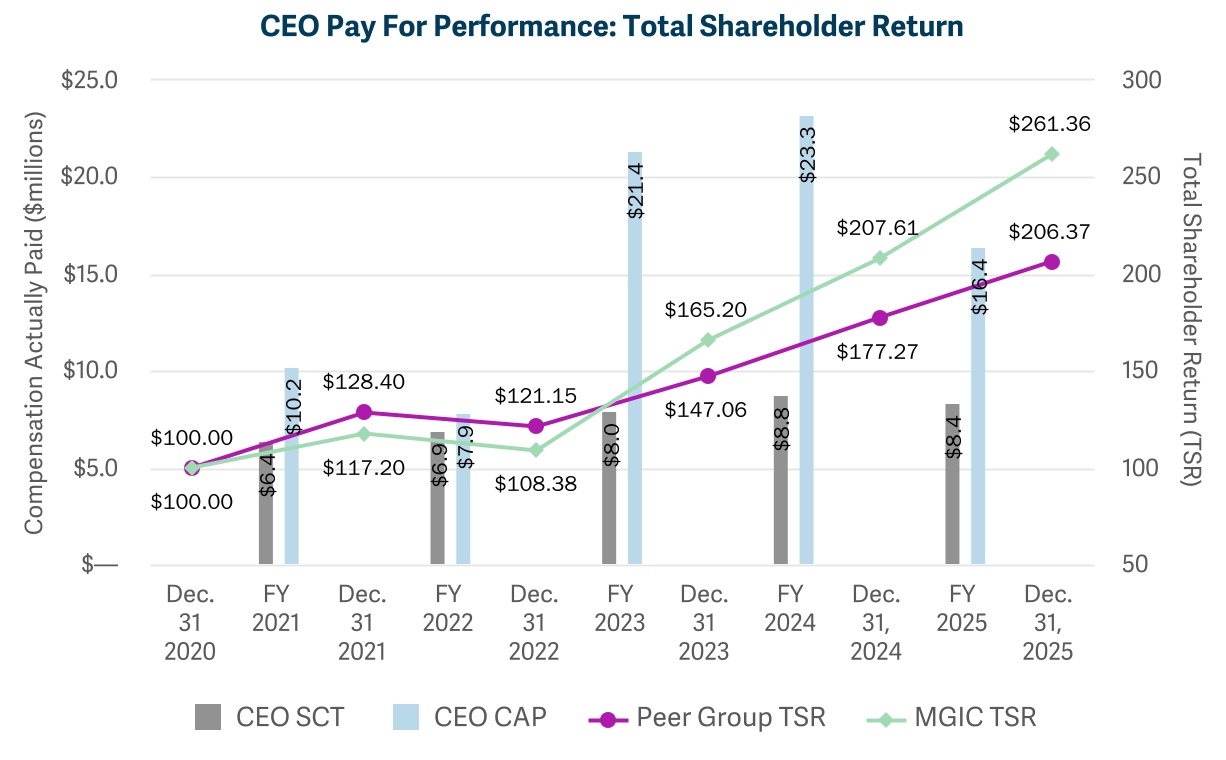
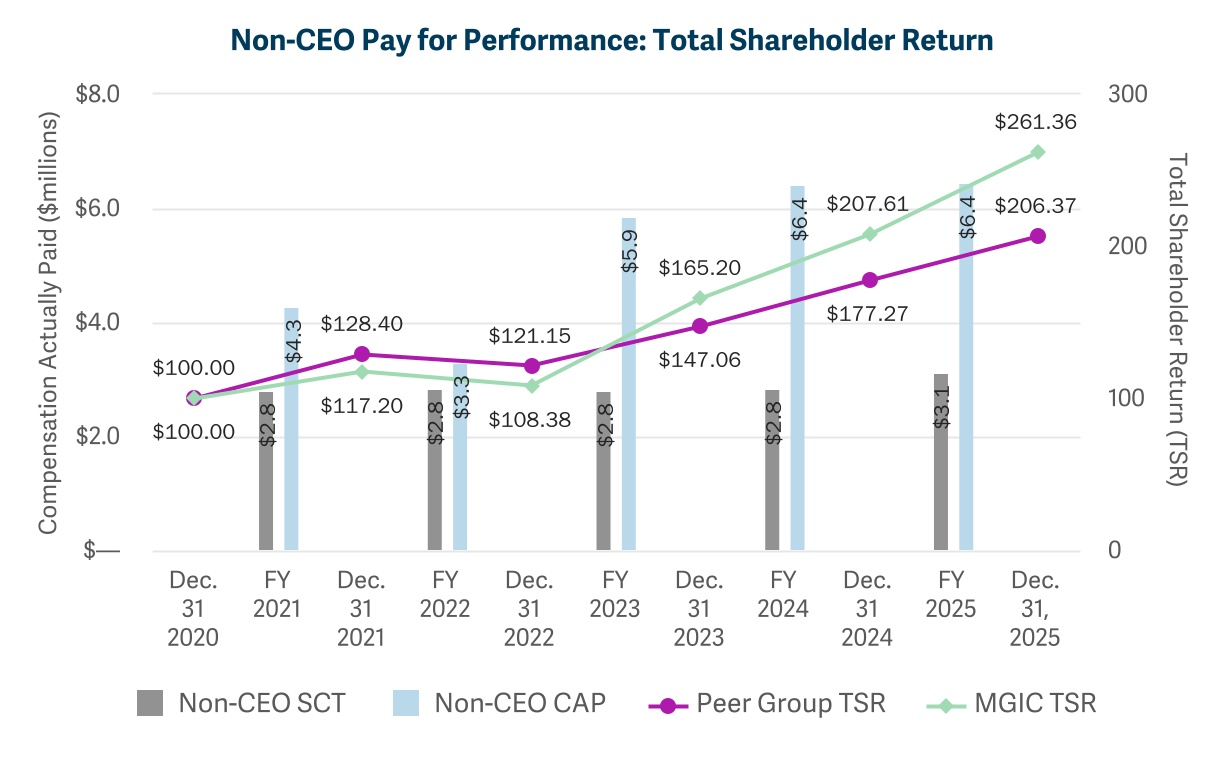
MGIC Investment Corporation – 2026 Proxy Statement │ 67
COMPENSATION AND RELATED TABLES
Relationship between CAP and GAAP Net Income. The graph below reflects the relationship between the CEO and average other NEO CAP and our GAAP Net Income. GAAP net income is not used as a metric in our annual or long-term incentive plans, but its value affects various metrics used to determine executive compensation.
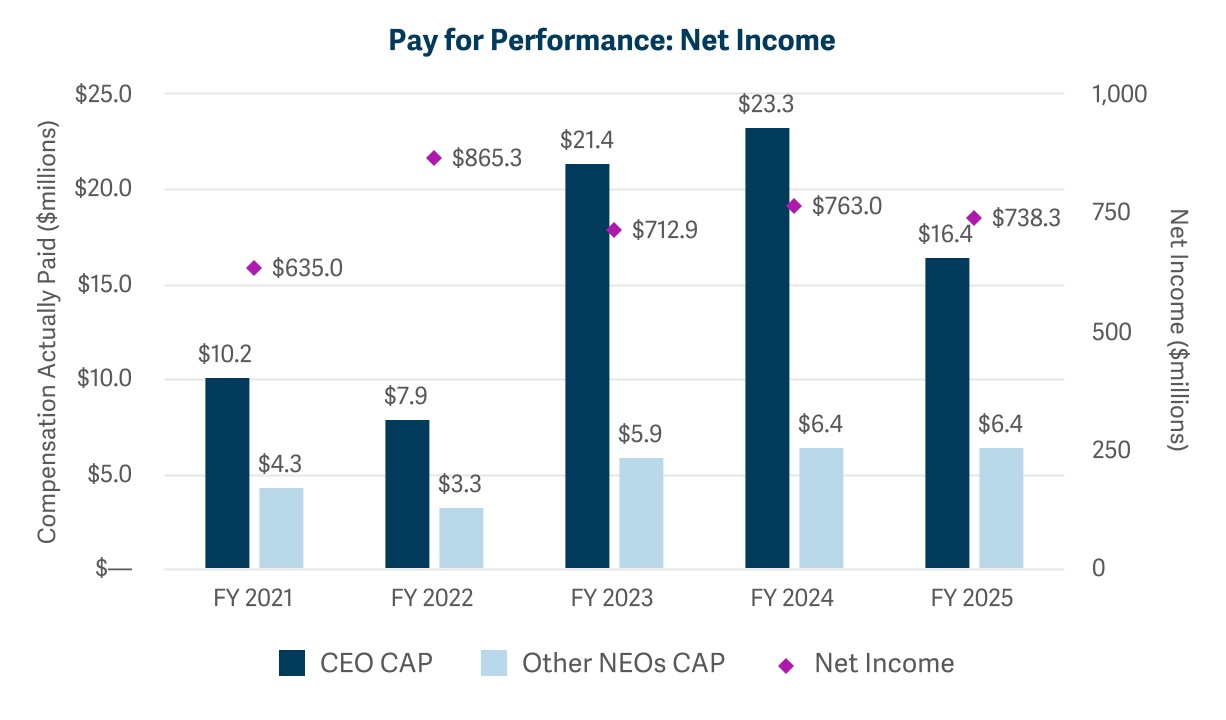
Relationship between CAP and Adjusted Book Value per Share Growth (our Company-Selected Measures). The graph below reflects the relationship between CEO and average other NEO CAP and Annual ABVS Growth. Cumulative ABVS Growth determines the number of performance-based restricted stock units that vest under our long-term equity awards granted under our executive compensation program, and it is an important driver of long-term shareholder value creation.
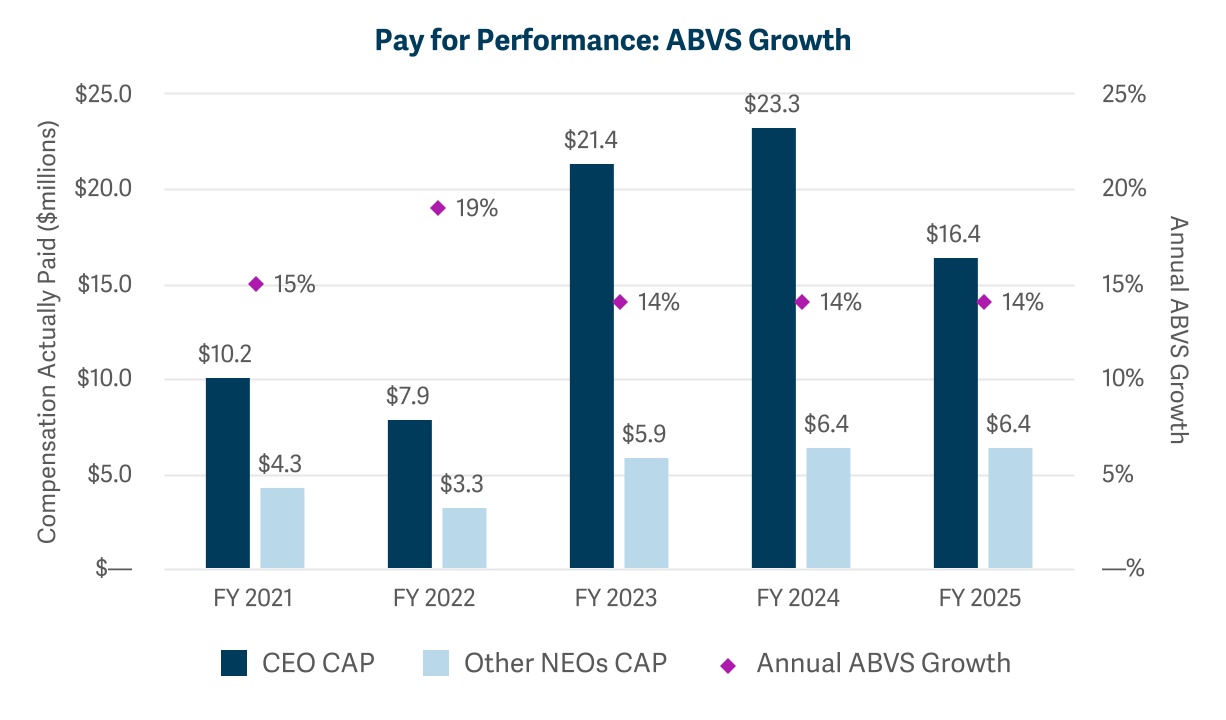
68 │ MGIC Investment Corporation – 2026 Proxy Statement
COMPENSATION AND RELATED TABLES
This disclosure has been prepared in accordance with Item 402(v) of Regulation S-K and does not necessarily reflect value actually realized by the executives or how our Committee evaluates compensation decisions in light of Company or individual performance. In particular, our Committee has not used CAP as a basis for making compensation decisions, nor has it used TSR or net income for purposes of determining incentive compensation. Additionally, as described above, Cumulative ABVS Growth is used to determine the number of performance-based restricted stock units that vest under our long-term equity awards granted under our executive compensation program.
Please refer to our CD&A for a discussion of our executive compensation program objectives and the ways in which we align executive compensation pay with performance.
The following table shows the performance measures considered most important for determining our 2025 executive compensation. The first four measures are financial performance measures and the fifth is non-financial.
| Performance Measure | ||
Cumulative adjusted book value per share growth is the sole measure by which vesting percentages of performance-based long-term equity awards are determined. ROE, NIW, and IIF are financial metrics, which along with our strategic performance objectives, are used to determine annual bonus percentages. For more information about each of these measures, please see "Annual Bonus" and "Long-Term Equity Awards" in our CD&A.
MGIC Investment Corporation – 2026 Proxy Statement │ 69
ITEM 3 - RATIFICATION OF INDEPENDENT REGISTERED PUBLIC ACCOUNTING FIRM
Item 3 – Ratification of Appointment of Independent Registered Public Accounting Firm
The Audit Committee has reappointed the accounting firm of PricewaterhouseCoopers LLP ("PwC") as our independent registered public accounting firm for the year ending December 31, 2026. As a matter of good corporate governance, the Board is seeking shareholder ratification of the appointment even though ratification is not legally required. If shareholders do not ratify this appointment, the Audit Committee will take this into consideration in its future selection of an independent registered public accounting firm. A representative of PwC is expected to attend the Annual Meeting and will be given an opportunity to make a statement and respond to appropriate questions.
Audit and Other Fees
For the years ended December 31, 2025 and 2024, PwC's fees for services were as shown in the table below.
2025 | 2024 | |||||||
| Audit Fees | $ | 2,455,000 | $ | 2,590,000 | ||||
| Audit-Related Fees | 65,000 | — | ||||||
| Tax Fees | 130,098 | 130,000 | ||||||
| All Other Fees | 2,000 | 2,000 | ||||||
| Total Fees | $ | 2,652,098 | $ | 2,722,000 | ||||
Audit Fees relate to PwC’s review of our quarterly financial statements, review of registration statements filed under the Securities Act of 1933, as amended, audit of our year-end financial statements and internal controls over financial reporting, and audits related to our statutory filings. Audit-Related Fees for 2025 relate to agreed upon procedures performed in connection with our excess of loss reinsurance transactions. Tax Fees relate to a review of our tax returns and a tax study. All Other Fees relate to subscriptions for an online checklist of disclosure requirements across different financial reporting frameworks.
The rules of the SEC regarding auditor independence provide that independence may be impaired if the auditor performs services without the pre-approval of the Audit Committee. The Audit Committee’s policy regarding pre-approval of audit and allowable non-audit services to be provided by the independent auditor includes a list of services that are pre-approved as they become necessary and requires the Audit Committee’s pre-approval of a schedule of other services expected to be performed during the ensuing year prior to the start of the annual audit engagement. If we desire the auditor to provide a service that is not in either category, the service may be presented for pre-approval by the Audit Committee at its next meeting or may be pre-approved by the Chairperson (or another member designated by the Audit Committee). The member approving the service will be given detail regarding the service equivalent to the detail that would be given to the Audit Committee, and the Audit Committee will be notified of the approved service at its next regularly scheduled meeting. We periodically provide the Audit Committee with information about fees paid for services that have been approved and pre-approved. The Audit Committee pre-approved all of the services that PwC provided in 2024 and 2025.
70 │ MGIC Investment Corporation – 2026 Proxy Statement
ITEM 3 - RATIFICATION OF INDEPENDENT REGISTERED PUBLIC ACCOUNTING FIRM
Shareholder Vote Required
The affirmative vote of a majority of the votes cast on this matter is required for the ratification of the appointment of PwC as our independent registered public accounting firm. Abstentions and broker non-votes, if any, will not be counted as votes cast.
| THE BOARD OF DIRECTORS RECOMMENDS A VOTE FOR RATIFICATION OF THE APPOINTMENT OF PWC AS OUR INDEPENDENT REGISTERED PUBLIC ACCOUNTING FIRM. SIGNED PROXY CARDS AND VOTING INSTRUCTION FORMS WILL BE VOTED FOR RATIFICATION UNLESS A SHAREHOLDER GIVES OTHER INSTRUCTIONS ON THE PROXY CARD OR VOTING INSTRUCTION FORM. | ||
Report of the Audit Committee
The Audit Committee assists the Board of Directors in the oversight by the Board of Directors of the integrity of MGIC Investment Corporation’s financial statements, the effectiveness of its system of internal controls, the qualifications, independence and performance of its independent accountants, the performance of its internal audit function, and its compliance with legal and regulatory requirements.
The Audit Committee reviewed and discussed with management and PricewaterhouseCoopers LLP ("PwC"), MGIC Investment Corporation’s independent registered public accounting firm, its audited financial statements for the year ended December 31, 2025. The Audit Committee discussed with PwC the matters required to be discussed by applicable requirements of the Public Company Accounting Oversight Board ("PCAOB") and the SEC. The Audit Committee also received the written disclosures and the letter from PwC required by applicable requirements of the PCAOB regarding auditor-audit committee communications about independence and discussed with PwC their independence from MGIC Investment Corporation and its management.
In reliance on the reviews and discussions referred to above, the Audit Committee recommended to the Board of Directors that MGIC Investment Corporation’s audited financial statements be included in its Annual Report on Form 10-K for the year ended December 31, 2025, which has been filed with the SEC. These are the same financial statements that appear in MGIC Investment Corporation’s Annual Report to Shareholders.
Members of the Audit Committee:
C. Edward Chaplin, Chair
Teresita M. Lowman
Daniela A. O'Leary-Gill
Sheryl L. Sculley
MGIC Investment Corporation – 2026 Proxy Statement │ 71
OTHER MATTERS
Other Matters
Stock Ownership Information
Security Ownership of Directors and Executive Officers
The following table shows the amount of our Common Stock beneficially owned by each of our directors, director nominees and NEOs, and by all directors and executive officers as a group, as of March 6, 2026. Unless otherwise noted, the persons listed in the table have sole voting and investment power over their shares.
| Name of Beneficial Owner | Common Stock Owned Directly | Common Stock Owned Indirectly1 | Restricted Stock and Common Stock Underlying RSUs2 | Total Number of Shares Beneficially Owned | Director Phantom Share Units3 | Restricted Stock Units4 | Total Shares Beneficially Owned Plus Underlying Units | Percent of Class5 | ||||||||||||||||||
| C. Edward Chaplin | 18,296 | — | — | 18,296 | 49,815 | 26,277 | 94,388 | * | ||||||||||||||||||
Curt S. Culver | 16,507 | 457,666 | — | 474,173 | — | 5,104 | 479,277 | * | ||||||||||||||||||
| Jay C. Hartzell | — | — | 10,086 | 10,086 | 19,637 | 25,141 | 54,864 | * | ||||||||||||||||||
Martin P. Klein | — | — | 1,339 | 1,339 | — | 5,104 | 6,443 | * | ||||||||||||||||||
| Jodeen A. Kozlak | 20,515 | — | 13,980 | 34,495 | 29,532 | — | 64,027 | * | ||||||||||||||||||
Teresita M. Lowman | 9 | — | 10,911 | 10,920 | — | 23,230 | 34,150 | * | ||||||||||||||||||
Daniela A. O'Leary-Gill | 1,332 | — | — | 1,332 | — | 5,104 | 6,436 | * | ||||||||||||||||||
| Sheryl L. Sculley | 11,453 | — | 18,467 | 29,920 | 19,637 | 5,104 | 54,661 | * | ||||||||||||||||||
Michael L. Thompson | 13,426 | — | — | 13,426 | — | 5,104 | 18,530 | * | ||||||||||||||||||
| Mark M. Zandi | 28,814 | — | — | 28,814 | 48,379 | 5,104 | 82,297 | * | ||||||||||||||||||
| Timothy M. Mattke | 1,112,169 | — | — | 1,112,169 | — | 668,876 | 1,781,045 | * | ||||||||||||||||||
| Salvatore A. Miosi | 546,875 | — | — | 546,875 | — | 260,034 | 806,909 | * | ||||||||||||||||||
| Nathaniel H. Colson | 321,504 | — | — | 321,504 | — | 186,813 | 508,317 | * | ||||||||||||||||||
| Paula C. Maggio | 162,300 | 110,422 | — | 272,722 | — | 131,897 | 404,619 | * | ||||||||||||||||||
All Directors and Executive Officers as a Group (14 Persons) | 2,253,200 | 433,998 | 54,783 | 2,876,071 | 167,000 | 1,352,889 | 4,395,963 | 1.34 | % | |||||||||||||||||
72 │ MGIC Investment Corporation – 2026 Proxy Statement
OTHER MATTERS
1 Includes: (a) Shares held by a family trust affiliated with Mr. Culver (323,576) and shares held by a trust affiliated with Ms. Maggio (110,422); and (b) 134,090 shares held by a Foundation for which Mr. Culver has no pecuniary interest but shares voting and dispositive power.
2 Includes: (a) Long-term Equity Awards granted to NEOs if such awards could be settled in shares of Common Stock within 60 days of the record date; and (b) Annual equity grants issued to each director and dividends reinvested on such shares, if such RSUs could be settled in shares of Common Stock within 60 days of the record date. No director has voting or investment power over the shares underlying these units.
3 Includes share equivalents held under our Deferred Compensation Plan for Non-Employee Directors (See “Compensation of Directors — Deferred Compensation Plan and Annual Grant of Share Units”) over which the directors have neither voting nor investment power. For all directors as a group — 167,000.
4 Represents shares underlying stock-settled RSUs that cannot be settled in Common Stock within 60 days of the record date. For all executive officers as a group — 1,247,620, for all directors as a group — 105,269.
5 As of March 6, 2026, no individual director or executive officer beneficially owned more than 1% of the Common Stock outstanding, and all directors and executive officers as a group beneficially owned 1.34% of the shares of Common Stock outstanding.
Security Ownership of Certain Beneficial Owners
The following table shows the amount of our Common Stock held by persons who were beneficial owners of more than 5% of our shares as of March 6, 2026, based on information filed with the SEC.
| Name | Shares Beneficially Owned | Percent of Class | ||||||
The Vanguard Group, Inc.1 100 Vanguard Boulevard, Malvern, PA 19355 | 38,899,017 | 18.1% | ||||||
BlackRock, Inc.2 50 Hudson Yards, New York, NY 10001 | 21,404,266 | 10.0% | ||||||
JPMorgan Chase & Co.3 383 Madison Avenue, New York, NY 10179 | 18,111,064 | 8.4% | ||||||
Dimensional Fund Advisors LP4 6300 Bee Cave Road, Building 1, Austin, TX 78746 | 14,412,658 | 6.7% | ||||||
AQR Capital Management, LLC5 1 Greenwich Plaza, Suite 130, Greenwich, Connecticut 06830 | 11,616,282 | 5.4% | ||||||
| 1 | The Vanguard Group, Inc. reported ownership as of December 29, 2023. It reported that it had sole dispositive power for 38,406,398 shares and shared dispositive power for 492,619 shares. It further reported that it had sole voting power for no shares and shared voting power for 187,763 shares. | ||||
| 2 | BlackRock, Inc. reported ownership as of June 30, 2025, on behalf of itself and certain subsidiaries. It reported that it had sole dispositive power for 21,404,266 shares and shared dispositive power for no shares. It further reported that it had sole voting power for 20,558,945 shares and shared voting power for no shares. | ||||
| 3 | JPMorgan Chase & Co. reported ownership as of June 30, 2025, on behalf of itself and certain subsidiaries. It reported that it had sole dispositive power for 18,072,928 shares and shared dispositive power for 12,463 shares. It further reported that it had sole voting power for 16,927,029 shares and shared voting power for no shares. | ||||
| 4 | Dimensional Fund Advisors reported ownership as of December 29, 2023. It reported that it had shared dispositive power for no shares and sole dispositive power for 14,412,658 shares. It further reported that it had shared voting power for no shares and sole voting power for 14,326,017 shares. | ||||
| 5 | AQR Capital Management, LLC reported ownership as of December 31, 2025. It reported that it had shared dispositive power for 11,616,282 shares and sole dispositive power for 0 shares. It further reported that it had shared voting power for 11,616,282 and sole voting power for 0 shares. | ||||
MGIC Investment Corporation – 2026 Proxy Statement │ 73
OTHER MATTERS
About the Meeting and the Proxy Materials
What is the purpose of the Annual Meeting?
At our Annual Meeting, shareholders will act on the matters outlined in our Notice of Annual Meeting preceding the Table of Contents, including election of the ten directors named in the Proxy Statement, an advisory vote to approve our executive compensation, ratification of the appointment of PricewaterhouseCoopers LLP as our independent registered public accounting firm for 2026, and any other matters that properly come before the meeting.
Where will the meeting be held?
The 2026 Annual Meeting will be held entirely online via webcast. While you will not be able to attend the meeting at a physical location, we are committed to ensuring that shareholders will be afforded the same rights and opportunities to participate as they would at an in-person meeting. You will be able to attend the meeting online, vote your shares electronically and submit questions during the virtual annual meeting. We are excited to provide expanded access, allowing shareholders to participate from any location, at no cost to them.
How do I attend the meeting?
There will be no physical location for the 2026 Annual Meeting. To attend the virtual meeting, please visit www.virtualshareholdermeeting.com/MTG2026. Online access for the meeting will begin at 8:45 a.m. Central time on April 23, 2026. The virtual meeting will begin promptly at 9:00 a.m. Central time on April 23, 2026. To participate in the meeting, you will need to enter the 16-digit control number that appears on your voting instruction form or proxy card, or follow the other instructions provided on the voting instruction form for attending the meeting.
How do I submit questions for the meeting?
During the meeting, shareholders may ask questions by visiting www.virtualshareholdermeeting.com/MTG2026, entering their control number as described above, and clicking the “Q&A” button once in the meeting. We intend to answer all questions submitted that are pertinent to the business of the meeting, as time permits and in accordance with our meeting procedures. We will post all such questions and their answers on our Investor Relations website for a period of 30 days after our meeting.
What if I experience technical difficulties entering the meeting?
Online access to the virtual meeting will open at 8:45 a.m. Central time, 15 minutes prior to the start of the meeting, to allow time for you to log in and test your computer audio system. We encourage you to access the meeting prior to the start time. A technical support telephone number will be available on the registration page at www.virtualshareholdermeeting.com/MTG2026.
Who is entitled to vote at the meeting?
Only shareholders of record at the close of business on March 6, 2026, the record date for the meeting, are entitled to receive notice of and to participate in the Annual Meeting. For each share of Common Stock for which you were shareholder of record on that date, you are entitled to one vote on each matter considered at the meeting. On the record date, 215,094,659 shares of Common Stock were entitled to vote.
74 │ MGIC Investment Corporation – 2026 Proxy Statement
OTHER MATTERS
What is a proxy?
A proxy is another person you legally designate to vote your shares. If you designate someone as your proxy in a written document, that document is also called a proxy or a proxy card.
How do I vote my shares?
“Street Name” Holders: If you hold your shares in “street name,” meaning your shares are held in a stock brokerage account or by a bank or other nominee, your broker, bank or nominee has enclosed or provided a voting instruction form for you to use to direct the broker, bank or nominee how to vote your shares. Some of these institutions offer telephone and online voting. If you attend the Annual Meeting, you may withdraw your proxy and vote your shares at the meeting.
Shareholders of Record: If you are a shareholder of record, meaning your shares are registered directly in your name with our stock transfer agent, Equiniti Trust Company, LLC (formerly known as American Stock Transfer & Trust Company, LLC), you may vote your shares in one of three ways:
•By Telephone — Call toll-free 1-800-690-6903 and follow the instructions. Have your proxy card available when you call.
•Online — Access www.proxyvote.com and follow the on-screen instructions. Have your proxy card available when you access the web page.
•By Mail — You may submit a proxy by completing, signing and dating your proxy card and mailing it in the accompanying pre-addressed envelope.
If you attend the Annual Meeting, you may withdraw your proxy and vote your shares at the meeting.
Please contact our Investor Relations personnel at (414) 347-2635 if you would like information about attending the virtual Annual Meeting and voting at the meeting.
Can I change my vote after I return my proxy card?
Yes. If you are a shareholder of record, you can revoke your proxy by advising our corporate Secretary in a writing that is received by her at any time before your shares are voted, by providing a new proxy with a later date, or by voting at the Annual Meeting. If your shares are held in street name by a broker, bank or nominee, you must follow the instructions of the broker, bank, nominee or plan trustee on how to change your vote.
If you are a shareholder of record or your shares are held in street name by a broker, bank or nominee, and if you attend the Annual Meeting, you may withdraw your proxy and vote your shares at the meeting.
How are the votes counted?
A quorum is necessary to hold the meeting and will exist if a majority of the 215,094,659 shares of Common Stock entitled to vote as of the record date are represented, in person or by proxy, at the meeting. Votes cast by proxy or in person at the meeting will be counted by Broadridge Financial Solutions, Inc., which has been appointed by our Board to act as inspector of election for the meeting. All shares voted by proxy are counted as present for purposes of establishing a quorum, including those that abstain or as to which the proxies contain “broker non-votes” as to one or more items.
“Broker non-votes” occur when a broker or other nominee does not vote on a particular matter because the broker or other nominee does not have authority to vote without instructions from the beneficial owner of the shares and has not received such instructions. Broker non-votes will not be counted as votes for or against any matter. Brokers and other nominees have discretionary authority to vote shares without instructions from the beneficial owner of the shares only for matters considered routine. For the
MGIC Investment Corporation – 2026 Proxy Statement │ 75
OTHER MATTERS
2026 Annual Meeting, brokers and other nominees will only have discretionary authority to vote shares on the ratification of the appointment of the independent registered public accounting firm without instructions from the beneficial owner.
What are the Board’s recommendations?
Our Board of Directors recommends a vote FOR all of the nominees for director (Item 1), FOR approval of our executive compensation (Item 2), and FOR ratification of the appointment of PricewaterhouseCoopers LLP as our independent registered public accounting firm for 2026 (Item 3).
If you sign and return a proxy card or voting instruction form without specifying how you want your shares voted, the named proxies will vote your shares in accordance with the recommendations of the Board for all Items and in their best judgment on any other matters that properly come before the meeting.
Will any other items be acted upon at the Annual Meeting?
The Board does not know of any other business to be presented at the Annual Meeting. No shareholder proposals will be presented at this year’s Annual Meeting.
What are the deadlines for submission of shareholder proposals, or for nominating or recommending a director candidate for nomination, for the next Annual Meeting?
Shareholders may submit proposals on matters appropriate for shareholder action at future Annual Meetings by following the SEC’s rules. Proposals intended for inclusion in next year’s proxy materials must be received by our Secretary no later than November 20, 2026. Additionally, shareholders may recommend a director candidate for consideration by the MDNG Committee by submitting background information about the candidate, a description of his or her qualifications and the candidate’s consent to being recommended as a candidate. If the candidate is to be considered for nomination at the next annual shareholder meeting, the submission must be received by our Corporate Secretary in writing no later than November 20, 2026.
Under our Bylaws, a shareholder who wants to bring business before the Annual Meeting that has not been included in the proxy materials for the meeting, or who wants to nominate directors at the meeting, must be eligible to vote at the meeting and give written notice of the proposal to our corporate Secretary in accordance with the SEC rules and the procedures contained in our Bylaws. For the 2027 Annual Meeting, the notice must be received by the Secretary no later than February 2, 2027, and no earlier than January 8, 2027. The notice must describe the proposal and why it should be approved, identify any material interest of the shareholder in the matter, and include other information required by our Bylaws.
Who pays to prepare, mail and solicit the proxies?
We will pay the cost of soliciting proxies. In addition to soliciting proxies by mail, our employees may solicit proxies by telephone, email, facsimile or personal interview. We have also engaged D.F. King & Co., Inc. to provide proxy solicitation services for a fee of $16,000, plus certain expenses, if any.
76 │ MGIC Investment Corporation – 2026 Proxy Statement
OTHER MATTERS
Householding
The broker, bank or other nominee for any shareholder who holds shares in “street name” and is not a shareholder of record may deliver only one copy of this Proxy Statement and the Annual Report to Shareholders to multiple shareholders who share the same address, unless that broker, bank or other nominee has received contrary instructions from one or more of the shareholders. We will deliver promptly, upon written or oral request, a separate copy of this Proxy Statement and the Annual Report to Shareholders to a shareholder at a shared address to which a single copy of the document was delivered. A shareholder who wishes to receive a separate copy of the Proxy Statement and Annual Report to Shareholders, now or in the future, should submit a request to MGIC by telephone at (414) 347-2635 or by submitting a written request to Investor Relations, MGIC Investment Corporation, P.O. Box 488, Milwaukee, WI 53201. Beneficial owners sharing an address who are receiving multiple copies of the Proxy Statement and Annual Report to Shareholders and wish to receive a single copy of such materials in the future will need to contact their broker, bank or other nominee to request that only a single copy be mailed to all shareholders at the shared address in the future.
MGIC Investment Corporation – 2026 Proxy Statement │ 77
APPENDIX A — GLOSSARY
Glossary of Terms and Acronyms
| Term | Description | ||||
ABV | Adjusted Book Value | ||||
ABVS | Adjusted Book Value per Share | ||||
| ASC | Accounting Standards Codification | ||||
| Benchmarking Peers | The peer group used by the MDNG Committee to benchmark executive compensation | ||||
BT&T | The Business Technology & Transformation Committee of our Board | ||||
Bylaws | Our Amended and Restated Bylaws | ||||
CAP | Compensation Actually Paid | ||||
| CD&A | Compensation Discussion & Analysis | ||||
CEO | Chief Executive Officer | ||||
CFO | Chief Financial Officer | ||||
COO | Chief Operating Officer | ||||
| Common Stock | Common stock of the Company | ||||
| Compensation Consultant | Frederic W. Cook & Co., the MDNG Committee’s independent compensation consultant | ||||
ERM | Enterprise Risk Management | ||||
| EVP | Executive Vice President | ||||
| FASB | Financial Accounting Standards Board | ||||
| GAAP | Generally Accepted Accounting Principles in the United States | ||||
GSEs | Fannie Mae and Freddie Mac | ||||
IIF | Insurance in Force | ||||
KEESA | Key Executive Employment and Severance Agreement | ||||
MDNG Committee | The Management Development, Nominating and Governance Committee of our Board | ||||
| MGIC | Our wholly-owned subsidiary, Mortgage Guaranty Insurance Corporation | ||||
| Named Executive Officers | Our chief executive officer, our chief financial officer and our other most highly compensated executive officers (up to three) serving on the last day of the most recent fiscal year. The NEOs are the officers listed in the SCT | ||||
| NEOs | Named Executive Officers | ||||
| NIW | New Insurance Written | ||||
| NYSE | New York Stock Exchange | ||||
Options | Stock Options | ||||
Plan | MGIC Investment Corporation 2025 Omnibus Incentive Plan | ||||
| PwC | PricewaterhouseCoopers LLP | ||||
| ROE | Return on Equity | ||||
| RSUs | Restricted Stock Units | ||||
| SCT | Summary Compensation Table that appears on page 53 | ||||
| SEC | Securities and Exchange Commission | ||||
| SERP | Supplemental Executive Retirement Plan | ||||
SMOC | The Senior Management Oversight Committee, which serves as the primary business, operations, strategy and risk management committee at the management level | ||||
Severance Plan | Our Executive Severance Plan | ||||
TSR | Total Shareholder Return | ||||
| TDC | Total direct compensation, which consists of base salary, bonus (or non-equity incentive compensation) and equity awards (valued at their grant date value reported in the SCT) | ||||
A - 1 │ MGIC Investment Corporation – 2026 Proxy Statement
APPENDIX B — EXPLANATION AND RECONCILIATION OF NON-GAAP MEASURES
Explanation and Reconciliation of Our Use of Non-GAAP Financial Measures
Non-GAAP Financial Measures
We believe that use of the Non-GAAP measures of adjusted pre-tax operating income (loss), adjusted net operating income (loss) and adjusted net operating income (loss) per diluted share facilitate the evaluation of the company's core financial performance thereby providing relevant information to investors. These measures are not recognized in accordance with GAAP and should not be viewed as alternatives to GAAP measures of performance.
Adjusted pre-tax operating income (loss) is defined as GAAP income (loss) before tax, excluding the effects of net realized investment gains (losses), gain and losses on debt extinguishment, and infrequent or unusual non-operating items, where applicable.
Adjusted net operating income (loss) is defined as GAAP net income (loss) excluding the after-tax effects of net realized investment gains (losses), gain and losses on debt extinguishment, and infrequent or unusual non-operating items, where applicable. The amounts of adjustments to components of pre-tax operating income (loss) are tax effected using a federal statutory tax rate of 21%.
Adjusted net operating income (loss) per diluted share is calculated in a manner consistent with the accounting standard regarding earnings per share, by dividing (i) adjusted net operating income (loss) after making adjustments for interest expense on convertible debt, whenever the impact is dilutive, by (ii) diluted weighted average common shares outstanding, which reflects share dilution from unvested restricted stock units and from convertible debt when dilutive under the "if-converted" method.
Although adjusted pre-tax operating income (loss) and adjusted net operating income (loss) exclude certain items that have occurred in the past and are expected to occur in the future, the excluded items represent items that are: (1) not viewed as part of the operating performance of our primary activities; or (2) impacted by both discretionary and other economic or regulatory factors and are not necessarily indicative of operating trends, or both. These adjustments, along with the reasons for their treatment, are described below. Trends in the profitability of our fundamental operating activities can be more clearly identified without the fluctuations of these adjustments. Other companies may calculate these measures differently. Therefore, their measures may not be comparable to those used by us.
(1)Net realized investment gains (losses). The recognition of net realized investment gains or losses can vary significantly across periods as the timing of individual securities sales is highly discretionary and is influenced by such factors as market opportunities, our tax and capital profile, and overall market cycles.
(2)Gains and losses on debt extinguishment. Gains and losses on debt extinguishment result from discretionary activities that are undertaken to enhance our capital position, improve our debt profile, and/or reduce potential dilution from our outstanding convertible debt.
(3)Infrequent or unusual non-operating items. Items that are non-recurring in nature and are not part of our primary operating activities.
MGIC Investment Corporation – 2026 Proxy Statement │ B - 1
APPENDIX B — EXPLANATION AND RECONCILIATION OF NON-GAAP MEASURES
Non-GAAP reconciliations | ||||||||||||||||||||||||||||||||||||||||||||||||||||||||
Reconciliation of Income before tax / Net income to Adjusted pre-tax operating income / Adjusted net operating income: | ||||||||||||||||||||||||||||||||||||||||||||||||||||||||
| Years Ended December 31, | ||||||||||||||||||||||||||||||||||||||||||||||||||||||||
2025 | 2024 | 2023 | ||||||||||||||||||||||||||||||||||||||||||||||||||||||
| (in thousands) | Pre-tax | Tax Effect | Net (after-tax) | Pre-tax | Tax Effect | Net (after-tax) | Pre-tax | Tax Effect | Net (after-tax) | |||||||||||||||||||||||||||||||||||||||||||||||
| Income before tax / Net income | $ | 928,537 | $ | 190,190 | $ | 738,347 | $ | 968,709 | $ | 205,715 | $ | 762,994 | $ | 902,229 | $ | 189,280 | $ | 712,949 | ||||||||||||||||||||||||||||||||||||||
| Adjustments: | ||||||||||||||||||||||||||||||||||||||||||||||||||||||||
| Net realized investment (gains) losses | 75 | 16 | 59 | 6,914 | 1,452 | 5,462 | 14,549 | 3,055 | 11,494 | |||||||||||||||||||||||||||||||||||||||||||||||
| Adjusted pre-tax operating income / Adjusted net operating income | $ | 928,612 | $ | 190,206 | $ | 738,406 | $ | 975,623 | $ | 207,167 | $ | 768,456 | $ | 916,778 | $ | 192,335 | $ | 724,443 | ||||||||||||||||||||||||||||||||||||||
| Reconciliation of Net income per diluted share to Adjusted net operating income per diluted share: | ||||||||||||||||||||||||||||||||||||||||||||||||||||||||
| Years Ended December 31, | ||||||||||||||||||||||||||||||||||||||||||||||||||||||||
| 2025 | 2024 | 2023 | ||||||||||||||||||||||||||||||||||||||||||||||||||||||
Weighted average diluted shares outstanding (in thousands) | 235,099 | 263,995 | 287,155 | |||||||||||||||||||||||||||||||||||||||||||||||||||||
| Net income per diluted share | $ | 3.14 | $ | 2.89 | $ | 2.49 | ||||||||||||||||||||||||||||||||||||||||||||||||||
| Net realized investment (gains) losses | — | 0.02 | 0.04 | |||||||||||||||||||||||||||||||||||||||||||||||||||||
| Adjusted net operating income per diluted share | $ | 3.14 | $ | 2.91 | $ | 2.53 | ||||||||||||||||||||||||||||||||||||||||||||||||||
B - 2 │ MGIC Investment Corporation – 2026 Proxy Statement
APPENDIX B — EXPLANATION AND RECONCILIATION OF NON-GAAP MEASURES
Non-GAAP reconciliations | ||||||||||||||||||||||||||||||||||||||||||||||||||||||||
Reconciliation of Income before tax / Net income to Adjusted pre-tax operating income / Adjusted net operating income: | ||||||||||||||||||||||||||||||||||||||||||||||||||||||||
| Years Ended December 31, | ||||||||||||||||||||||||||||||||||||||||||||||||||||||||
2022 | 2021 | 2020 | ||||||||||||||||||||||||||||||||||||||||||||||||||||||
| (in thousands) | Pre-tax | Tax Effect | Net (after-tax) | Pre-tax | Tax Effect | Net (after-tax) | Pre-tax | Tax Effect | Net (after-tax) | |||||||||||||||||||||||||||||||||||||||||||||||
| Income before tax / Net income | $ | 1,090,034 | $ | 224,685 | $ | 865,349 | $ | 801,777 | $ | 166,794 | $ | 634,983 | $ | 559,263 | $ | 113,170 | $ | 446,093 | ||||||||||||||||||||||||||||||||||||||
| Adjustments: | ||||||||||||||||||||||||||||||||||||||||||||||||||||||||
| Net realized investment (gains) losses | 9,745 | 2,046 | 7,699 | (7,009) | (1,472) | (5,537) | (13,245) | (2,781) | (10,464) | |||||||||||||||||||||||||||||||||||||||||||||||
| Loss on debt extinguishment | 40,199 | 8,442 | 31,757 | 36,914 | 7,752 | 29,162 | 26,736 | 5,615 | 21,121 | |||||||||||||||||||||||||||||||||||||||||||||||
| Adjusted pre-tax operating income / Adjusted net operating income | $ | 1,139,978 | $ | 235,173 | $ | 904,805 | $ | 831,682 | $ | 173,074 | $ | 658,608 | $ | 572,754 | $ | 116,004 | $ | 456,750 | ||||||||||||||||||||||||||||||||||||||
| Reconciliation of Net income per diluted share to Adjusted net operating income per diluted share: | ||||||||||||||||||||||||||||||||||||||||||||||||||||||||
| Years Ended December 31, | ||||||||||||||||||||||||||||||||||||||||||||||||||||||||
| 2022 | 2021 | 2020 | ||||||||||||||||||||||||||||||||||||||||||||||||||||||
Weighted average diluted shares outstanding (in thousands) | 311,229 | 351,308 | 359,293 | |||||||||||||||||||||||||||||||||||||||||||||||||||||
| Net income per diluted share | $ | 2.79 | $ | 1.85 | $ | 1.29 | ||||||||||||||||||||||||||||||||||||||||||||||||||
| Net realized investment (gains) losses | — | (0.02) | (0.03) | |||||||||||||||||||||||||||||||||||||||||||||||||||||
| Loss on debt extinguishment | 0.10 | 0.08 | 0.06 | |||||||||||||||||||||||||||||||||||||||||||||||||||||
Adjusted net operating income per diluted share (1) | $ | 2.91 | $ | 1.91 | $ | 1.32 | ||||||||||||||||||||||||||||||||||||||||||||||||||
MGIC Investment Corporation – 2026 Proxy Statement │ B - 3
APPENDIX B — EXPLANATION AND RECONCILIATION OF NON-GAAP MEASURES
Reconciliation of Book Value per Share to Adjusted Book Value (ABV) per Share
Following is the reconciliation of book value per share to ABV per share used in determining vesting of each of the 2025, 2024 and 2023 equity awards.
Reconciliation of Book Value per Share to Adjusted Book Value per Share for 2025 Equity Awards | ||||||||||||||
| (In thousands, except per share amounts) | 2025 | 2024 | ||||||||||||
| Shareholders' Equity (Book Value) | $ | 5,147,551 | $ | 5,172,375 | ||||||||||
| Divided by Shares Outstanding | 219,367 | 248,449 | ||||||||||||
| Book Value per Share | $ | 23.47 | $ | 20.82 | ||||||||||
| Adjusted Book Value for 2025 Equity Awards (from below) | $ | 6,199,010 | $ | 5,460,537 | ||||||||||
| Divided by Shares Outstanding (from below) | 248,449 | 248,449 | ||||||||||||
| Adjusted Book Value per Share for 2025 Equity Awards | $ | 24.95 | $ | 21.98 | ||||||||||
| Shareholders' Equity (Book Value) | $ | 5,147,551 | $ | 5,172,375 | ||||||||||
| Common Stock Repurchases | 789,577 | — | ||||||||||||
| Dividends | 132,771 | — | ||||||||||||
| Share-Based Compensation Program | (5,283) | — | ||||||||||||
| Accumulated Other Comprehensive (Income) Loss | 134,394 | 288,162 | ||||||||||||
| Adjusted Book Value for 2025 Equity Awards | $ | 6,199,010 | $ | 5,460,537 | ||||||||||
| Shares Outstanding | 219,367 | 248,449 | ||||||||||||
| Common Stock Repurchases | 30,139 | — | ||||||||||||
| Share-Based Compensation Program | (1,057) | — | ||||||||||||
| Adjusted Shares Outstanding | 248,449 | 248,449 | ||||||||||||
The grant documents and the Omnibus Incentive Plan for the 2025 equity awards provide for certain specific eliminations in arriving at adjusted book value per share, as follows:
•Accumulated Other Comprehensive Income (Loss)
•Certain Litigation Settlements / Judgments
•Repurchases of Common Stock
•Repurchases of Debt
•Adjustments for Changes in Tax Laws
•Adjustments for Changes in Accounting Principle
•Dividends
•Share-Based Compensation Programs
In addition, the Omnibus Incentive Plan allows the MDNG Committee to revise the performance goals if significant events occur during a performance period that the MDNG Committee expects will have a substantial effect on the performance goals.
B - 4 │ MGIC Investment Corporation – 2026 Proxy Statement
APPENDIX B — EXPLANATION AND RECONCILIATION OF NON-GAAP MEASURES
Reconciliation of Book Value per Share to Adjusted Book Value per Share for 2024 Equity Awards | ||||||||||||||||||||
| (In thousands, except per share amounts) | 2025 | 2024 | 2023 | |||||||||||||||||
| Shareholders' Equity (Book Value) | $ | 5,147,551 | $ | 5,172,375 | $ | 5,072,017 | ||||||||||||||
| Divided by Shares Outstanding | 219,367 | 248,449 | 272,494 | |||||||||||||||||
| Book Value per Share | $ | 23.47 | $ | 20.82 | $ | 18.61 | ||||||||||||||
| Adjusted Book Value for 2024 Equity Awards (from below) | $ | 6,889,908 | $ | 6,151,435 | $ | 5,388,298 | ||||||||||||||
| Divided by Shares Outstanding (from below) | 272,494 | 272,494 | 272,494 | |||||||||||||||||
| Adjusted Book Value per Share for 2024 Equity Awards | $ | 25.28 | $ | 22.57 | $ | 19.77 | ||||||||||||||
| Shareholders' Equity (Book Value) | $ | 5,147,551 | $ | 5,172,375 | $ | 5,072,017 | ||||||||||||||
| Common Stock Repurchases | 1,361,548 | 571,971 | — | |||||||||||||||||
| Dividends | 263,956 | 131,185 | — | |||||||||||||||||
| Share-Based Compensation Program | (17,541) | (12,258) | — | |||||||||||||||||
| Accumulated Other Comprehensive (Income) Loss | 134,394 | 288,162 | 316,281 | |||||||||||||||||
| Adjusted Book Value for 2024 Equity Awards | $ | 6,889,908 | $ | 6,151,435 | $ | 5,388,298 | ||||||||||||||
| Shares Outstanding | 219,367 | 248,449 | 272,494 | |||||||||||||||||
| Common Stock Repurchases | 55,410 | 25,271 | — | |||||||||||||||||
| Share-Based Compensation Program | (2,283) | (1,226) | — | |||||||||||||||||
| Adjusted Shares Outstanding | 272,494 | 272,494 | 272,494 | |||||||||||||||||
Reconciliation of Book Value per Share to Adjusted Book Value per Share for 2023 Equity Awards | ||||||||||||||||||||||||||
| (In thousands, except per share amounts) | 2025 | 2024 | 2023 | 2022 | ||||||||||||||||||||||
| Shareholders' Equity (Book Value) | $ | 5,147,551 | $ | 5,172,375 | $ | 5,072,017 | $ | 4,642,740 | ||||||||||||||||||
| Divided by Shares Outstanding | 219,367 | 248,449 | 272,494 | 293,433 | ||||||||||||||||||||||
| Book Value per Share | $ | 23.47 | $ | 20.82 | $ | 18.61 | $ | 15.82 | ||||||||||||||||||
| Adjusted Book Value for 2023 Equity Awards (from below) | 7,375,529 | $ | 6,631,773 | $ | 5,856,378 | $ | 5,124,251 | |||||||||||||||||||
| Divided by Adjusted Shares Outstanding (from below) | 296,450 | 295,393 | 294,167 | 293,433 | ||||||||||||||||||||||
| Adjusted Book Value per Share for 2023 Equity Awards | $ | 24.88 | $ | 22.45 | $ | 19.91 | $ | 17.46 | ||||||||||||||||||
| Shareholders' Equity (Book Value) | $ | 5,147,551 | $ | 5,172,375 | $ | 5,072,017 | $ | 4,642,740 | ||||||||||||||||||
| Common Stock Repurchases | 1,705,367 | 915,790 | 343,819 | — | ||||||||||||||||||||||
| Dividends | 388,217 | 255,446 | 124,261 | — | ||||||||||||||||||||||
| Accumulated Other Comprehensive (Income) Loss | 134,394 | 288,162 | 316,281 | 481,511 | ||||||||||||||||||||||
| Adjusted Book Value for 2023 Equity Awards | $ | 7,375,529 | $ | 6,631,773 | $ | 5,856,378 | $ | 5,124,251 | ||||||||||||||||||
| Shares Outstanding | 219,367 | 248,449 | 272,494 | 293,433 | ||||||||||||||||||||||
| Common Stock Repurchases | 77,083 | 46,944 | 21,673 | — | ||||||||||||||||||||||
| Adjusted Shares Outstanding | 296,450 | 295,393 | 294,167 | 293,433 | ||||||||||||||||||||||
MGIC Investment Corporation – 2026 Proxy Statement │ B - 5
APPENDIX B — EXPLANATION AND RECONCILIATION OF NON-GAAP MEASURES
Reconciliation of Book Value per Share to Adjusted Book Value (ABV) per Share
Following is the reconciliation of book value per share to ABV per share as shown in the Pay Versus Performance Table.
Reconciliation of Book Value per Share to Adjusted Book Value per Share for 2025 Equity Awards | ||||||||||||||
| (In thousands, except per share amounts) | 2025 | 2024 | ||||||||||||
| Shareholders' Equity (Book Value) | $ | 5,147,551 | $ | 5,172,375 | ||||||||||
| Divided by Shares Outstanding | 219,367 | 248,449 | ||||||||||||
| Book Value per Share | $ | 23.47 | $ | 20.82 | ||||||||||
| Adjusted Book Value for 2025 Equity Awards (from below) | $ | 6,199,010 | $ | 5,460,537 | ||||||||||
| Divided by Shares Outstanding (from below) | 248,449 | 248,449 | ||||||||||||
| Adjusted Book Value per Share for 2025 Equity Awards | $ | 24.95 | $ | 21.98 | ||||||||||
| Shareholders' Equity (Book Value) | $ | 5,147,551 | $ | 5,172,375 | ||||||||||
| Common Stock Repurchases | 789,577 | — | ||||||||||||
| Dividends | 132,771 | — | ||||||||||||
| Share-Based Compensation Program | (5,283) | — | ||||||||||||
| Accumulated Other Comprehensive (Income) Loss | 134,394 | 288,162 | ||||||||||||
| Adjusted Book Value for 2025 Equity Awards | $ | 6,199,010 | $ | 5,460,537 | ||||||||||
| Shares Outstanding | 219,367 | 248,449 | ||||||||||||
| Common Stock Repurchases | 30,139 | — | ||||||||||||
| Share-Based Compensation Program | (1,057) | — | ||||||||||||
| Adjusted Shares Outstanding | 248,449 | 248,449 | ||||||||||||
The grant documents and the Omnibus Incentive Plan for the 2025 equity awards provide for certain specific eliminations in arriving at adjusted book value per share, as follows:
•Accumulated Other Comprehensive Income (Loss)
•Certain Litigation Settlements / Judgments
•Repurchases of Common Stock
•Repurchases of Debt
•Adjustments for Changes in Tax Laws
•Adjustments for Changes in Accounting Principle
•Dividends
•Share-Based Compensation Programs
In addition, the Omnibus Incentive Plan allows the MDNG Committee to revise the performance goals if significant events occur during a performance period that the MDNG Committee expects will have a substantial effect on the performance goals.
B - 6 │ MGIC Investment Corporation – 2026 Proxy Statement
APPENDIX B — EXPLANATION AND RECONCILIATION OF NON-GAAP MEASURES
Reconciliation of Book Value per Share to Adjusted Book Value per Share for 2024 Equity Awards | ||||||||||||||||||||
| (In thousands, except per share amounts) | 2025 | 2024 | 2023 | |||||||||||||||||
| Shareholders' Equity (Book Value) | $ | 5,147,551 | $ | 5,172,375 | $ | 5,072,017 | ||||||||||||||
| Divided by Shares Outstanding | 219,367 | 248,449 | 272,494 | |||||||||||||||||
| Book Value per Share | $ | 23.47 | $ | 20.82 | $ | 18.61 | ||||||||||||||
| Adjusted Book Value for 2024 Equity Awards (from below) | $ | 6,889,908 | $ | 6,151,435 | $ | 5,388,298 | ||||||||||||||
| Divided by Shares Outstanding (from below) | 272,494 | 272,494 | 272,494 | |||||||||||||||||
| Adjusted Book Value per Share for 2024 Equity Awards | $ | 25.28 | $ | 22.57 | $ | 19.77 | ||||||||||||||
| Shareholders' Equity (Book Value) | $ | 5,147,551 | $ | 5,172,375 | $ | 5,072,017 | ||||||||||||||
| Common Stock Repurchases | 1,361,548 | 571,971 | — | |||||||||||||||||
| Dividends | 263,956 | 131,185 | — | |||||||||||||||||
| Share-Based Compensation Program | $ | (17,541) | (12,258) | — | ||||||||||||||||
| Accumulated Other Comprehensive (Income) Loss | 134,394 | 288,162 | 316,281 | |||||||||||||||||
| Adjusted Book Value for 2024 Equity Awards | $ | 6,889,908 | $ | 6,151,435 | $ | 5,388,298 | ||||||||||||||
| Shares Outstanding | 219,367 | 248,449 | 272,494 | |||||||||||||||||
| Common Stock Repurchases | 55,410 | 25,271 | — | |||||||||||||||||
| Share-Based Compensation Program | (2,283) | (1,226) | — | |||||||||||||||||
| Adjusted Shares Outstanding | 272,494 | 272,494 | 272,494 | |||||||||||||||||
Reconciliation of Book Value per Share to Adjusted Book Value per Share for 2023 Equity Awards | ||||||||||||||||||||||||||
| (In thousands, except per share amounts) | 2025 | 2024 | 2023 | 2022 | ||||||||||||||||||||||
| Shareholders' Equity (Book Value) | $ | 5,147,551 | $ | 5,172,375 | $ | 5,072,017 | $ | 4,642,740 | ||||||||||||||||||
| Divided by Shares Outstanding | 219,367 | 248,449 | 272,494 | 293,433 | ||||||||||||||||||||||
| Book Value per Share | $ | 23.47 | $ | 20.82 | $ | 18.61 | $ | 15.82 | ||||||||||||||||||
| Adjusted Book Value for 2023 Equity Awards (from below) | 7,333,638 | $ | 6,595,165 | $ | 5,832,028 | $ | 5,124,251 | |||||||||||||||||||
| Divided by Adjusted Shares Outstanding (from below) | 293,433 | 293,433 | 293,433 | 293,433 | ||||||||||||||||||||||
| Adjusted Book Value per Share for 2023 Equity Awards | $ | 24.99 | $ | 22.48 | $ | 19.88 | $ | 17.46 | ||||||||||||||||||
| Shareholders' Equity (Book Value) | $ | 5,147,551 | $ | 5,172,375 | $ | 5,072,017 | $ | 4,642,740 | ||||||||||||||||||
| Common Stock Repurchases | 1,705,367 | 915,790 | 343,819 | — | ||||||||||||||||||||||
| Dividends | 388,217 | 255,446 | 124,261 | — | ||||||||||||||||||||||
| Share-Based Compensation Program | (41,891) | (36,608) | (24,350) | — | ||||||||||||||||||||||
| Accumulated Other Comprehensive (Income) Loss | 134,394 | 288,162 | 316,281 | 481,511 | ||||||||||||||||||||||
| Adjusted Book Value for 2023 Equity Awards | $ | 7,333,638 | $ | 6,595,165 | $ | 5,832,028 | $ | 5,124,251 | ||||||||||||||||||
| Shares Outstanding | 219,367 | 248,449 | 272,494 | 293,433 | ||||||||||||||||||||||
| Common Stock Repurchases | 77,083 | 46,944 | 21,673 | — | ||||||||||||||||||||||
| Share-Based Compensation Program | (3,017) | (1,960) | (734) | — | ||||||||||||||||||||||
| Adjusted Shares Outstanding | 293,433 | 293,433 | 293,433 | 293,433 | ||||||||||||||||||||||
MGIC Investment Corporation – 2026 Proxy Statement │ B - 7
APPENDIX B — EXPLANATION AND RECONCILIATION OF NON-GAAP MEASURES
Reconciliation of Book Value per Share to Adjusted Book Value per Share for 2022 Equity Awards | ||||||||||||||||||||||||||
| (In thousands, except per share amounts) | 2024 | 2023 | 2022 | 2021 | ||||||||||||||||||||||
| Shareholders' Equity (Book Value) | $ | 5,172,375 | $ | 5,072,017 | $ | 4,642,740 | $ | 4,861,382 | ||||||||||||||||||
| Divided by Shares Outstanding | 248,449 | 272,494 | 293,433 | 320,336 | ||||||||||||||||||||||
| Book Value per Share | $ | 20.82 | $ | 18.61 | $ | 15.82 | $ | 15.18 | ||||||||||||||||||
| Adjusted Book Value for 2022 Equity Awards (from below) | 7,109,848 | $ | 6,346,711 | $ | 5,638,934 | $ | 4,741,685 | |||||||||||||||||||
| Divided by Adjusted Shares Outstanding (from below) | 320,336 | 320,336 | 320,336 | 320,336 | ||||||||||||||||||||||
| Adjusted Book Value per Share for 2022 Equity Awards | $ | 22.19 | $ | 19.81 | $ | 17.60 | $ | 14.80 | ||||||||||||||||||
| Shareholders' Equity (Book Value) | $ | 5,172,375 | $ | 5,072,017 | $ | 4,642,740 | $ | 4,861,382 | ||||||||||||||||||
| Litigation Accruals, Net of Tax | — | — | — | |||||||||||||||||||||||
| Common Stock Repurchases | 1,301,504 | 729,533 | 385,714 | — | ||||||||||||||||||||||
| Dividends | 367,335 | 236,150 | 111,889 | — | ||||||||||||||||||||||
| Share-Based Compensation Program | (51,285) | (39,027) | (14,677) | — | ||||||||||||||||||||||
| Loss on Debt Extinguishment, Net of Tax | 31,757 | 31,757 | 31,757 | — | ||||||||||||||||||||||
| Accumulated Other Comprehensive (Income) Loss | 288,162 | 316,281 | 481,511 | (119,697) | ||||||||||||||||||||||
| Adjusted Book Value for 2022 Equity Awards | $ | 7,109,848 | $ | 6,346,711 | $ | 5,638,934 | $ | 4,741,685 | ||||||||||||||||||
| Shares Outstanding | 248,449 | 272,494 | 293,433 | 320,336 | ||||||||||||||||||||||
| Common Stock Repurchases | 74,723 | 49,452 | 27,779 | — | ||||||||||||||||||||||
| Share-Based Compensation Program | (2,836) | (1,610) | (876) | — | ||||||||||||||||||||||
| Adjusted Shares Outstanding | 320,336 | 320,336 | 320,336 | 320,336 | ||||||||||||||||||||||
Reconciliation of Book Value per Share to Adjusted Book Value per Share for 2021 Equity Awards | ||||||||||||||||||||||||||
| (In thousands, except per share amounts) | 2023 | 2022 | 2021 | 2020 | ||||||||||||||||||||||
| Shareholders' Equity (Book Value) | $ | 5,072,017 | $ | 4,642,740 | $ | 4,861,382 | $ | 4,698,986 | ||||||||||||||||||
| Divided by Shares Outstanding | 272,494 | 293,433 | 320,336 | 338,573 | ||||||||||||||||||||||
| Book Value per Share | $ | 18.61 | $ | 15.82 | $ | 15.18 | $ | 13.88 | ||||||||||||||||||
| Adjusted Book Value for 2021 Equity Awards (from below) | $ | 6,756,416 | $ | 6,048,639 | $ | 5,151,388 | $ | 4,482,165 | ||||||||||||||||||
| Divided by Adjusted Shares Outstanding (from below) | 338,574 | 338,574 | 338,574 | 338,573 | ||||||||||||||||||||||
| Adjusted Book Value per Share for 2021 Equity Awards | $ | 19.96 | $ | 17.87 | $ | 15.21 | $ | 13.24 | ||||||||||||||||||
| Shareholders' Equity (Book Value) | $ | 5,072,017 | $ | 4,642,740 | $ | 4,861,382 | $ | 4,698,986 | ||||||||||||||||||
| Litigation Accruals, Net of Tax | 4,977 | 4,977 | 4,977 | — | ||||||||||||||||||||||
| Common Stock Repurchases | 1,020,351 | 676,532 | 290,818 | — | ||||||||||||||||||||||
| Dividends | 330,930 | 206,669 | 94,779 | — | ||||||||||||||||||||||
| Share-Based Compensation Program | (49,059) | (24,709) | (10,033) | — | ||||||||||||||||||||||
| Loss on Debt Extinguishment, Net of Tax | 60,919 | 60,919 | 29,162 | — | ||||||||||||||||||||||
| Accumulated Other Comprehensive (Income) Loss | 316,281 | 481,511 | (119,697) | (216,821) | ||||||||||||||||||||||
| Adjusted Book Value for 2021 Equity Awards | $ | 6,756,416 | $ | 6,048,639 | $ | 5,151,388 | $ | 4,482,165 | ||||||||||||||||||
| Shares Outstanding | 272,494 | 293,433 | 320,336 | 338,573 | ||||||||||||||||||||||
| Common Stock Repurchases | 68,442 | 46,769 | 18,990 | — | ||||||||||||||||||||||
| Share-Based Compensation Program | (2,362) | (1,628) | (752) | — | ||||||||||||||||||||||
| Adjusted Shares Outstanding | 338,574 | 338,574 | 338,574 | 338,573 | ||||||||||||||||||||||
B - 8 │ MGIC Investment Corporation – 2026 Proxy Statement